
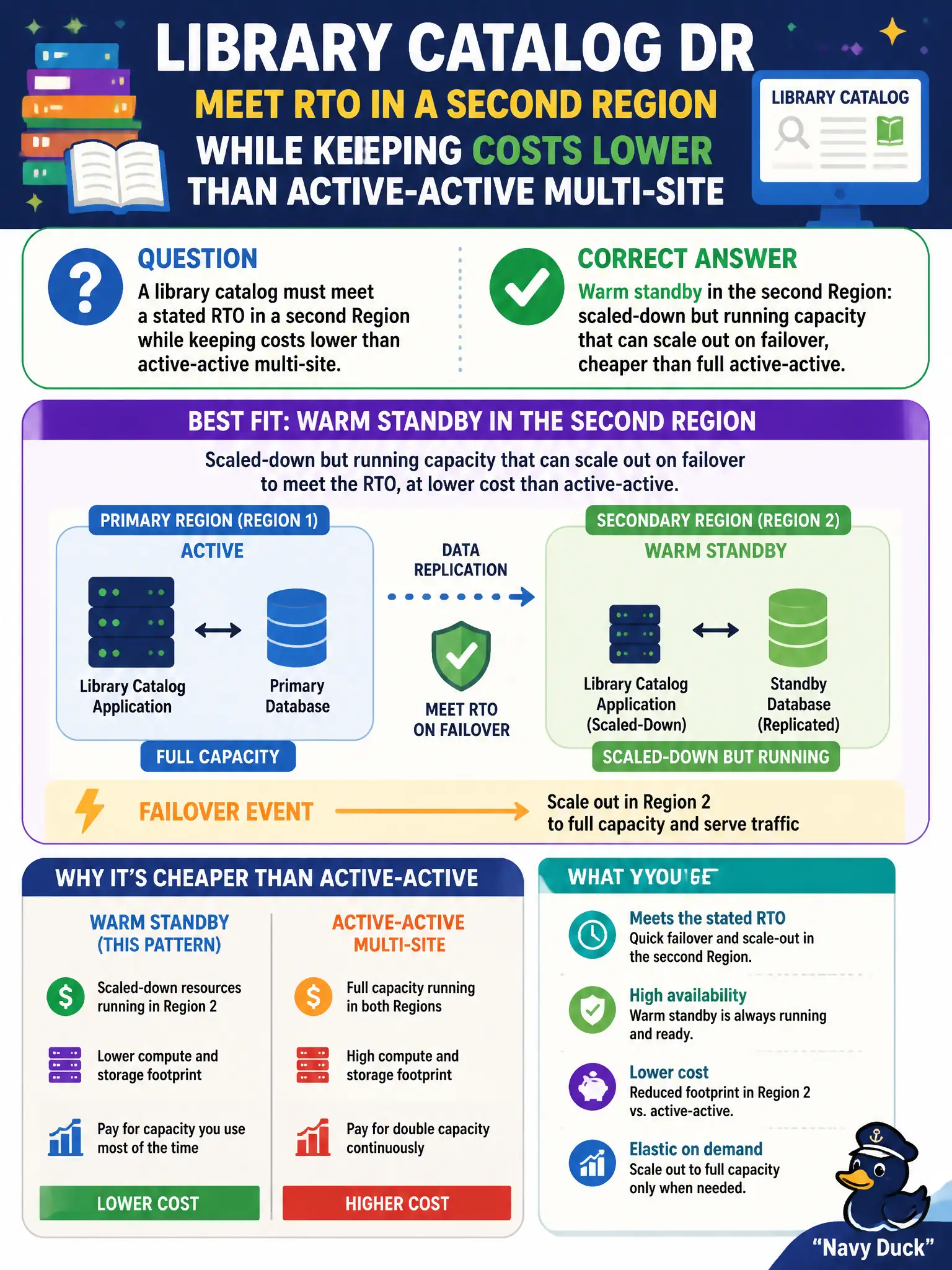
A library catalog must meet a stated RTO in a second Region while keeping costs lower than active-active multi-site. Which DR pattern fits best?
Select an answer to reveal the explanation.
Short Explanation
Warm standby is a smaller branch library kept open with fewer clerks—you staff up when the main branch floods. It hits RTO without paying for two full active-active catalogs. Annual tapes or one AZ won’t meet a real second-Region RTO.
Full Explanation
A library catalog that must meet a stated RTO in a second Region while keeping costs lower than active-active multi-site fits warm standby: scaled-down but running capacity in the standby Region that can scale out on failover. Warm standby costs more than pilot light or backup/restore but far less than full dual active write stacks, hitting the budget-versus-RTO compromise the stem describes for municipal catalog services.
Active-active multi-site with full duplicate write stacks in both Regions ignores the cost ceiling the library set. Backup and restore only from annual tape exports with multi-day RTO cannot meet a meaningful secondary-Region recovery time for patrons and staff who need the catalog. Having no secondary Region and relying on a single AZ saves DR spend only by accepting catastrophic Regional and AZ risk that the stated secondary-Region RTO already rejected.
Exam caveat: warm standby versus pilot light versus active-active is a frequent SAP-C02 costing and RTO tradeoff—warm standby keeps minimal running services ready to scale, whereas pilot light is thinner and active-active duplicates production. Operational check: maintain scaled-down catalog stacks in Region B with current data replication, rehearse DNS or traffic failover and scale-out, time the RTO against the objective, and compare monthly cost to a full active-active alternative for leadership.