
Utility meter readings have a 15-minute RPO. Which data protection approach should the architect select?
Select an answer to reveal the explanation.
Short Explanation
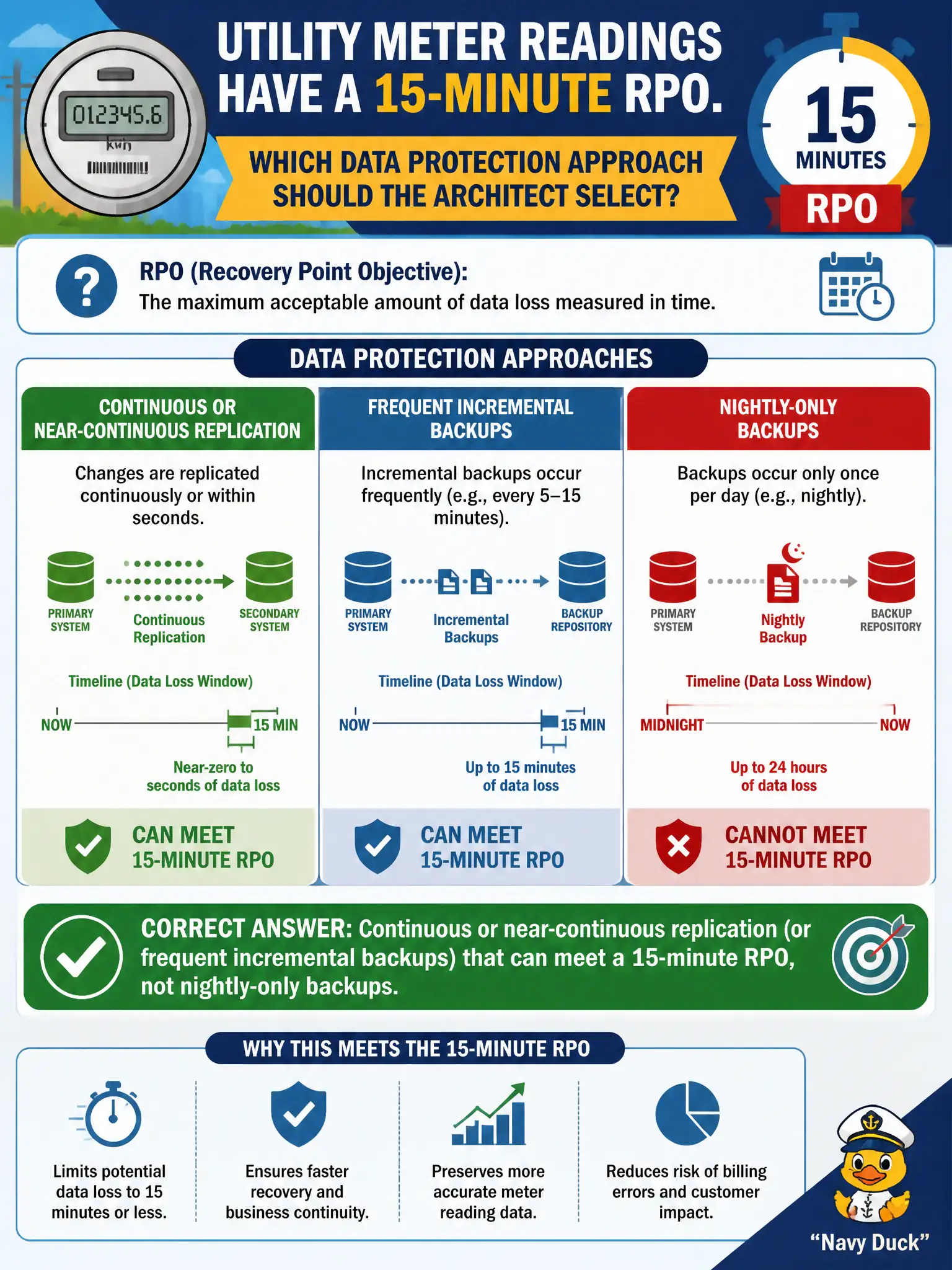
RPO is how much meter history you’re willing to lose when the lights flicker—here, fifteen minutes. That means continuous or very frequent replication, not “see you tomorrow” nightly backups or yearly Deep Archive dumps.
Full Explanation
Utility meter readings with a 15-minute RPO require continuous or near-continuous replication—or frequent incremental backups—capable of keeping potential data loss inside that window. Nightly-only backups imply up to roughly a day of loss and cannot meet a fifteen-minute objective. Architects must design the meter data plane (database replicas, streaming ingestion buffers with durable replicas, or high-frequency backup) explicitly against the stated RPO rather than defaulting to convenient daily jobs.
Nightly full backups only, accepting up to 24 hours of data loss, miss the 15-minute RPO by orders of magnitude and would force the utility to re-collect or interpolate large gaps after an outage. Monthly Glacier Deep Archive exports as the sole recovery path are appropriate for long-term compliance archive, not for quarter-hour recovery point objectives on live meter telemetry. Disabling replication and relying on application memory buffers during outages loses data when hosts die and is not a durable municipal protection strategy for billing-grade readings.
Exam caveat: RPO drives replication frequency on SAP-C02; match backup or replica cadence to the number in the stem—15 minutes means continuous or near-continuous protection, not daily snapshots dressed up as DR. Operational check: measure replication lag or backup interval against meter ingestion peaks, induce a failover or restore drill, quantify how many minutes of readings would be lost, and tune until potential loss stays under fifteen minutes with monitoring alarms on lag.