
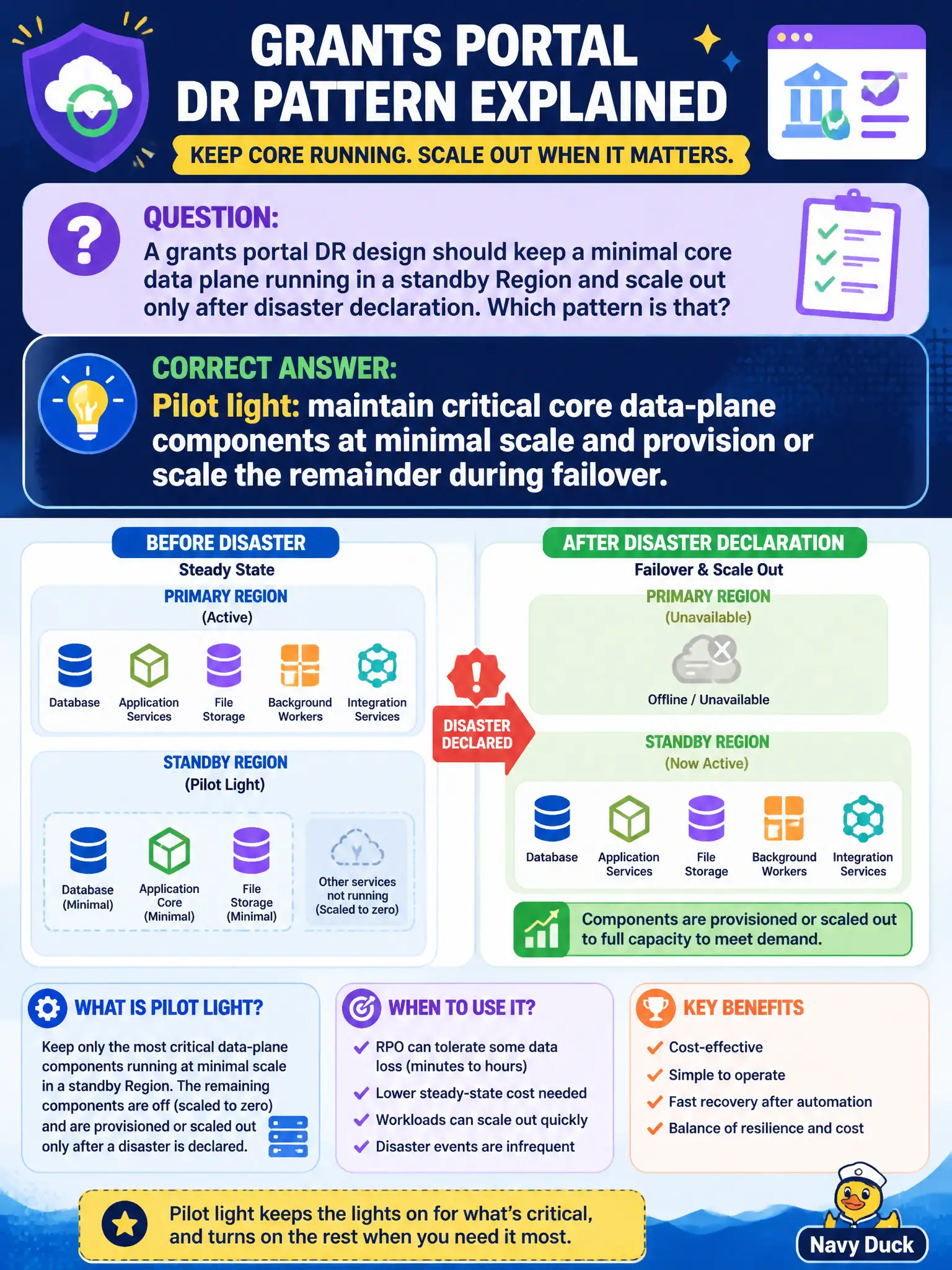
A grants portal DR design should keep a minimal core data plane running in a standby Region and scale out only after disaster declaration. Which pattern is that?
Select an answer to reveal the explanation.
Short Explanation
Pilot light is the furnace pilot—tiny flame always on, burners roar when you need heat. Grants portal keeps a skinny core warm, then scales out when disaster is declared. Full active-active or zero standby are different budgets and RTOs.
Full Explanation
A grants portal DR design that keeps a minimal core data plane running in a standby Region and scales out only after disaster declaration is the pilot light pattern. Critical data stores and minimal supporting infrastructure stay warm enough to accelerate recovery, while the bulk of application capacity is provisioned or scaled during failover. That matches the stem’s “minimal core…scale out after declaration” language for a cost-conscious municipal grants system.
Multi-site active-active serving 100% production traffic in both Regions continuously is a hotter, costlier pattern than the stem described. Backup and restore with no pre-provisioned infrastructure in the standby Region is colder than pilot light and usually slower to meet moderate RTOs. Deleting all standby replicas to guarantee the lowest possible DR cost regardless of RTO abandons readiness and contradicts keeping a minimal core data plane running.
Exam caveat: pilot light is not warm standby—pilot light is thinner and depends on provisioning at declaration time; warm standby runs a functional scaled-down environment continuously. Operational check: identify which grants portal components constitute the pilot core, keep their replicas current, automate scale-out playbooks with IaC, and time a declaration-to-service drill against the portal RTO.