
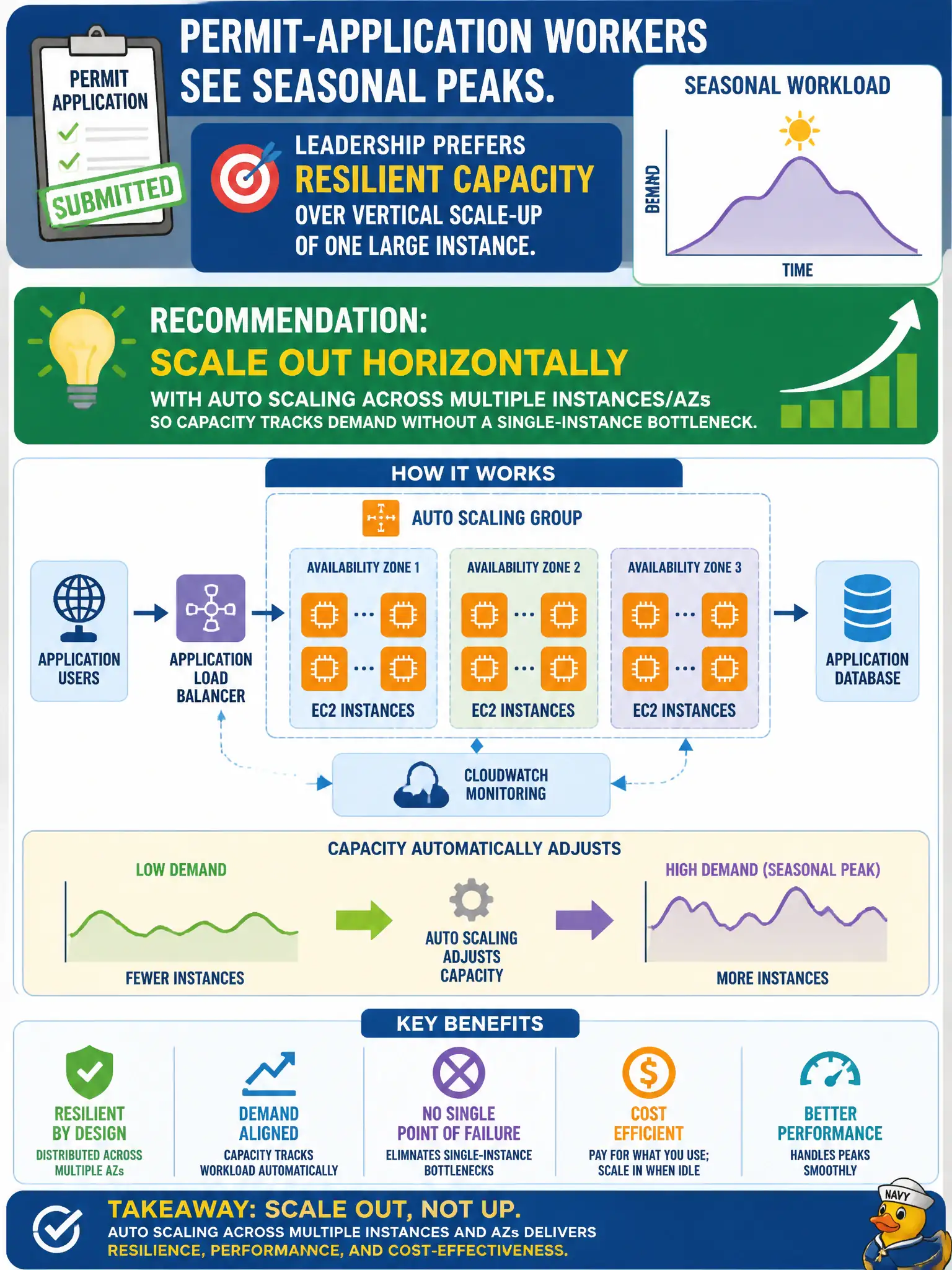
Permit-application workers see seasonal peaks. Leadership prefers resilient capacity over vertical scale-up of one large instance. What should the architect recommend?
Select an answer to reveal the explanation.
Short Explanation
Open more permit counters for spring rush—don’t buy one giant desk that becomes a single point of failure. Horizontal Auto Scaling across instances and AZs matches seasonal peaks. One mega-instance, one AZ, or reboot rituals are brittle.
Full Explanation
Permit-application workers with seasonal peaks should scale out horizontally with Auto Scaling across multiple instances and Availability Zones rather than vertically upsizing one large instance. Horizontal elasticity tracks demand, avoids a single-instance bottleneck, and improves resilience when an AZ or node fails during peak filing season. Leadership’s preference for resilient capacity over one big box maps directly to that pattern.
Resizing to the largest single instance type and disabling Auto Scaling recreates a vertical scale-up bottleneck and single point of failure. Pinning all traffic to one AZ to reduce cross-AZ data transfer during peaks sacrifices availability for a minor transfer saving. Scheduling nightly full cluster reboot as the primary elasticity mechanism does not add capacity during daytime permit surges.
Exam caveat: prefer horizontal scaling for elasticity and HA questions unless the stem forces vertical constraints (e.g., monolithic licensed software)—seasonal peaks are a classic ASG signal. Operational check: define ASG min/desired/max for seasonality, test scale-out on a synthetic load, verify multi-AZ distribution, and confirm permit latency stays within SLO as capacity rises.