
A municipal web tier must replace unhealthy instances automatically without waiting for human change windows. Which architecture best meets that requirement?
Select an answer to reveal the explanation.
Short Explanation
Self-healing fleets swap a bad snowplow without waiting for Monday’s meeting. Auto Scaling plus ELB health checks retire sick instances automatically. One pet server, mandatory CAB during outages, or ignoring health checks leaves citizens staring at an error page.
Full Explanation
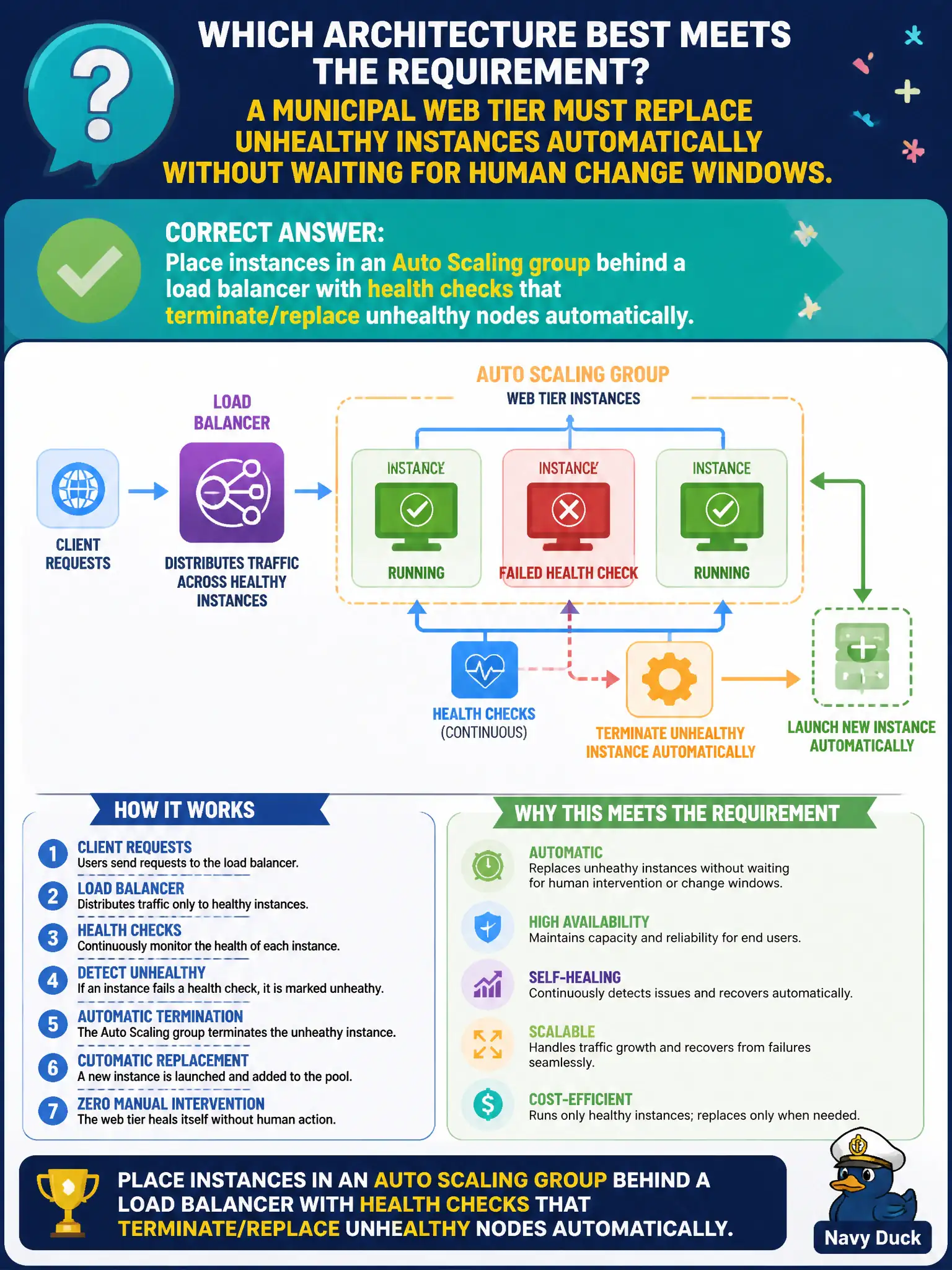
A municipal web tier that must replace unhealthy instances automatically without human change windows belongs in an Auto Scaling group behind a load balancer whose health checks mark unhealthy nodes for termination and replacement. Auto Scaling continuous health replacement removes waiting for engineers or CAB tickets during instance failure, restoring capacity as policy defines. That is the standard self-healing compute pattern for citizen-facing fleets.
Running a single manually patched instance and paging an engineer when health checks fail depends on humans and a single point of failure. Requiring a weekly CAB ticket before any instance replacement, even during outages, explicitly blocks the automatic recovery the stem requires. Disabling load balancer health checks so traffic continues to unhealthy hosts keeps bad nodes in rotation and harms residents.
Exam caveat: ELB health checks plus ASG health check types drive replacement; know that ASG can use ELB health to terminate unhealthy instances—manual EC2 recover is not the same automation. Operational check: deploy an ASG behind an ALB, fail a target’s health endpoint, observe deregistration and replacement, and confirm no CAB gate is required for that automated path.