
The county ERP that issues purchase orders cannot be rewritten in one release, but finance needs a new vendor-onboarding API this quarter. Which incremental modernization path should architects identify?
Select an answer to reveal the explanation.
Short Explanation
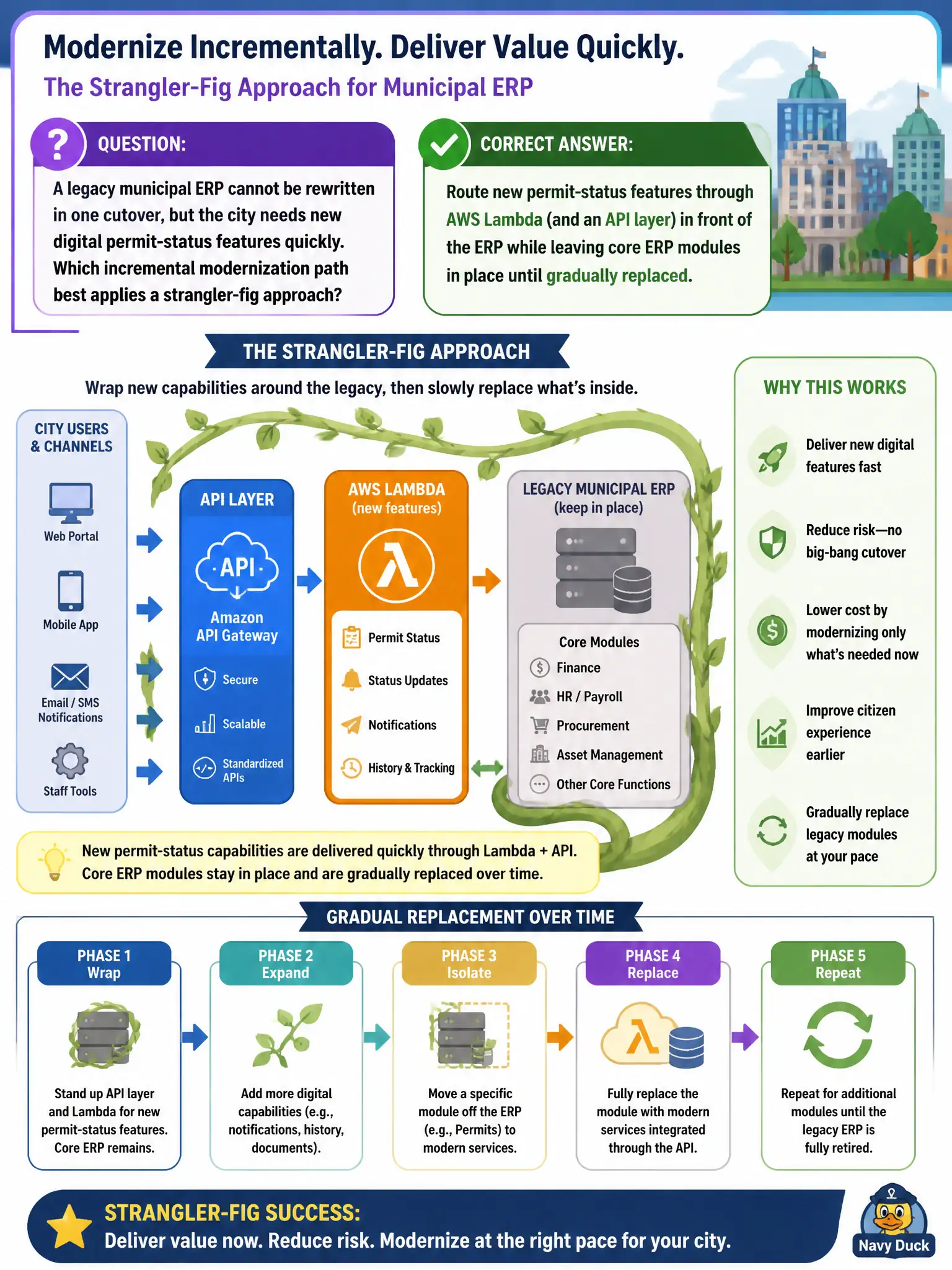
You don't demolish city hall to add a new service window. Put a Lambda or API in front, strangle off one feature at a time, and leave the old ERP running. Big-bang rewrites are how finance waits years for a form.
Full Explanation
The county ERP that issues purchase orders cannot be rewritten in one release, but finance needs a new vendor-onboarding API this quarter—so architects should place new AWS Lambda or API features in front of the legacy ERP using a strangler-fig path instead of a big-bang rewrite. Incremental modernization delivers the civic capability without freezing finance for years. Freezing all finance changes until a multi-year ERP replacement finishes fails business delivery. Duplicating the entire ERP schema into a new monolith and cutting over on a holiday weekend fails risk management. Exposing the ERP database to the public internet so vendors can SQL insert onboarding rows fails security catastrophically. Exam caveat: strangler-fig incremental APIs beat big-bang or freeze-everything. Operational check: publish the onboarding API on API Gateway/Lambda, integrate to ERP via controlled adapters, route new traffic gradually, keep ERP authoritative for POs, and expand the strangler facade by module. Document the decision in the municipal architecture decision record and re-verify controls after the first production wave so auditors see continuous improvement, not one-time tribal knowledge. Document the decision in the municipal architecture decision record and re-verify controls after the first production wave so auditors see continuous improvement, not one-time tribal knowledge.