
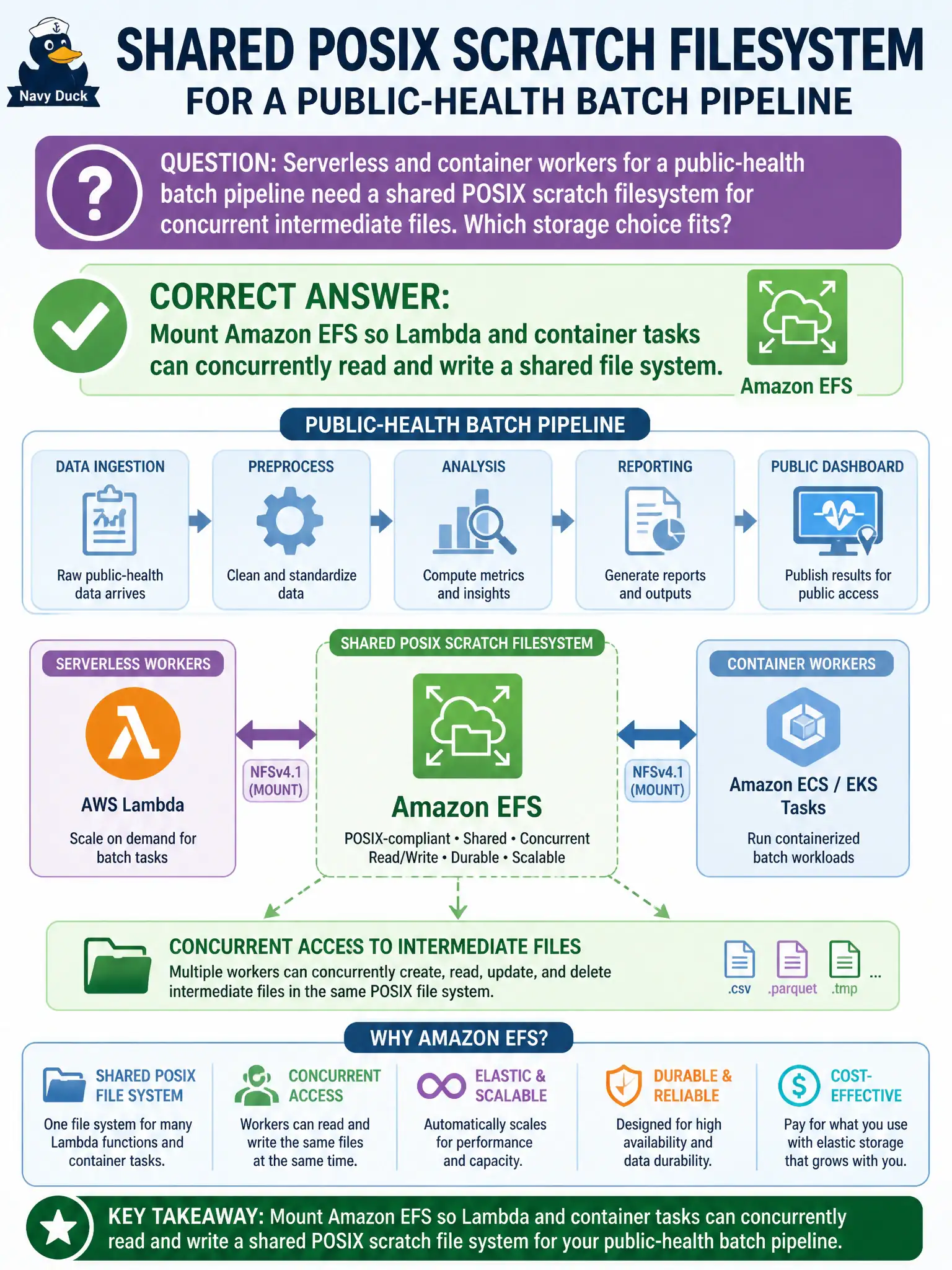
Permit-plan conversion Lambdas and Fargate tasks in the planning account must concurrently read and write intermediate CAD-derived files that exceed /tmp and must be visible to the next step. Which shared storage should architects attach?
Select an answer to reveal the explanation.
Short Explanation
When many workers need the same scratch folder at once, that's a shared kitchen counter, not a drawer on one desk. EFS mounts on Lambda and Fargate so files are visible to the next step. EBS on one function and Glacier are not a concurrent scratch disk.
Full Explanation
Permit-plan conversion Lambdas and Fargate tasks in the planning account that must concurrently read and write intermediate CAD-derived files exceeding /tmp and visible to the next step should attach Amazon EFS mounted on the Lambda functions and containers so concurrent file access is shared scratch space. That shared filesystem fits multi-compute pipelines better than single-AZ block myths. A single Amazon EBS volume attached to one Lambda in one Availability Zone as the team share fails because EBS is not a multi-attach shared scratch for Lambda fleets. Amazon S3 Glacier Deep Archive as the interactive scratch filesystem fails latency for pipeline intermediates. Instance store of a stopped bastion host mounted over SSHFS for every function fails durability, security, and operability. Exam caveat: EFS is the shared scratch answer for Lambda/container concurrent files. Operational check: create EFS in the planning VPC, mount from Lambda/Fargate, set POSIX permissions, clean lifecycle of intermediates, and validate multi-step CAD conversion throughput. Document the decision in the municipal architecture decision record and re-verify controls after the first production wave so auditors see continuous improvement, not one-time tribal knowledge.