
The planning department must archive decades of scanned building-permit PDFs and inspection photos that are rarely retrieved after the first year, while keeping the objects in a multi-account records bucket that legal can restore from without running a database. Which storage architecture should replace on-premises block LUNs?
Select an answer to reveal the explanation.
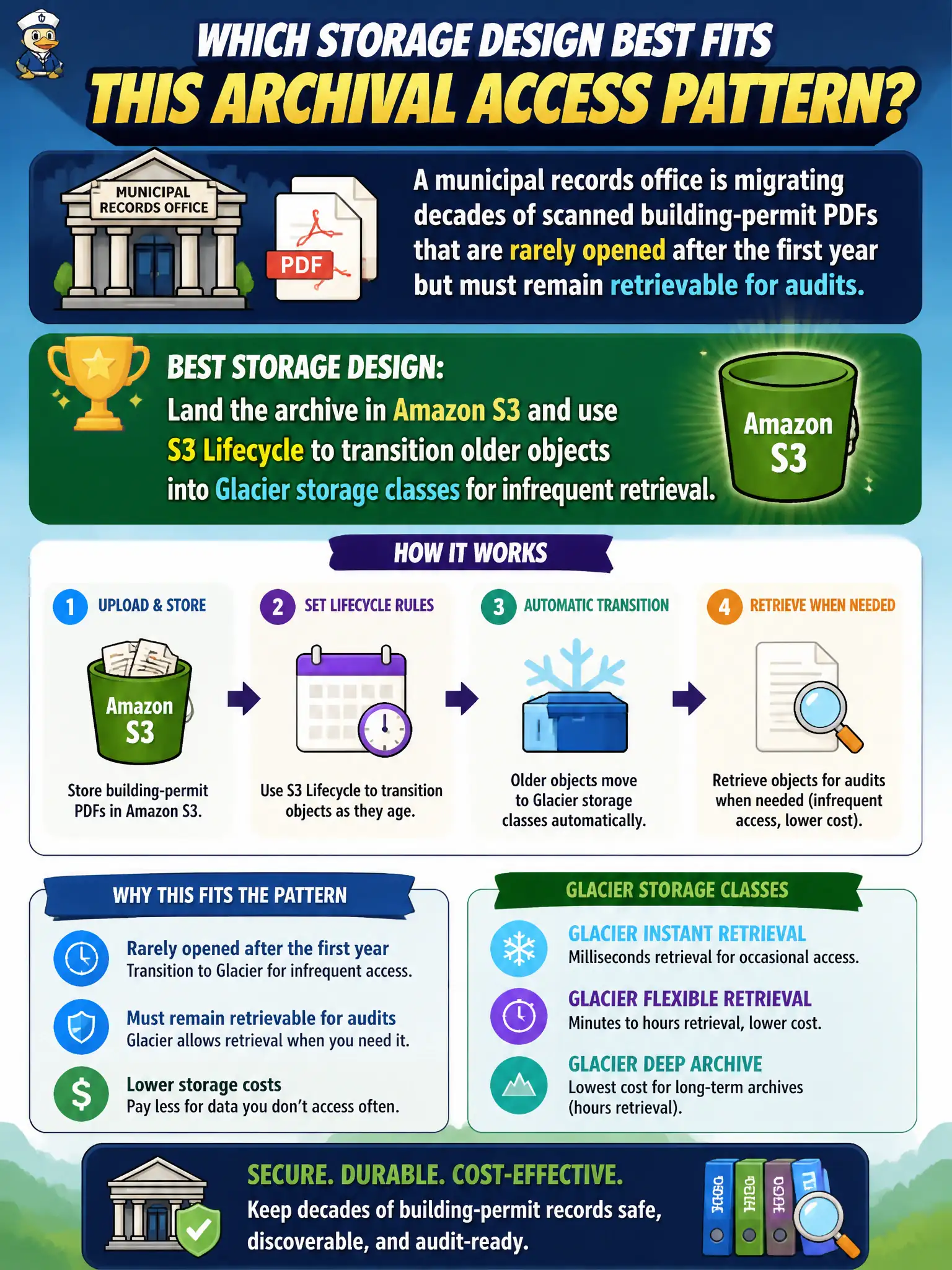
Short Explanation
Old permit scans are a warehouse of boxes, not a spinning disk you babysit. S3 plus Glacier classes keep objects cheap and restorable; stuffing archives onto EBS, instance store, or database BLOBs turns a records problem into a server problem.
Full Explanation
The planning department archiving decades of scanned building-permit PDFs and inspection photos that are rarely retrieved after the first year should store permit objects in Amazon S3 with lifecycle transitions to Glacier storage classes instead of treating block volumes as the archive, keeping objects in a multi-account records bucket that legal can restore from without running a database. That matches cold civic records economics and e-discovery restore paths. Provisioning a multi-petabyte io2 Amazon EBS volume on a single EC2 file server as the permanent archive fails cost and scalability for rarely retrieved scans. Keeping every scan on instance store of a dedicated archive EC2 host so retrieval is always local fails durability and economics. Loading each PDF as a row in Amazon RDS PostgreSQL BYTEA columns so SQL backups become the archive fails database anti-pattern for large object archives. Exam caveat: S3 plus Glacier lifecycle is the archive pattern, not block LUNs or BYTEA. Operational check: land objects in S3, set lifecycle transitions aligned to legal retention, test restores for counsel, enable Object Lock if required, and retire block LUN archives. Document the decision in the municipal architecture decision record and re-verify controls after the first production wave so auditors see continuous improvement, not one-time tribal knowledge.