
A public-works work-order application still requires iSCSI block volumes during a multi-year hybrid transition, even as newer permit systems already write to Amazon S3. Which storage pattern should architects use so the legacy app can keep its block interface while data lands in AWS?
Select an answer to reveal the explanation.
Short Explanation
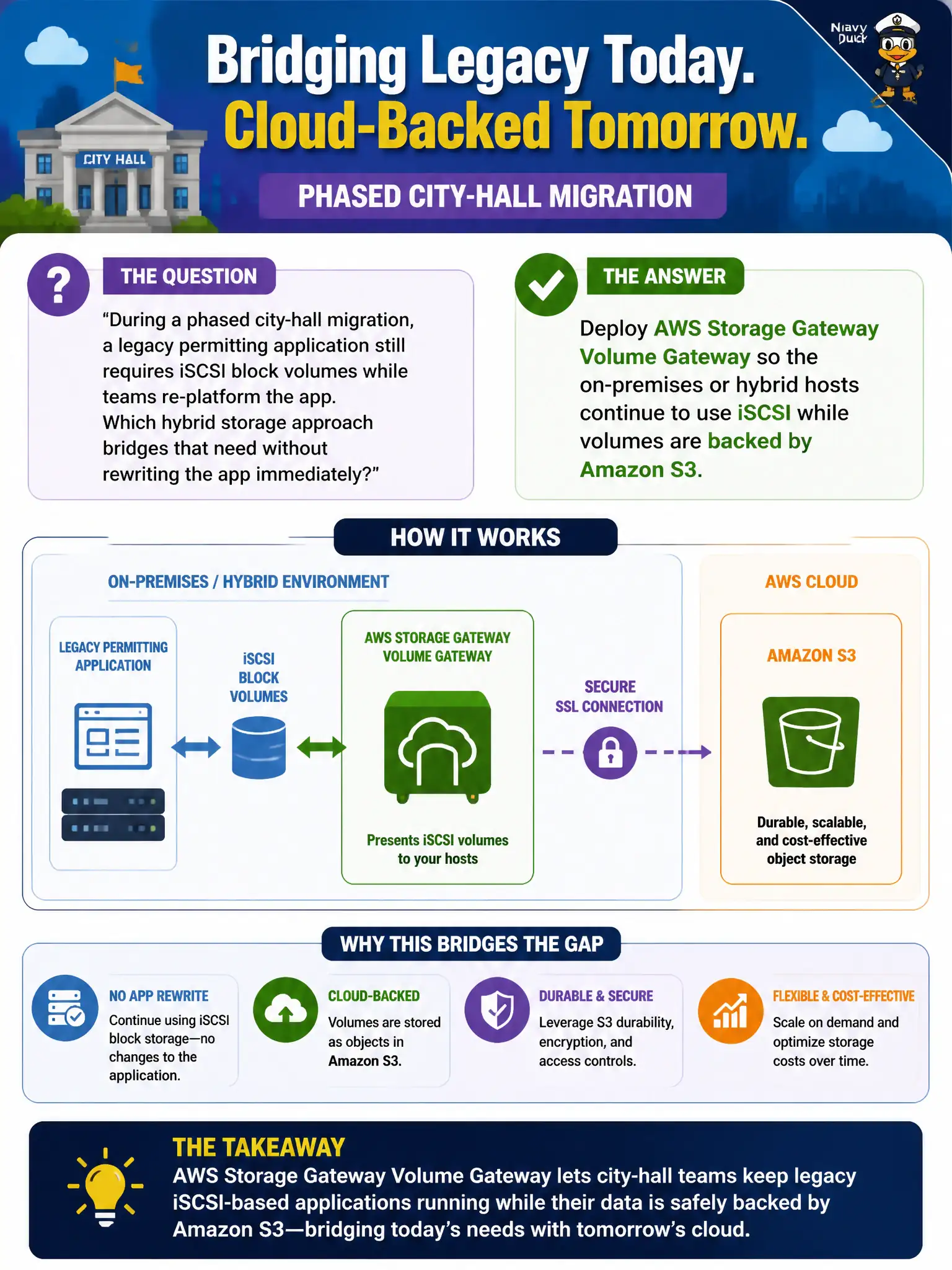
Some old apps still want a SCSI cable, not an object URL. Volume Gateway is the translator that keeps iSCSI on the floor while AWS holds the disks behind the scenes. Don't pretend S3 or Glacier speak iSCSI, and don't force a rewrite just to start the move.
Full Explanation
A public-works work-order application that still requires iSCSI block volumes during a multi-year hybrid transition—even as newer permit systems write to Amazon S3—should deploy AWS Storage Gateway Volume Gateway so the legacy application keeps iSCSI while volumes are backed by AWS. That bridge preserves the block interface without forcing an immediate rewrite of a critical field-operations system. Rewriting the work-order application to NFS on Amazon EFS before any data can move fails timeline pragmatism for a multi-year hybrid. Attaching public Amazon S3 bucket URLs directly as iSCSI targets in the on-premises initiator fails protocol reality—S3 is not an iSCSI target. Copying nightly VM snapshots to Amazon S3 Glacier Deep Archive and presenting them as live iSCSI disks fails because Deep Archive snapshots are not live iSCSI volumes. Exam caveat: Volume Gateway presents iSCSI backed by AWS for legacy block apps. Operational check: deploy Volume Gateway, present iSCSI to work-order hosts, validate performance against RPO, monitor cache, and plan eventual application modernization off iSCSI. Document the decision in the municipal architecture decision record and re-verify controls after the first production wave so auditors see continuous improvement, not one-time tribal knowledge.