
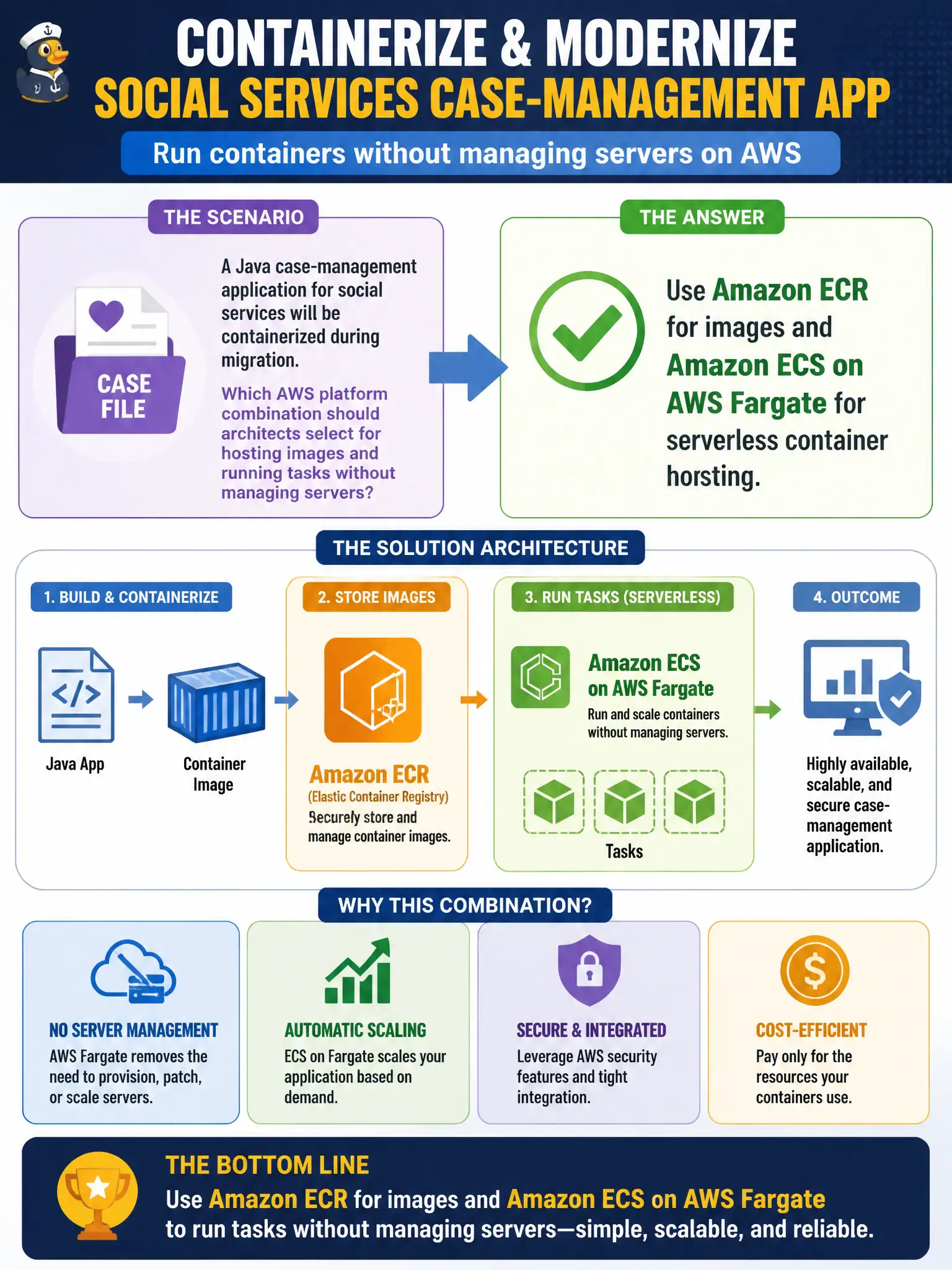
A Java case-management application for social services will be containerized during migration. Which AWS platform combination should architects select for hosting images and running tasks without managing servers?
Select an answer to reveal the explanation.
Short Explanation
Containers need a coat check and a stage. ECR holds the images; ECS on Fargate runs them without you patching container hosts—laptop registries and Glacier are not a platform.
Full Explanation
A Java case-management application for social services containerized during migration should use Amazon ECR for images and Amazon ECS on AWS Fargate for serverless container hosting so the county avoids managing container hosts while keeping images governed. That combination stores images under municipal control and runs tasks without EC2 capacity management. Storing images only on personal laptops and running containers on a single unmanaged EC2 host forever fails supply-chain control and availability. Placing container images in Amazon S3 Glacier Deep Archive as the runtime registry fails because Glacier is not a container registry runtime. Running the Java app as a single Windows service on Outposts without containers after all fails the containerization decision already taken. Exam caveat: ECR plus ECS/Fargate is the common serverless container hosting pair. Operational check: push images to ECR with scanning, define Fargate task definitions, place tasks in private subnets with ALB, set IAM task roles, and monitor case-management SLOs after cutover. Document the decision in the municipal architecture decision record and re-verify controls after the first production wave so auditors see continuous improvement, not one-time tribal knowledge.