
A large city already runs a multi-team Kubernetes platform with mature cluster operations skills and wants that model for newly migrated container workloads. Which hosting choice fits the organizational context?
Select an answer to reveal the explanation.
Short Explanation
If the city already has a Kubernetes pit crew, don't make them race go-karts. EKS fits when those skills and multi-team platform habits are real—not when you pretend Lambda is a stateful app server.
Full Explanation
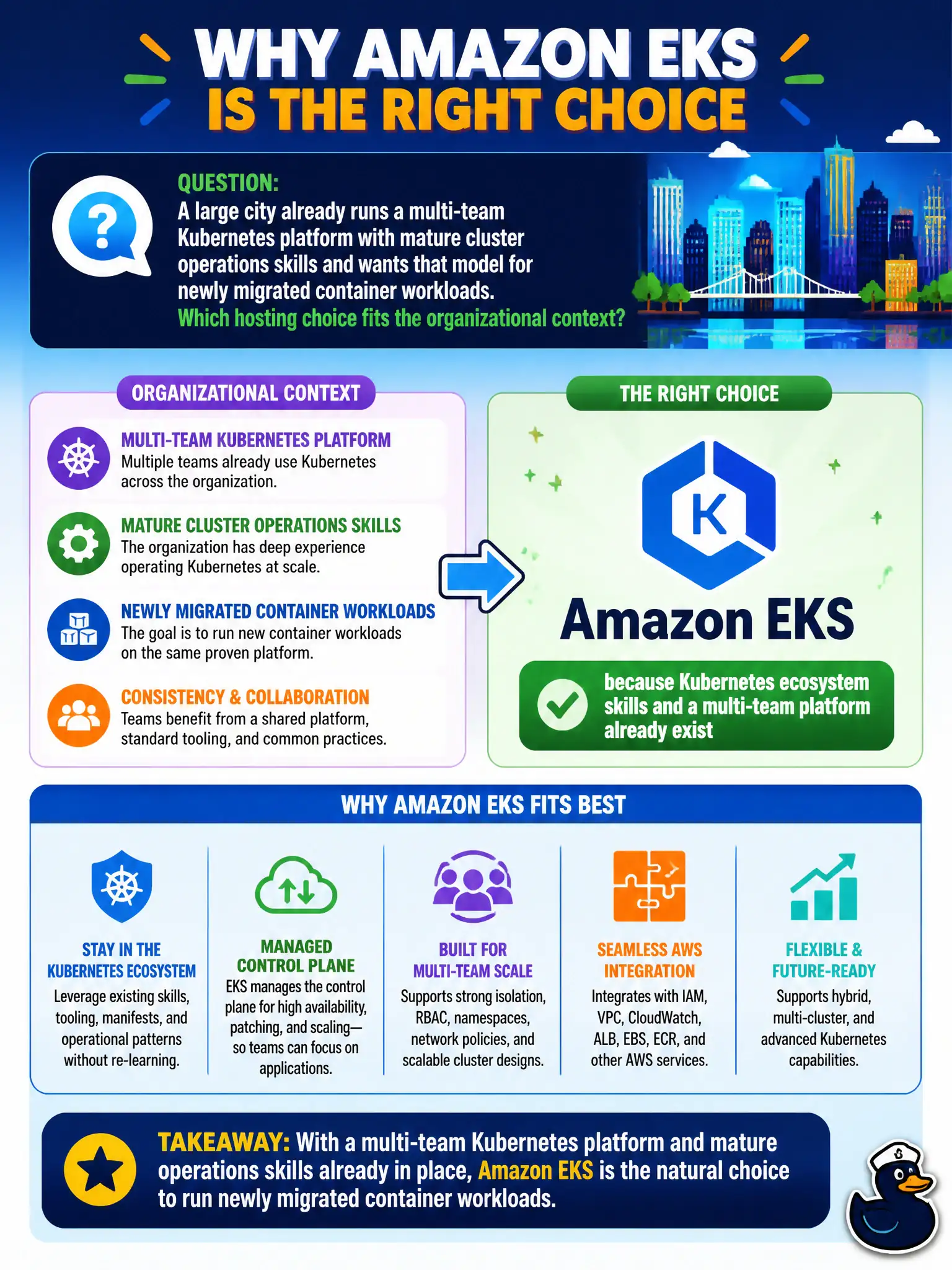
A large city that already runs a multi-team Kubernetes platform with mature cluster operations skills should choose Amazon EKS for newly migrated container workloads because Kubernetes ecosystem skills and a multi-team platform already exist. Organizational context drives the hosting choice toward EKS rather than forcing a different model onto platform teams. Forcing every team onto Elastic Beanstalk zip deployments exclusively fails to leverage existing Kubernetes investment. Banning containers and requiring only EC2 user-data bash scripts fails the city's container platform strategy. Using only AWS Lambda for long-running stateful Java application servers fails because Lambda is a poor fit for long-lived stateful server processes. Exam caveat: pick EKS when Kubernetes skills and multi-team platforms already exist. Operational check: onboard the migrated workloads to existing EKS standards, reuse platform CI/CD and network policies, train only on deltas, and avoid parallel competing runtimes without a decision record. Document the decision in the municipal architecture decision record and re-verify controls after the first production wave so auditors see continuous improvement, not one-time tribal knowledge.