
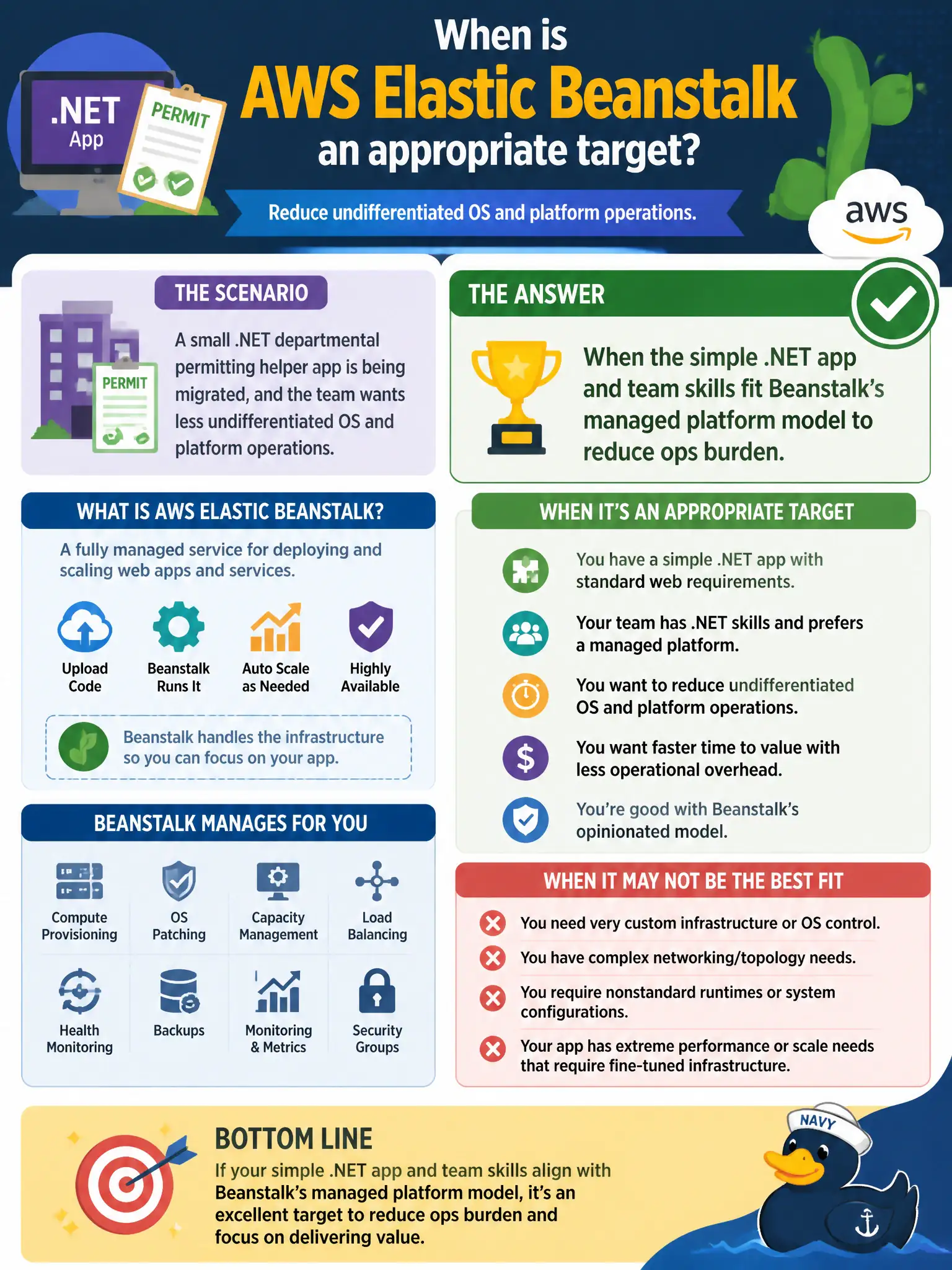
A small .NET departmental permitting helper app is being migrated, and the team wants less undifferentiated OS and platform operations. When is AWS Elastic Beanstalk an appropriate target?
Select an answer to reveal the explanation.
Short Explanation
Not every city app needs a Kubernetes parade. A simple .NET helper on Beanstalk can shed OS chores when the app and skills fit—use the easy road when it is actually easy.
Full Explanation
A small .NET departmental permitting helper app being migrated with a desire for less undifferentiated OS and platform operations is a fit for AWS Elastic Beanstalk when the simple .NET app and team skills fit Beanstalk's managed platform model to reduce ops burden. That target reduces patching and platform toil for a modest civic helper without forcing Kubernetes on day one. Claiming Beanstalk is appropriate only when the workload requires a custom multi-cluster Kubernetes control plane on day one fails by inverting the value proposition—Kubernetes is the heavier platform. Saying Beanstalk is never for any municipal workload because it cannot run web applications fails on fact. Allowing Beanstalk only after rewriting the .NET app entirely in assembler on bare metal fails modernization goals absurdly. Exam caveat: Beanstalk fits simple web apps when teams want managed platforms without full container orchestration. Operational check: confirm .NET runtime support, deploy a nonprod Beanstalk environment, validate permitting helper flows, set health checks and managed updates, and train the department team on Beanstalk deployments. Document the decision in the municipal architecture decision record and re-verify controls after the first production wave so auditors see continuous improvement, not one-time tribal knowledge.