
A county needs hybrid connectivity for early migration waves now, but Direct Connect provisioning will take months. How should architects document the phased network approach?
Select an answer to reveal the explanation.
Short Explanation
The highway is still under construction, so take the service road first—just write it down. VPN gets waves moving now; Direct Connect takes the heavy freight when it arrives.
Full Explanation
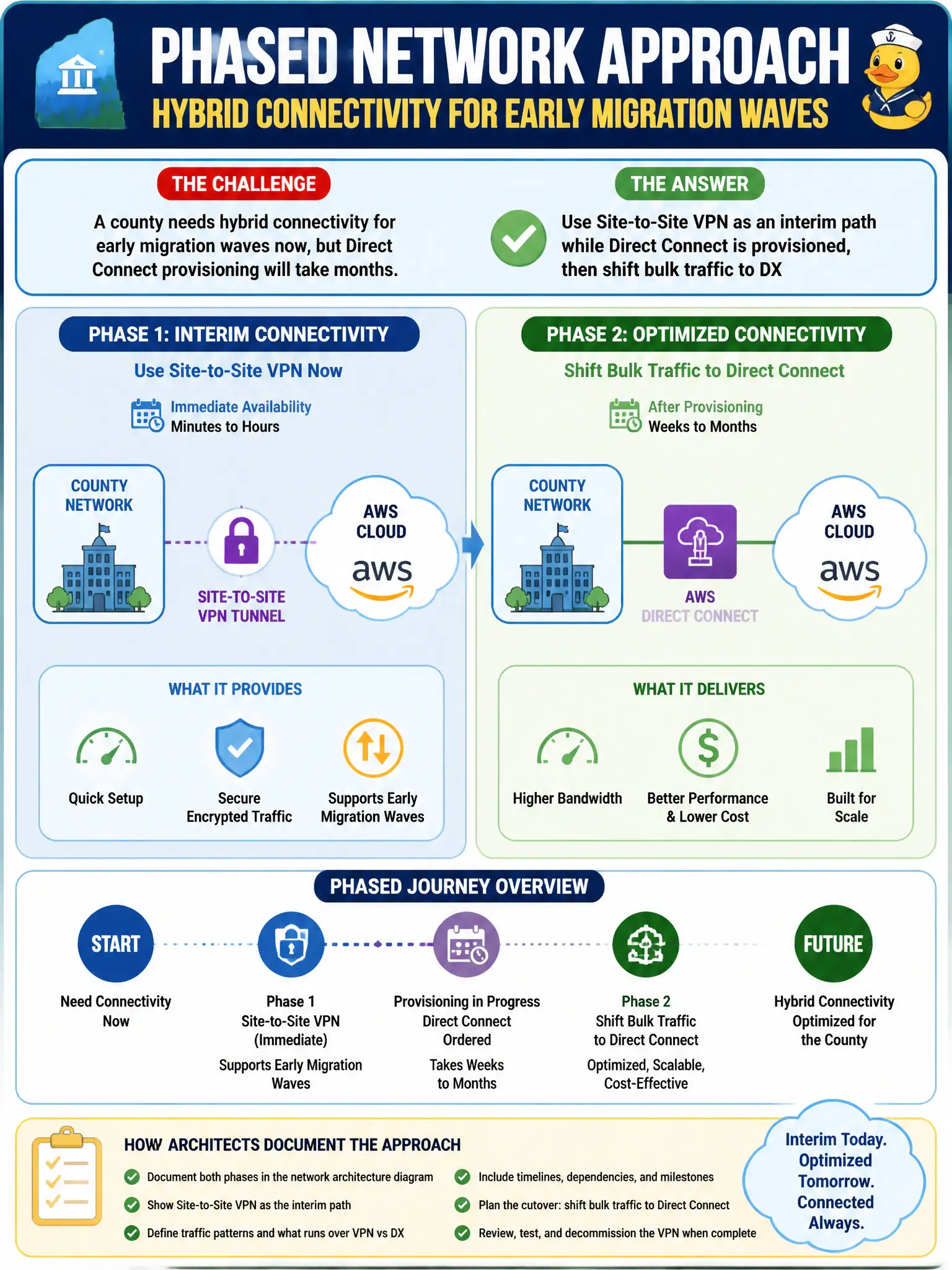
A county that needs hybrid connectivity for early migration waves now while Direct Connect provisioning takes months should document a phased network approach: use Site-to-Site VPN as an interim path while Direct Connect is provisioned, then shift bulk traffic to DX. That keeps waves moving without pretending VPN is the forever bulk path for county replication. Waiting until DX is fully provisioned before allowing any migration replication fails schedule reality and stalls early waves unnecessarily. Requiring every wave to use only public internet HTTPS without a private path fails hybrid private connectivity goals for many municipal systems. Canceling DX permanently once any VPN tunnel comes up fails the capacity and predictability goals DX was meant to solve. Exam caveat: VPN interim then DX for bulk is the classic phased connectivity answer. Operational check: stand up redundant VPN, start limited replication, track DX order milestones, migrate bulk flows to DX when live, retain VPN as backup, and update the network ADR. Document the decision in the municipal architecture decision record and re-verify controls after the first production wave so auditors see continuous improvement, not one-time tribal knowledge.