
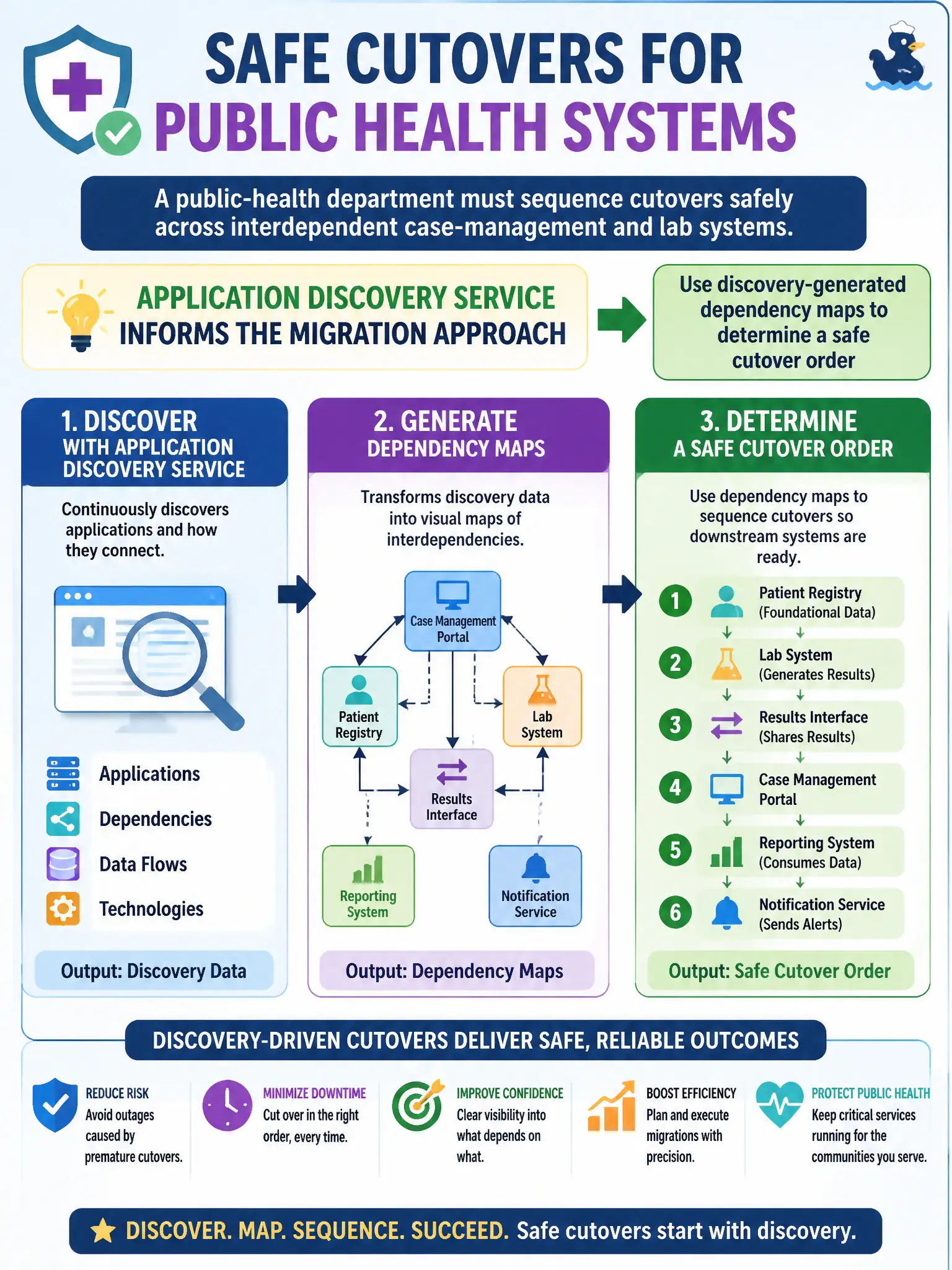
A public-health department must sequence cutovers safely across interdependent case-management and lab systems. How should Application Discovery Service inform the migration approach?
Select an answer to reveal the explanation.
Short Explanation
Cutting systems over alphabetically is how you orphan a lab feed at 2 a.m. Let Application Discovery draw the dependency map and schedule cutover so nothing wakes up missing its friends.
Full Explanation
A public-health department sequencing cutovers across interdependent case-management and lab systems should let Application Discovery Service inform order through dependency maps. Use discovery-generated dependency maps to determine a safe cutover order so lab and case-management hops do not strand each other mid-wave and clinicians keep working. Treating discovery maps as optional slides and cutting over systems in alphabetical order fails dependency-aware planning and invites broken integrations. Deleting dependency data after the first workshop to reduce documentation burden fails knowledge retention for the PMO. Migrating only the presentation tier and leaving unknown backend dependencies undocumented fails completeness and hides cutover risk. Exam caveat: discovery dependency maps drive cutover sequencing for interdependent civic systems. Operational check: refresh discovery agents, validate maps with application owners, sequence waves so shared dependencies move first or dual-run, rehearse cutover order in nonprod, and lock the public-health wave board to the map. Document the decision in the municipal architecture decision record and re-verify controls after the first production wave so auditors see continuous improvement, not one-time tribal knowledge.