
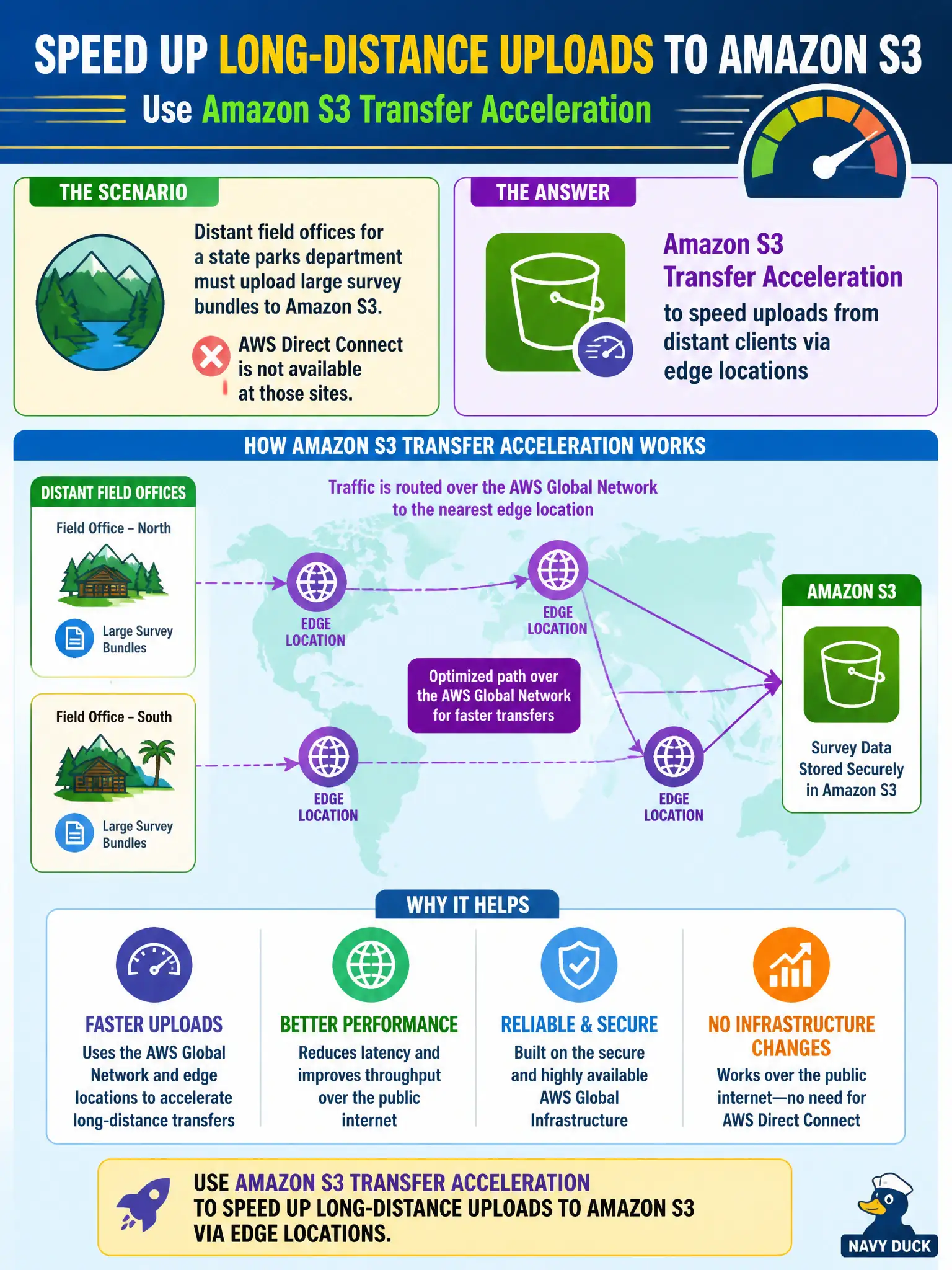
Distant field offices for a state parks department must upload large survey bundles to Amazon S3; AWS Direct Connect is not available at those sites. Which S3 feature helps accelerate long-distance transfers over the public internet?
Select an answer to reveal the explanation.
Short Explanation
Far-flung parks offices without Direct Connect still need a fast on-ramp. S3 Transfer Acceleration uses edge locations to shorten the long haul into your bucket—Inventory and Object Lock don't move bytes faster.
Full Explanation
Distant field offices for a state parks department uploading large survey bundles to Amazon S3 without Direct Connect at those sites should use Amazon S3 Transfer Acceleration to speed uploads from distant clients via edge locations over the public internet. That feature targets long-distance PUT performance when DX is unavailable at remote parks facilities. S3 Object Lock Legal Hold as a substitute for higher throughput fails because Object Lock is a WORM retention control, not a transfer accelerator. S3 Inventory reports configured as the data plane for binary uploads fail conceptually: Inventory lists objects; it does not upload survey binaries. S3 Glacier Instant Retrieval as the primary ingest endpoint for live survey bundles fails because Glacier classes are retrieval/storage classes, not the optimized ingest path for interactive field uploads. Exam caveat: Transfer Acceleration addresses distant client upload latency/throughput to S3; do not confuse with Object Lock or Glacier. Operational check: enable Transfer Acceleration on the destination bucket, point field tools at the accelerate endpoint, measure upload times versus standard endpoints, control costs, and keep encryption and IAM intact for parks survey data.