
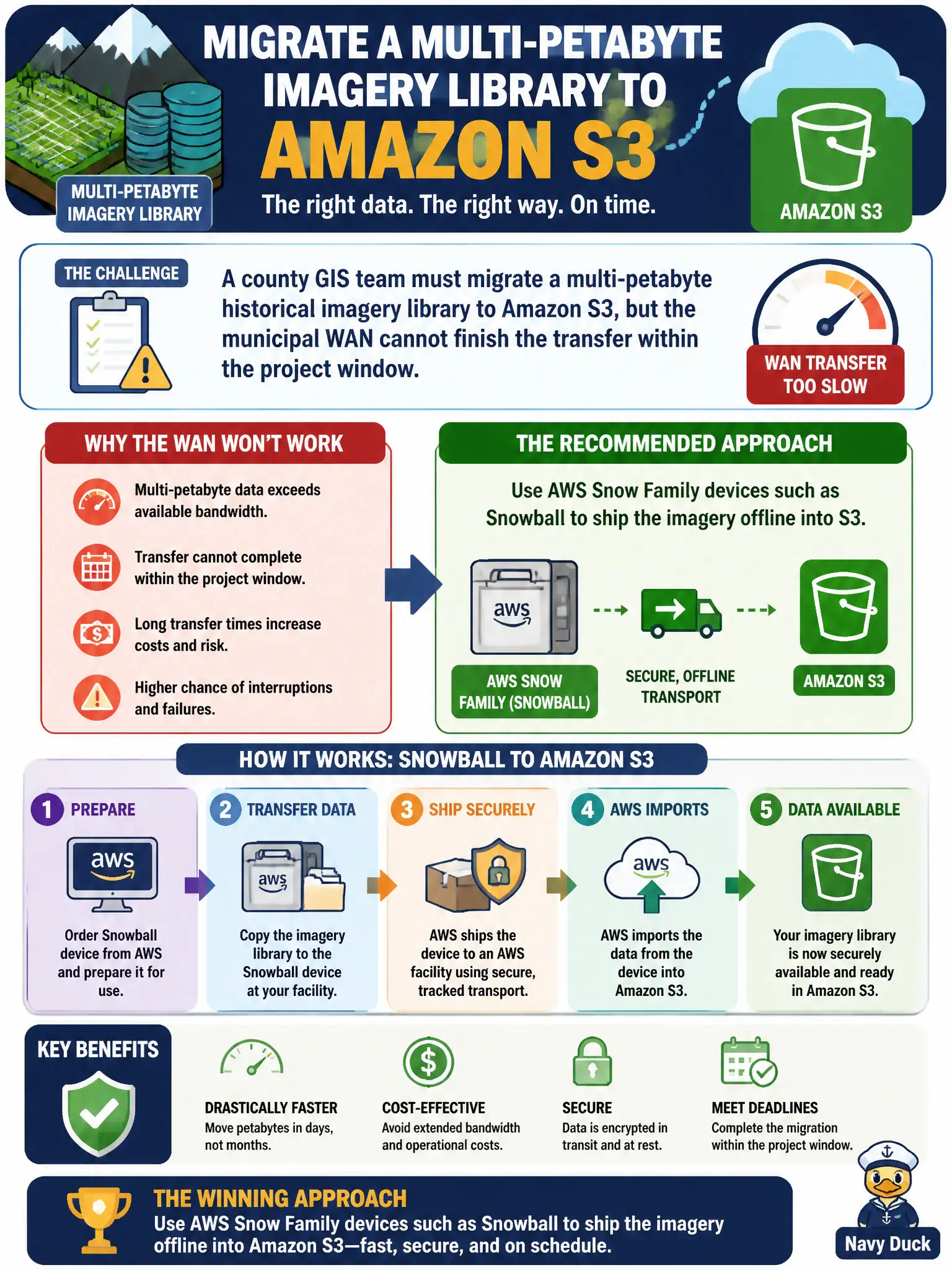
A county GIS team must migrate a multi-petabyte historical imagery library to Amazon S3, but the municipal WAN cannot finish the transfer within the project window. Which approach should the architects select?
Select an answer to reveal the explanation.
Short Explanation
When the pipe is a garden hose and the data is a swimming pool, you don't wait for drip irrigation. Snowball and friends truck the imagery offline into S3 when the WAN simply cannot win.
Full Explanation
When a county GIS team must migrate a multi-petabyte historical imagery library to Amazon S3 but the municipal WAN cannot finish within the project window, architects should use AWS Snow Family devices such as Snowball to ship the imagery offline into S3. That offline path matches bulk geospatial archives when networks are the constraint and citizen planning timelines cannot wait on thin WAN pipes. Streaming the entire library overnight over the existing consumer-grade VPN only fails bandwidth and schedule reality for multi-petabyte orthophoto sets. Emailing compressed ZIP archives of each orthophoto to a shared mailbox fails scale, security, and reliability for county imagery that underpins tax maps and planning reviews. Copying imagery to personal USB drives carried by unpaid interns without chain-of-custody controls fails governance and custody requirements for geospatial assets used in official decisions. Exam caveat: Snow Family is the standard answer for large offline ingress when WAN is insufficient. Operational check: size Snowball capacity and device count, define encryption and chain-of-custody with GIS custodians, validate sample tiles after import to S3, parallelize devices if needed, then switch incremental updates to online sync such as DataSync for ongoing flights.