
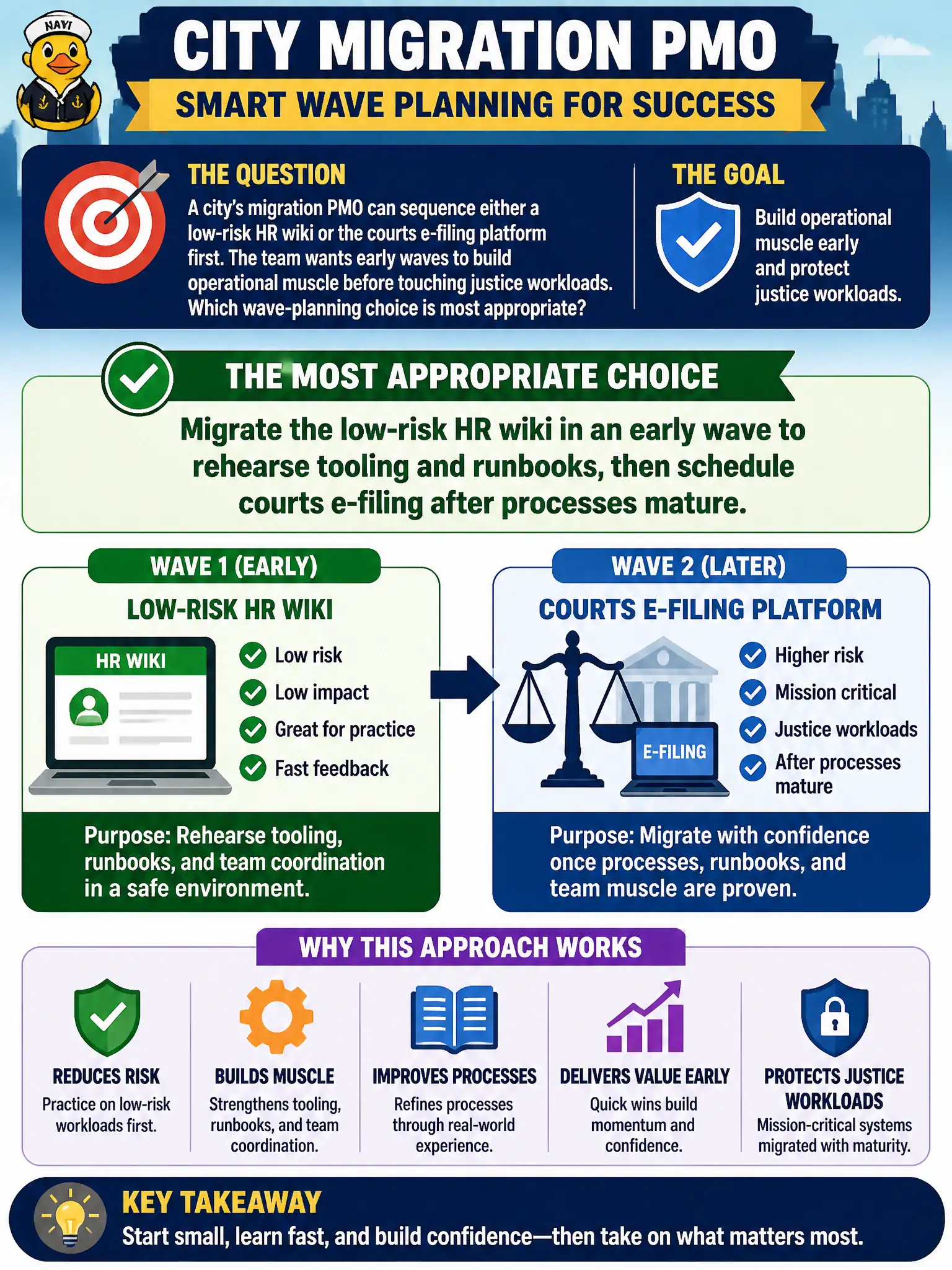
A city’s migration PMO can sequence either a low-risk HR wiki or the courts e-filing platform first. The team wants early waves to build operational muscle before touching justice workloads. Which wave-planning choice is most appropriate?
Select an answer to reveal the explanation.
Short Explanation
Use the HR wiki as spring training—learn Migration Hub, cutovers, and runbooks—before you touch courts e-filing. Visibility is not the same thing as a good first wave.
Full Explanation
A city's migration PMO choosing between a low-risk HR wiki and the courts e-filing platform for early waves should build operational muscle before touching justice workloads. Migrate the low-risk HR wiki in an early wave to rehearse tooling and runbooks, then schedule courts e-filing after processes mature. That wave-planning choice protects high-stakes civic systems while still delivering progress. Starting with courts e-filing because the highest political visibility should always go first fails by prioritizing optics over readiness and concentrating learning risk on a justice platform. Combining HR wiki and courts e-filing into one undifferentiated megawave to save calendar time fails because it couples unlike risk profiles and defeats rehearsal value. Skipping wave planning and migrating whenever individual teams feel ready with no program sequence fails program governance and creates unmanaged dependency collisions. Exam caveat: early waves often favor lower-risk rehearsals before politically visible critical systems. Operational check: place HR wiki in wave one with explicit runbook learning objectives, gate courts e-filing on rehearsal exit criteria, keep waves sequenced in Migration Hub, and brief the courts CIO on the readiness rationale.