
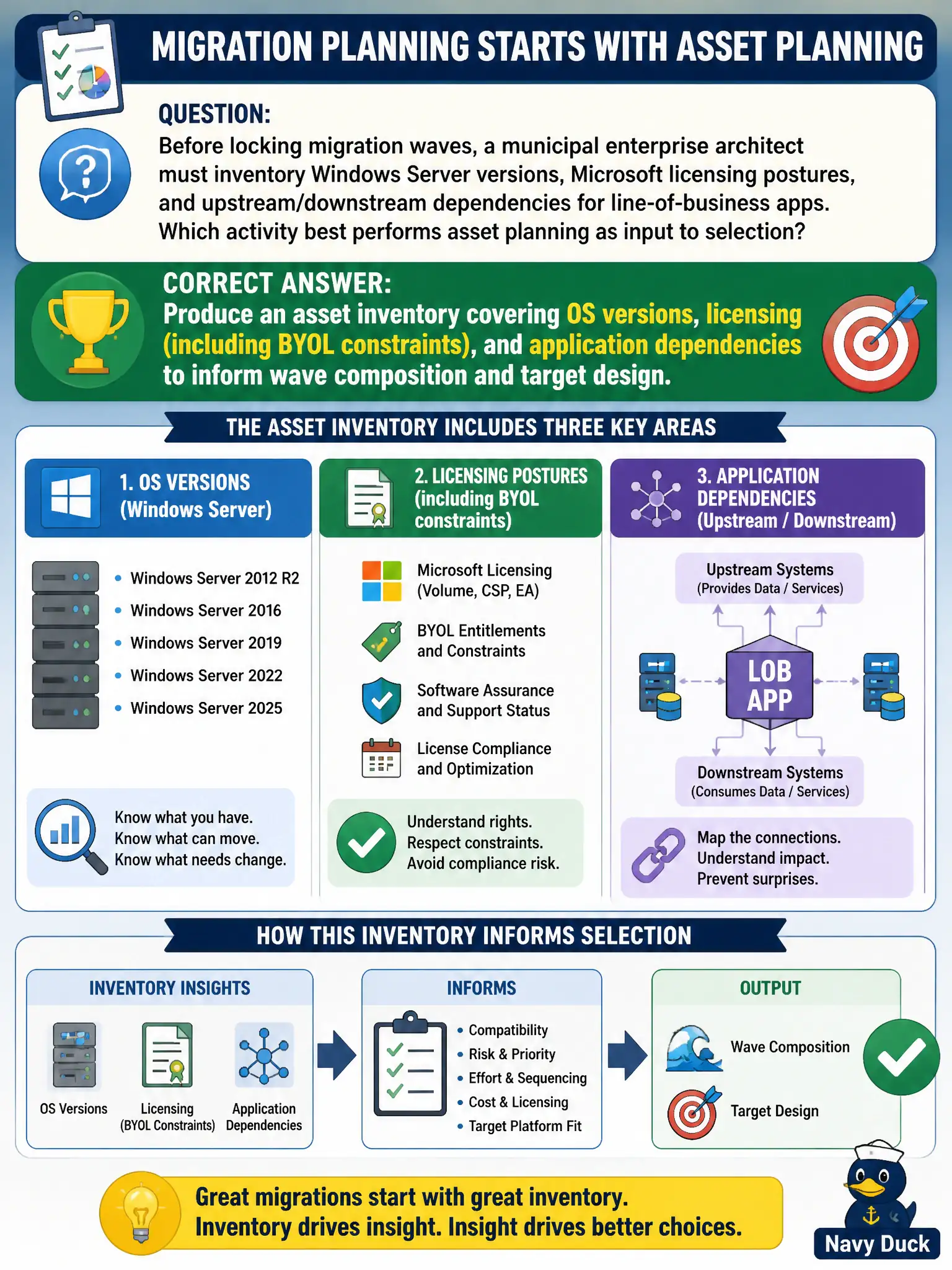
Before locking migration waves, a municipal enterprise architect must inventory Windows Server versions, Microsoft licensing postures, and upstream/downstream dependencies for line-of-business apps. Which activity best performs asset planning as input to selection?
Select an answer to reveal the explanation.
Short Explanation
Asset planning is the pre-game film: OS versions, license fine print, and who talks to whom. Pick waves from that inventory—not from vibes after cutover night.
Full Explanation
Before locking migration waves, a municipal enterprise architect must inventory Windows Server versions, Microsoft licensing postures, and upstream/downstream dependencies for line-of-business apps. Produce an asset inventory covering OS versions, licensing including BYOL constraints, and application dependencies to inform wave composition and target design. That asset planning is the selection input SAP-C02 expects. Selecting target instance families first and inventing dependency maps after cutover fails by designing targets without knowing what must move together. Inventorying only CPU clock speeds and ignoring OS versions, licenses, and integration dependencies fails because clock speed alone does not drive licensing or wave grouping. Deferring all discovery until the night of cutover to avoid outdated CMDB data fails by guaranteeing surprises during the civic maintenance window. Exam caveat: discovery and licensing inventory precede wave lock; post-cutover invention is a classic wrong answer. Operational check: export OS and license inventories, map BYOL versus License Included candidates, build dependency graphs from discovery tooling, compose waves from coupled sets, and refresh the inventory on a fixed cadence before each wave freeze.