
Finance asks for a three-year TCO comparison between refreshing an aging on-premises SAN for records storage versus rehosting the same workloads to EC2 with EBS (and related AWS storage). Which evaluation best supports the migrate-versus-stay decision?
Select an answer to reveal the explanation.
Short Explanation
TCO isn’t sticker price on a controller versus one EC2 size—it’s three years of iron, power, people, and risk versus cloud run-rate. Put both paths on the same spreadsheet before the budget hearing.
Full Explanation
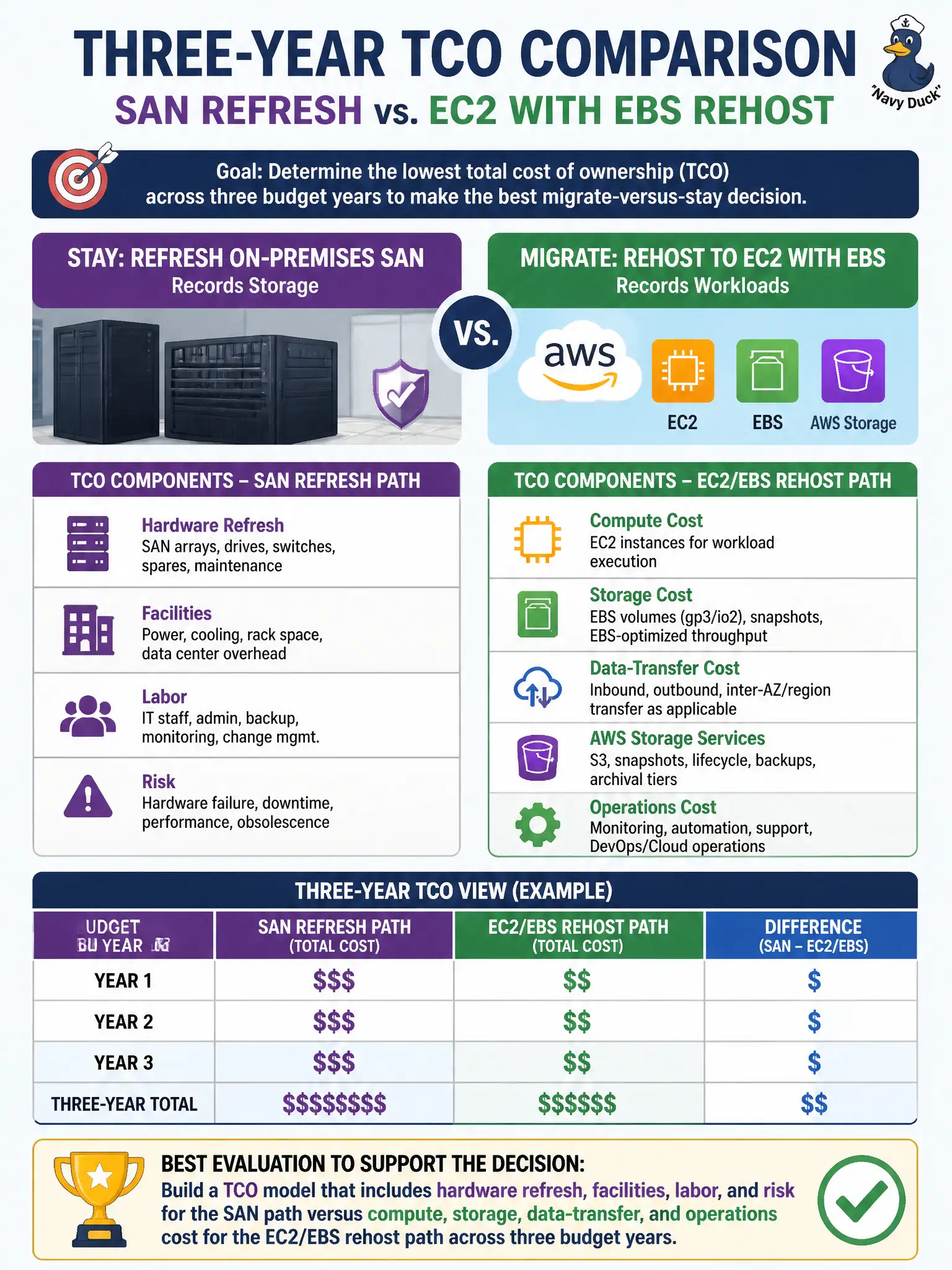
When finance asks for a three-year TCO comparison between refreshing an aging on-premises SAN for records storage versus rehosting workloads to EC2 with EBS and related AWS storage, the evaluation must be holistic. Build a TCO model that includes hardware refresh, facilities, labor, and risk for the SAN path versus compute, storage, data-transfer, and operations cost for the EC2/EBS rehost path across three budget years. That gives the city council a defendable migrate-versus-stay decision. Comparing only the list price of one SAN controller to one m5.large instance and ignoring facilities and labor fails because it omits the dominant civic cost drivers. Assuming AWS storage is always free for government accounts and skipping quantitative TCO fails on fact and process—government accounts still incur storage charges and still need numbers. Using only the prior year’s electricity bill as the complete TCO for both options fails by ignoring hardware, labor, risk, and cloud service dimensions. Exam caveat: migration TCO items expect multi-year, multi-cost-category models, not single-line list-price tricks. Operational check: inventory SAN refresh quotes, power/cooling/floor, admin FTE, and risk premiums; price EC2/EBS/transfer/ops for the same workloads; sensitivity-test utilization; present three-year totals to finance; and record assumptions for audit.