
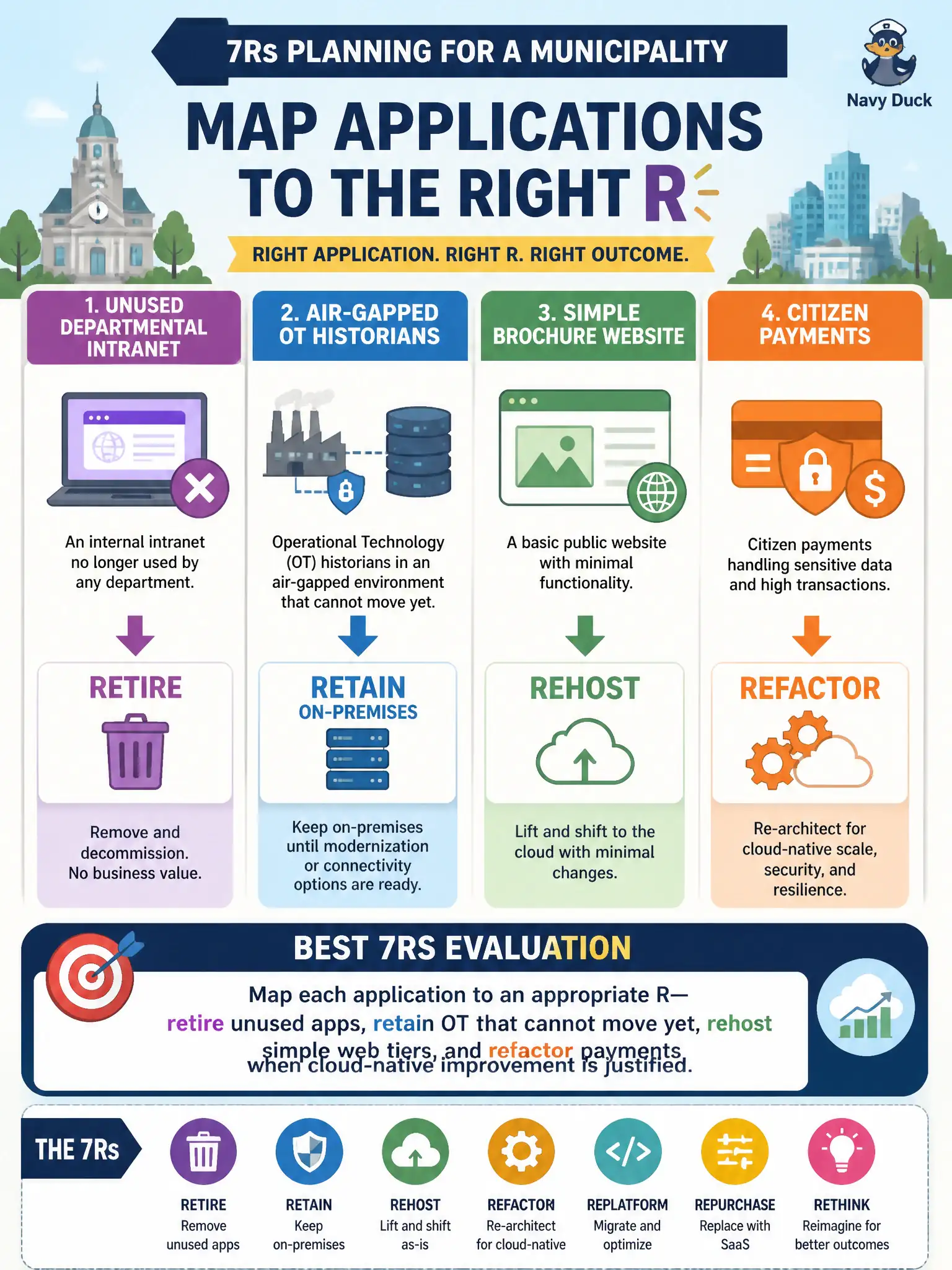
During 7Rs planning for a municipality, architects classify: an unused departmental intranet as retire, air-gapped OT historians as retain on-premises, a simple brochure website as rehost, and citizen payments as refactor. Which statement best reflects correct 7Rs evaluation?
Select an answer to reveal the explanation.
Short Explanation
Seven Rs aren’t a slogan—they’re a sorting hat. Retire the dead intranet, retain air-gapped OT for now, rehost the brochure site, refactor payments when the juice is worth the squeeze. Forcing everything to EC2 in wave one is how programs stall.
Full Explanation
During 7Rs planning for a municipality, correct evaluation maps each application to an appropriate R: retire unused departmental intranets, retain air-gapped OT historians on-premises when they cannot move yet, rehost simple brochure websites, and refactor citizen payments when cloud-native improvement is justified. That differentiated strategy respects civic risk and value instead of forcing one pattern. Claiming retire and retain are invalid 7R strategies and that every workload must rehost to EC2 in the first wave fails because retire and retain are first-class strategies that reduce unnecessary migration cost and protect OT. Saying refactor is only allowed for file servers while payments must always rehost unchanged fails by inverting where refactor value usually lives—customer-facing payments often justify modernization more than file servers. Requiring air-gapped OT to be replatformed to Lambda in wave one to complete the datacenter exit fails conceptually and operationally: OT isolation and safety constraints frequently mandate retain until a deliberate program exists. Exam caveat: SAP-C02 expects nuanced 7Rs mapping, including retire/retain, not universal rehost. Operational check: document R disposition per app with owners, keep OT on retain with compensating controls, schedule brochure rehost early, charter payments refactor with success metrics, and revisit dispositions each portfolio review.