
Before approving a new multi-account citizen-services architecture, council asks for an options memo with credible cost ranges. Which approach best supports that design decision?
Select an answer to reveal the explanation.
Short Explanation
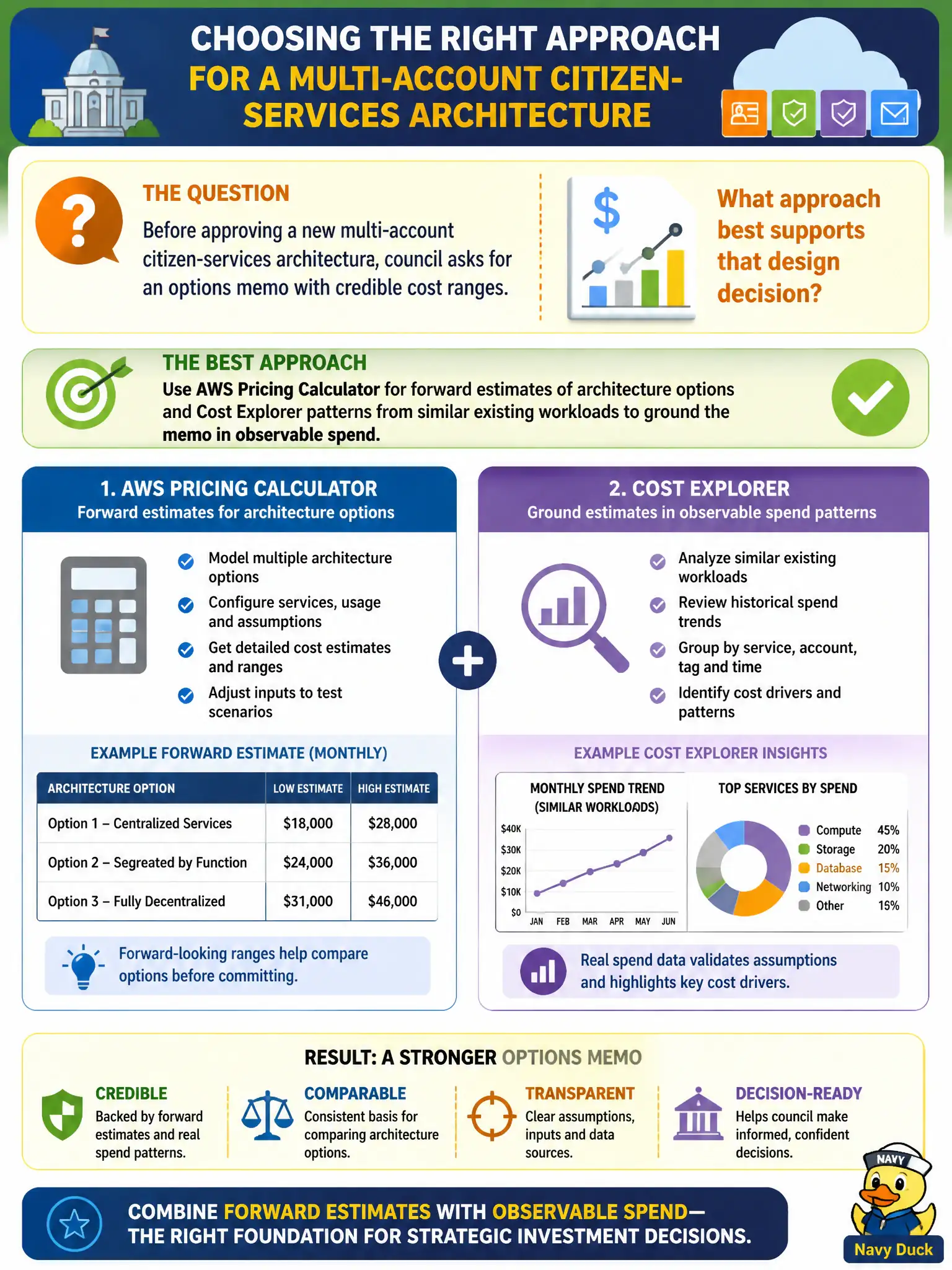
Council wants numbers before the dig starts—Pricing Calculator for the blueprint, Cost Explorer lessons from cousins already in the cloud. Hand-waving until the bill explodes is not a design tool.
Full Explanation
Council approval of a multi-account citizen-services architecture needs credible cost ranges before dig day, not after an overrun. AWS Pricing Calculator provides forward estimates of candidate service mixes with explicit assumptions, while Cost Explorer patterns from similar existing municipal workloads ground those estimates in observable spend. Together they support an options memo that compares architectures on service-level cost drivers rather than politics or hope. Omitting cost figures until after a production overrun fails because design-phase cost analysis is part of cost-optimization strategy for new solutions—governance cannot steer blind. Guessing monthly cost from a single undocumented spreadsheet cell fails conceptually: without service breakdowns, quantities, and assumptions, the number is not decision-grade. Relying solely on a vendor blog anecdote from another industry fails because anecdote lacks mapping to the city’s proposed services, Regions, and traffic model. Exam caveat: Pricing Calculator outputs are only as good as inputs—always state Region, data transfer, HA topology, and growth assumptions, and refresh estimates when the architecture changes. Operational check: build two or three Calculator scenarios (lean, baseline, HA-heavy), annotate them with Cost Explorer analogues from sibling apps, include assumption footnotes in the council memo, and require sign-off on the selected cost envelope before account vending.