
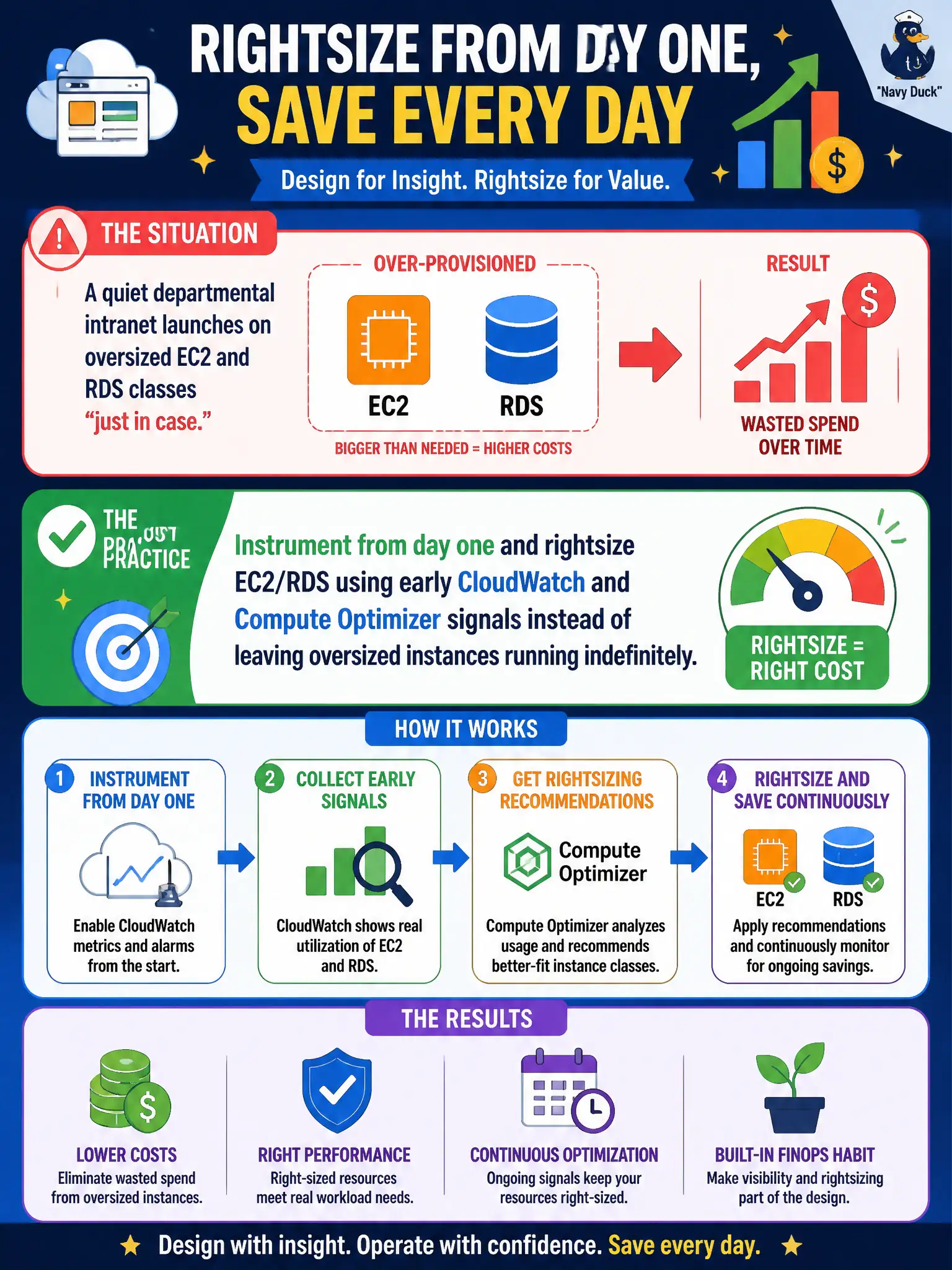
A quiet departmental intranet launches on oversized EC2 and RDS classes “just in case.” Which cost practice should architects bake into the new-solution design?
Select an answer to reveal the explanation.
Short Explanation
Big boxes for a sleepy intranet are like heating an empty stadium—measure early, then rightsize. Buying max RIs blind or flying without metrics just burns budget.
Full Explanation
Quiet departmental intranet workloads frequently launch on oversized EC2 and RDS classes “just in case,” which locks in waste until someone measures. Baking instrumentation into the new-solution design—CloudWatch metrics from day one plus Compute Optimizer signals—lets architects rightsize classes to actual CPU, memory, and storage demand instead of leaving stadium-sized capacity idle indefinitely. That practice works because cost-efficient selection for low-traffic municipal apps is evidence-driven: you cannot optimize what you do not observe. Locking the largest instance classes into three-year Reserved Instances before production metrics exist fails because commitment magnifies a guess and makes correction expensive. Disabling detailed monitoring so rightsizing relies on anecdotal complaints fails conceptually—complaints lag saturation and miss chronic underutilization that burns budget quietly. Scaling vertically every weekend without reviewing metrics fails as process theater: churn without signals does not converge on an efficient size and risks both waste and accidental undersizing. Exam caveat: rightsizing must respect headroom for known peaks (month-end, enrollment windows); the goal is fit-to-demand with documented burst margin, not the absolute smallest class that passes a quiet Tuesday. Operational check: enable appropriate monitoring at launch, review seven-to-fourteen-day CloudWatch and Compute Optimizer findings, resize nonprod first, then production during a change window, and record pre/post utilization and monthly run-rate in the cost review.