
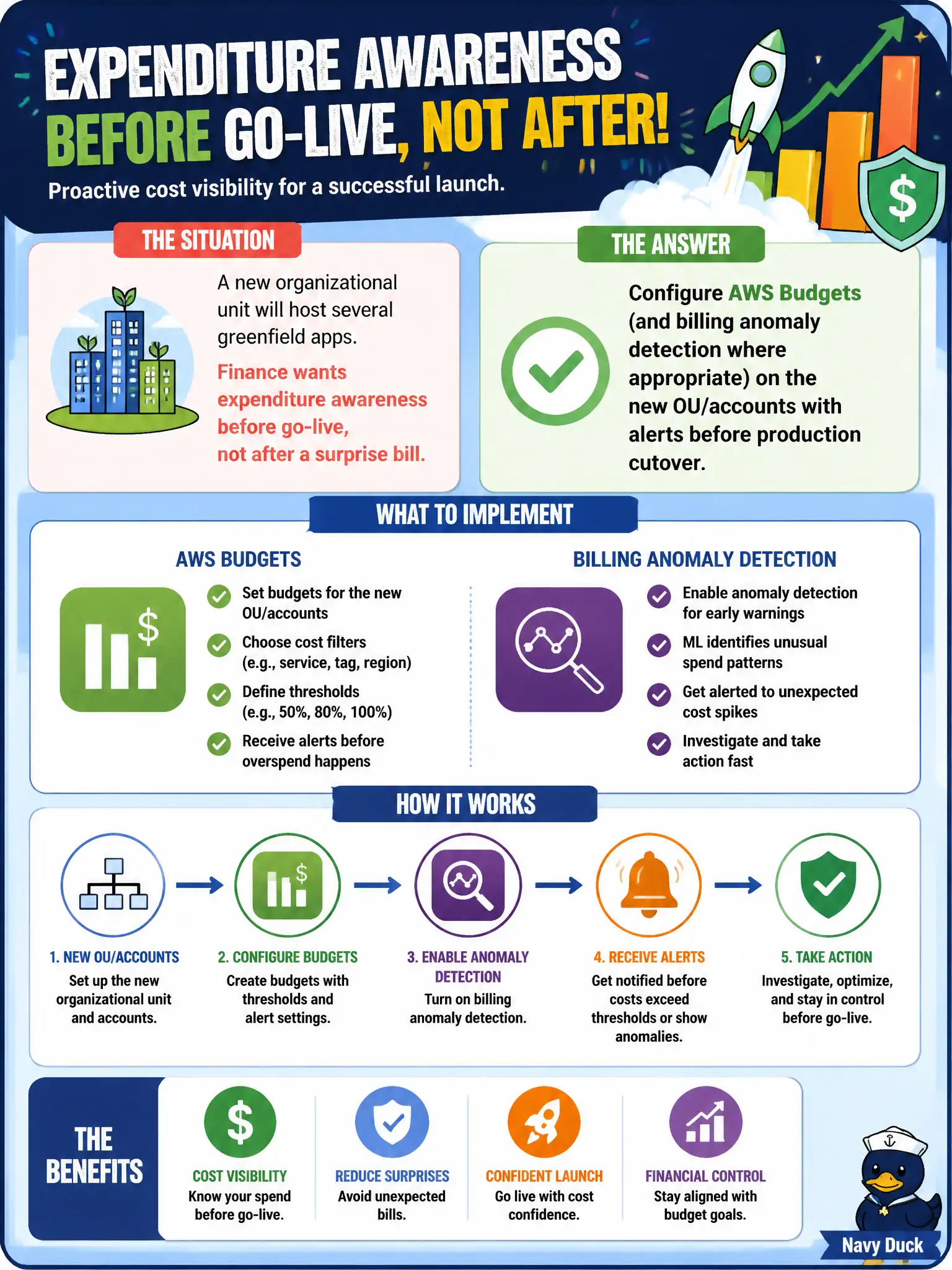
A new organizational unit will host several greenfield apps. Finance wants expenditure awareness before go-live, not after a surprise bill. What should architects implement?
Select an answer to reveal the explanation.
Short Explanation
Put the smoke alarm in before anyone moves into the new OU—Budgets and anomaly alerts at go-live, not after the house is smoking. Annual PDFs alone won’t wake anyone at 2 a.m.
Full Explanation
Expenditure awareness for a new organizational unit must exist before go-live so finance sees drift while it is still small. Configuring AWS Budgets—and billing anomaly detection where appropriate—on the new OU or accounts with alerts before production cutover puts proactive controls in the design rather than after a surprise bill. That approach works because multi-account civic environments need programmatic thresholds tied to owners, not retrospective surprise. Waiting six months after launch to create any budget fails by accepting undetected early overruns during the riskiest learning period for a greenfield unit. Disabling Cost Explorer access for operators fails conceptually: reducing “noise” by removing visibility prevents the very awareness finance requested. Publishing static PDF invoices only annually fails as an alerting strategy—annual paper cannot wake anyone when daily spend spikes on a new account. Exam caveat: budgets without owners and escalation paths become ignored email; pair alerts with tagged cost allocation and a named finance or platform contact per OU. Operational check: create Budgets matching the approved envelope before cutover, enable anomaly detection on the accounts, send a test alert to the on-call/finance distribution, and verify the alert references the correct account tags and application name.