
Council meeting recordings land in Amazon S3, stay warm for weeks of citizen review, then are rarely opened. Which storage design best reduces long-term cost while preserving retrieval when needed?
Select an answer to reveal the explanation.
Short Explanation
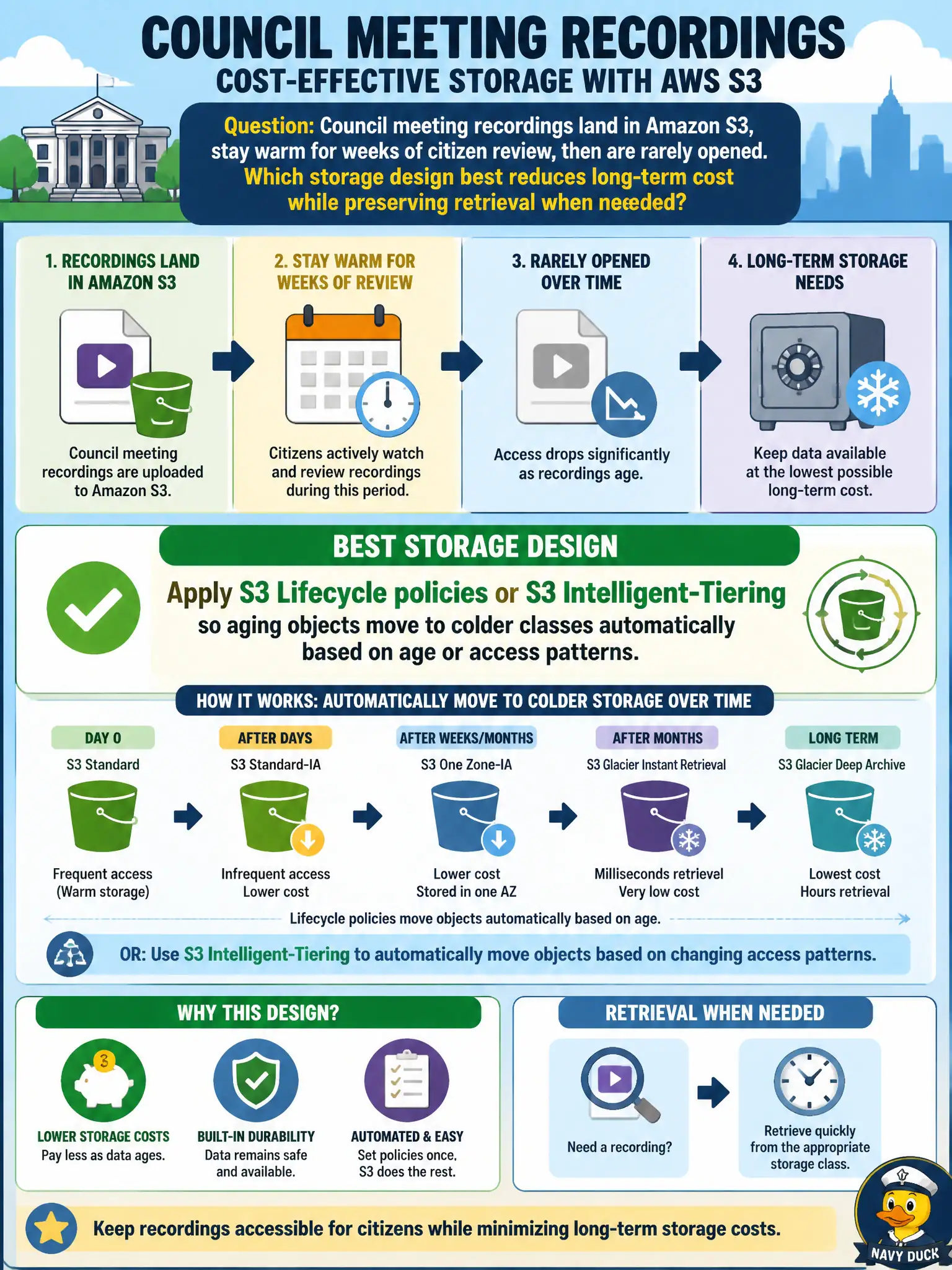
Fresh meeting video hangs out in the expensive seats; old footage moves to the cheap balcony via Lifecycle or Intelligent-Tiering. Leaving everything in Standard forever—or nuking tapes after a day—either burns money or burns history.
Full Explanation
Council meeting recordings that are warm for weeks of citizen review and then rarely opened are a textbook aging-object pattern for Amazon S3 cost control. S3 Lifecycle policies transition objects by age into colder classes, while S3 Intelligent-Tiering moves objects based on observed access—both preserve retrieval while reducing long-term storage spend for municipal archives. The correct design works because retention and accessibility remain intact; only the storage class (and thus unit price) changes as access cools after the public review window. Keeping every recording in S3 Standard indefinitely with lifecycle disabled fails because warm-class pricing continues forever on cold civic video, inflating TCO without improving citizen outcomes. Deleting all objects after 24 hours fails conceptually and legally when retention, sunshine, or legal-hold requirements still apply—storage cost cannot override records policy. Continuously replicating every object to three additional Regions solely to increase spend fails because multi-Region replication is a continuity or residency decision, not a vanity cost multiplier without a DR requirement. Exam caveat: colder classes can add retrieval fees and restore latency (especially Glacier variants); pick classes that still meet the municipality’s retrieval SLA for rare citizen or auditor access. Operational check: define Lifecycle or Intelligent-Tiering rules from the records schedule, sample a 30-day access report on meeting prefixes, estimate Standard-vs-tiered monthly cost, and document restore test results for one aged object before go-live.