
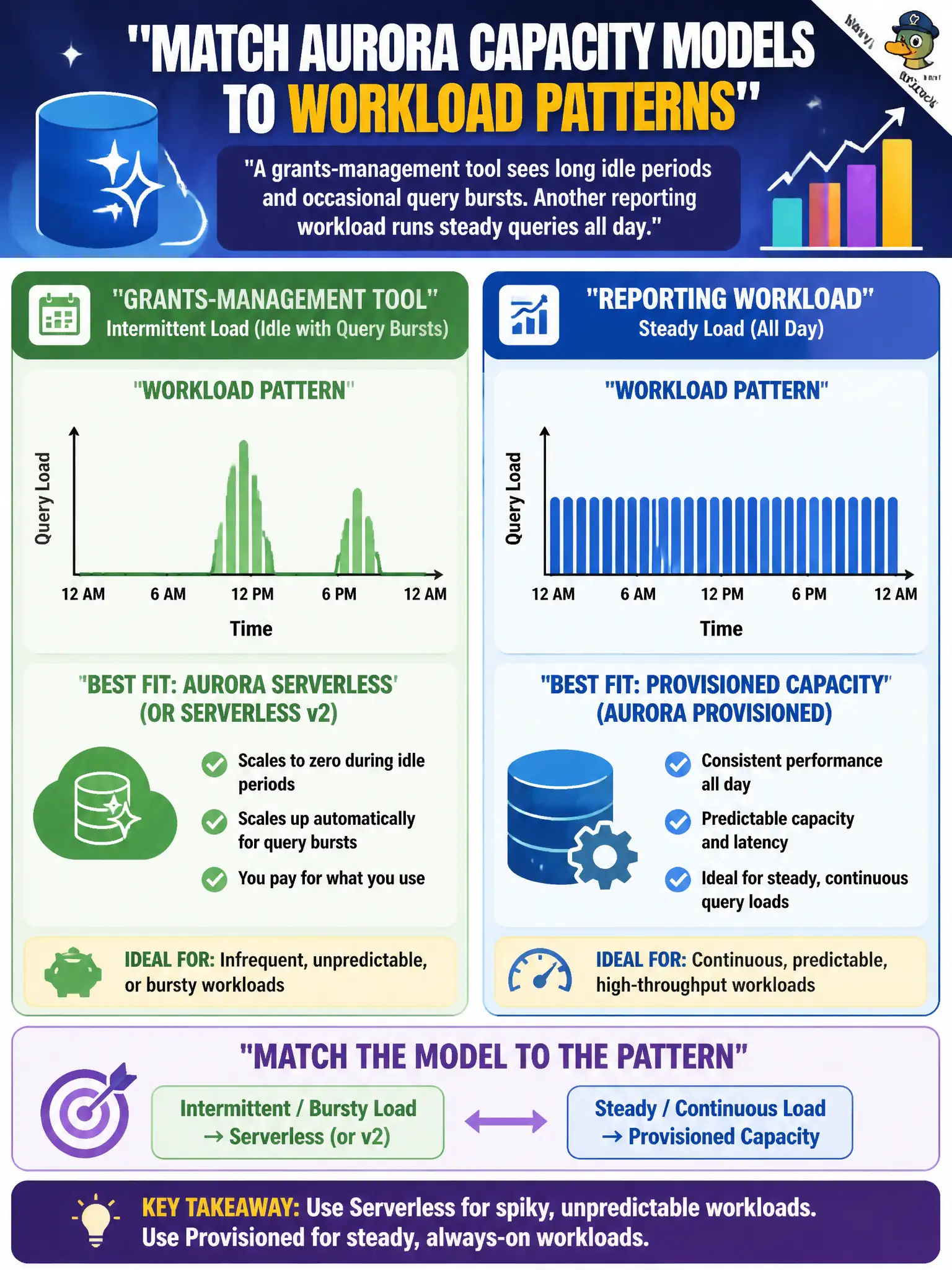
A grants-management tool sees long idle periods and occasional query bursts. Another reporting workload runs steady queries all day. How should Aurora capacity models be matched?
Select an answer to reveal the explanation.
Short Explanation
Bursty grants queries like a database that can nap; steady reporting likes predictable provisioned power. Match Aurora’s capacity model to the shape of the work.
Full Explanation
Aurora capacity models should match workload shape: intermittent grants-management queries fit Aurora Serverless (or Serverless v2), while steady all-day reporting prefers provisioned capacity. That pairing avoids paying for idle provisioned capacity on the grants tool and avoids Serverless pause/scale behavior surprises on steady reporting. Using Serverless for the steady reporter and provisioned only for the intermittent grants tool inverts the match. Using the largest provisioned cluster for both regardless of idle time overspends. Stopping the database manually each night without a capacity strategy is operationally brittle. Exam caveat: Serverless scaling rates and minimum ACUs still need SLO testing for grants bursts after idle. Operational check: place the grants tool on Serverless v2 with a low minimum, run reporting on provisioned, chart cost and latency for a week, and adjust minima if cold starts or scale events breach KPIs. In municipal cloud governance, record the owners, success metrics, and rollback or restore contacts beside this technical choice so the next incident, budget review, or audit does not rediscover the decision from scratch under time pressure. In municipal cloud governance, record the owners, success metrics, and rollback or restore contacts beside this technical choice so the next incident, budget review, or audit does not rediscover the decision from scratch under time pressure.