
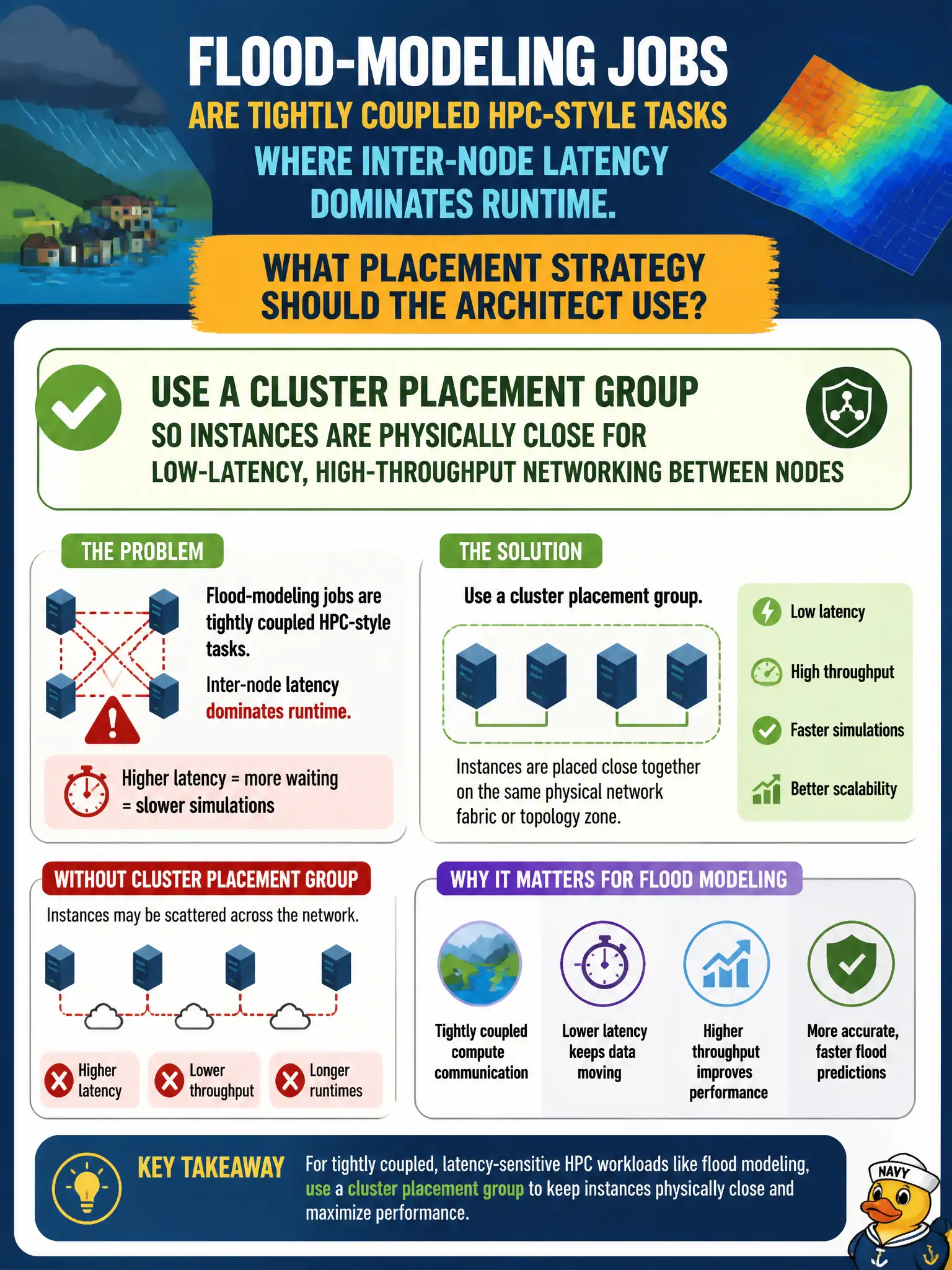
Flood-modeling jobs are tightly coupled HPC-style tasks where inter-node latency dominates runtime. What placement strategy should the architect use?
Select an answer to reveal the explanation.
Short Explanation
When model nodes must gossip quickly, seat them close together in a cluster placement group—distance is the enemy of tightly coupled flood jobs.
Full Explanation
Flood-modeling jobs that are tightly coupled HPC-style tasks where inter-node latency dominates runtime need instances placed close together. A cluster placement group provides low-latency, high-throughput networking between nodes for that mesh. Spreading instances across as many Regions as possible harms tightly coupled MPI-style steps. Placing each node on a different continent maximizes network distance contrary to the goal. Avoiding placement groups and relying on best-effort cross-AZ chatter leaves latency-sensitive exchanges on longer paths. Exam caveat: cluster placement groups have capacity constraints in an AZ—use diversified instance types and retry logic when launching large jobs. Operational check: launch a small cluster placement group, run a latency microbenchmark between nodes versus cross-AZ, execute a flood-model step, and compare wall-clock time to a spread placement. In municipal cloud governance, record the owners, success metrics, and rollback or restore contacts beside this technical choice so the next incident, budget review, or audit does not rediscover the decision from scratch under time pressure. In municipal cloud governance, record the owners, success metrics, and rollback or restore contacts beside this technical choice so the next incident, budget review, or audit does not rediscover the decision from scratch under time pressure.