
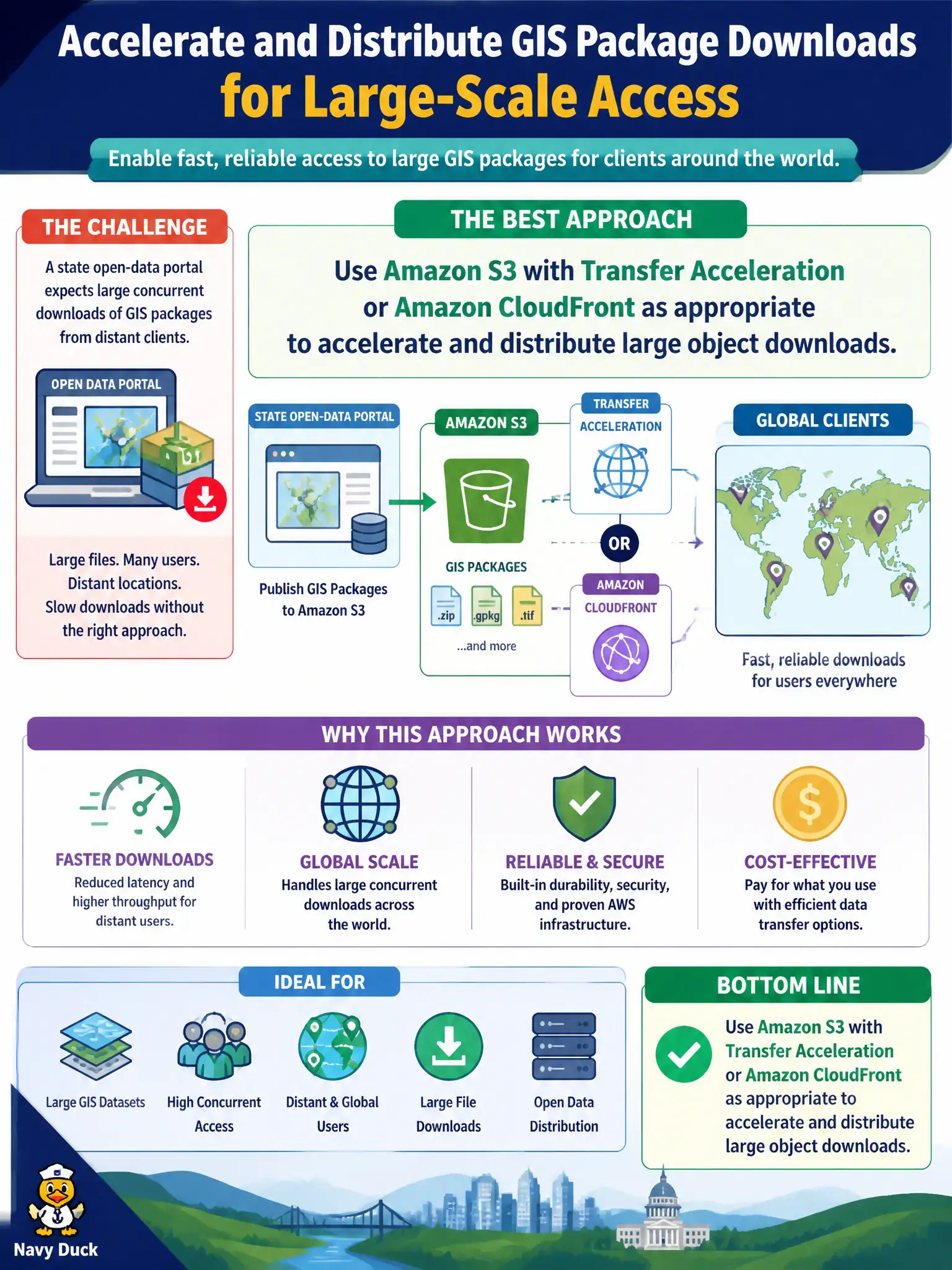
A state open-data portal expects large concurrent downloads of GIS packages from distant clients. Which approach best supports large-scale access patterns?
Select an answer to reveal the explanation.
Short Explanation
Big GIS zips shouldn’t crawl across the internet from one lonely origin. Transfer Acceleration or CloudFront gives distant downloaders a faster on-ramp.
Full Explanation
A state open-data portal expecting large concurrent downloads of GIS packages from distant clients should use Amazon S3 with Transfer Acceleration or CloudFront as appropriate to accelerate and distribute large object downloads. Forcing every download through a single VPN concentrator in one AZ creates a bottleneck and poor global experience. Serving multi-gigabyte objects only from an EC2 instance with a public Elastic IP and no edge acceleration limits throughput and availability. Emailing GIS packages as mailbox attachments fails size limits and auditability. Exam caveat: CloudFront versus Transfer Acceleration fits different patterns—CDN caching for popular objects, acceleration for put/get to a single bucket from distant clients—choose deliberately. Operational check: publish a large GIS package, download from a distant network via the chosen accelerator/CDN path, compare throughput to a direct regional URL, and confirm CloudWatch and access logs show edge or accelerated transfers. In municipal cloud governance, record the owners, success metrics, and rollback or restore contacts beside this technical choice so the next incident, budget review, or audit does not rediscover the decision from scratch under time pressure.