
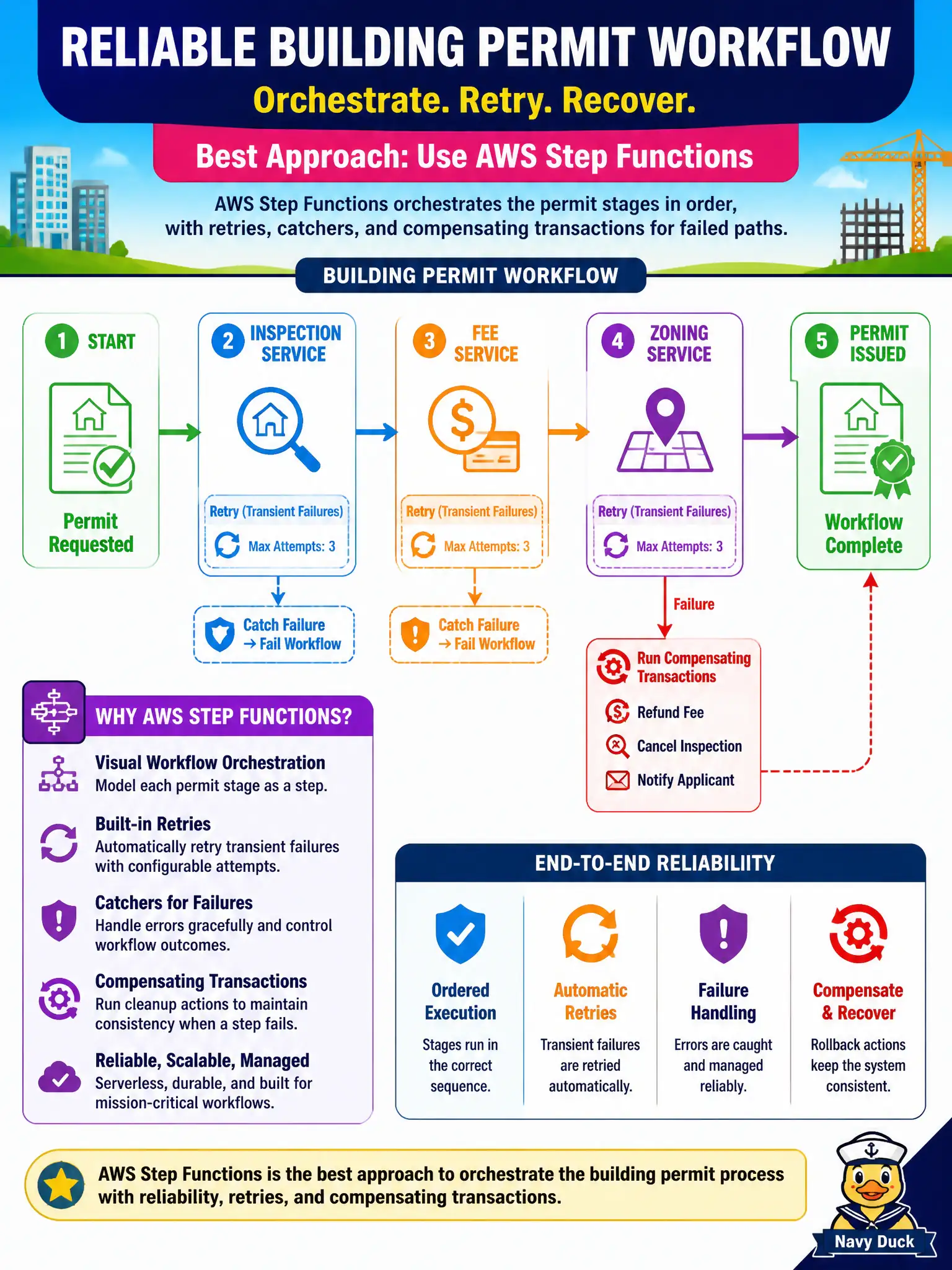
A county planning office needs a multi-step building-permit workflow that calls inspection, fee, and zoning services in order, retries transient failures, and runs compensating steps if a later stage fails. Which approach best meets reliability and orchestration needs?
Select an answer to reveal the explanation.
Short Explanation
Picture the permit as a relay race with a clipboard that never gets lost. Step Functions keeps that clipboard—retries the dropped baton and runs undo steps when a later leg fails.
Full Explanation
When citizen traffic to a parks portal is unpredictable, Auto Scaling policies driven by meaningful demand metrics keep capacity aligned without permanent overprovision. Configuring target tracking or step scaling on CPU, request count, or custom metrics—and pairing with an ALB—lets the portal absorb spikes and scale in when quiet. Running a fixed maximum fleet every hour of the year wastes budget in off-peak periods. Scaling only once annually by ticket request cannot react to weather-driven portal surges. Disabling health checks so unhealthy instances stay in service undermines elasticity benefits. Exam caveat: scaling metrics must reflect user experience; CPU-only policies can miss queue-depth or latency saturation. Operational check: load-test the portal, confirm scale-out events, watch scale-in after cool-down, and compare p99 latency during the test to the parks SLO. In municipal cloud governance, record the owners, success metrics, and rollback or restore contacts beside this technical choice so the next incident, budget review, or audit does not rediscover the decision from scratch under time pressure. In municipal cloud governance, record the owners, success metrics, and rollback or restore contacts beside this technical choice so the next incident, budget review, or audit does not rediscover the decision from scratch under time pressure.