
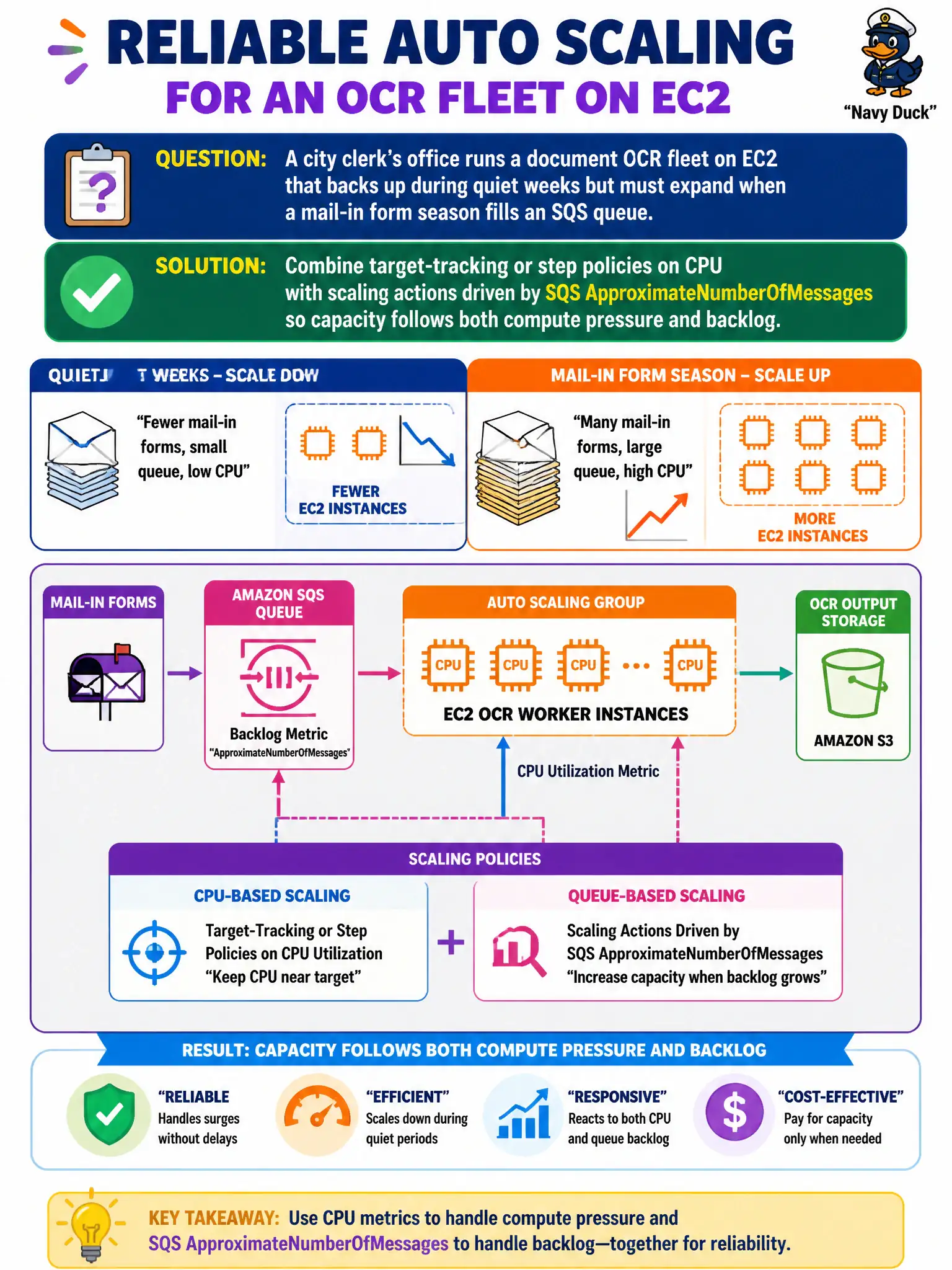
A city clerk’s office runs a document OCR fleet on EC2 that backs up during quiet weeks but must expand when a mail-in form season fills an SQS queue. How should Auto Scaling be designed for reliability?
Select an answer to reveal the explanation.
Short Explanation
Quiet weeks shouldn’t pay for parade-day capacity, and a fat queue shouldn’t wait for a clock. Tie scaling to CPU and to how deep the OCR inbox is.
Full Explanation
A city data warehouse team wants analysts to query S3 data lakes with standard SQL without standing up always-on clusters for every ad-hoc question. Amazon Athena (with Glue Data Catalog as needed) provides serverless SQL over S3 for that pattern, charging for queries rather than idle clusters. Requiring a dedicated Redshift cluster for every one-off civic question increases cost and operations for sporadic work. Downloading entire lakes to analyst laptops for Excel pivots fails governance and scale. Granting analysts AdministratorAccess to production OLTP databases for ad-hoc exploration endangers transactional systems. Exam caveat: Athena cost controls need partition projection, columnar formats, and workgroup limits so wide scans do not surprise finance. Operational check: register a partitioned civic dataset in the catalog, run Athena in a constrained workgroup, verify results match a known sample, and review bytes scanned against budget alarms. In municipal cloud governance, record the owners, success metrics, and rollback or restore contacts beside this technical choice so the next incident, budget review, or audit does not rediscover the decision from scratch under time pressure.