
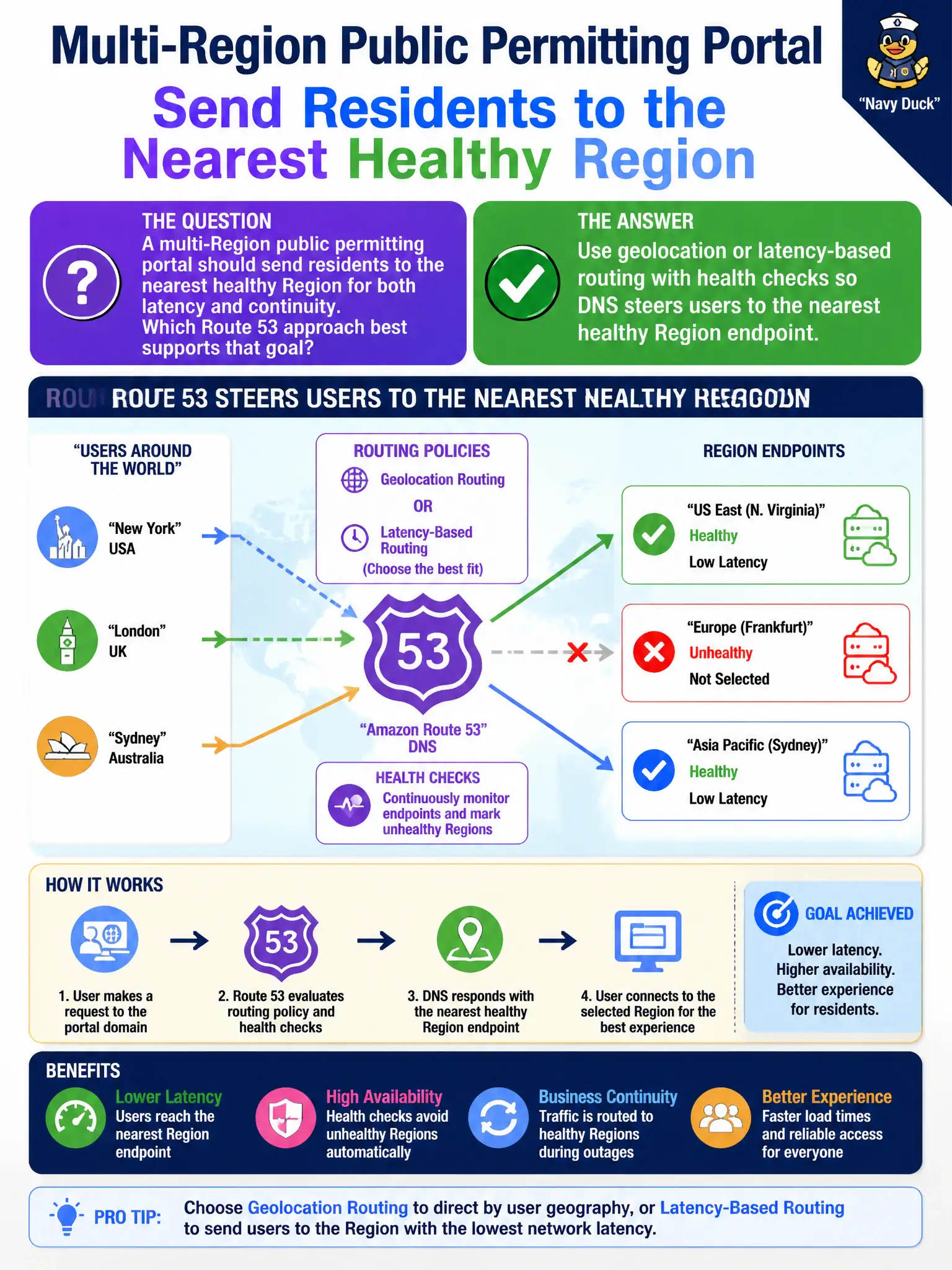
A multi-Region public permitting portal should send residents to the nearest healthy Region for both latency and continuity. Which Route 53 approach best supports that goal?
Select an answer to reveal the explanation.
Short Explanation
Route 53 geo or latency routing plus health checks is the traffic cop that points residents to the closest open city hall window—and stops sending them to a boarded-up one.
Full Explanation
A multi-Region public permitting portal should steer residents to the nearest healthy Region for latency and continuity. Geolocation or latency-based Route 53 routing with health checks removes unhealthy endpoints while preferring nearer healthy ones. A single static A record to one Region plus VPN instructions for remote residents creates friction and a single point of failure. Equal weighted routing with no health checks keeps sending traffic to failed Regions. Private-hosted-zone-only resolution blocks public residents from either Region. Exam caveat: latency-based and geolocation policies differ at boundaries—validate answers from multiple client networks and align health checks to real permit API health. Operational check: query from two distant networks, confirm nearer healthy endpoints, mark a Region unhealthy, and verify DNS stops returning it while permits still submit elsewhere. In municipal cloud governance, record the owners, success metrics, and rollback or restore contacts beside this technical choice so the next incident, budget review, or audit does not rediscover the decision from scratch under time pressure. In municipal cloud governance, record the owners, success metrics, and rollback or restore contacts beside this technical choice so the next incident, budget review, or audit does not rediscover the decision from scratch under time pressure.