
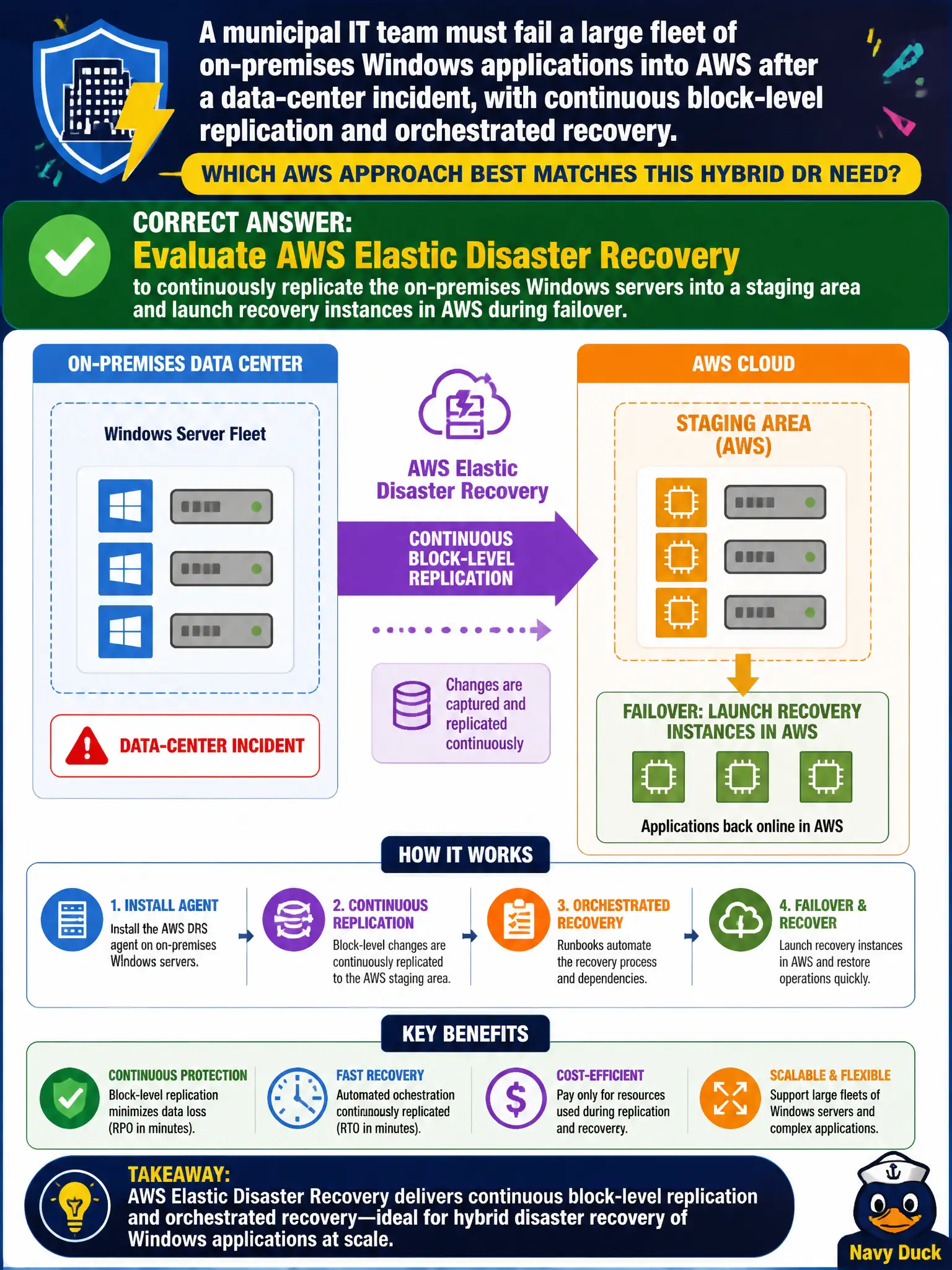
A municipal IT team must fail a large fleet of on-premises Windows applications into AWS after a data-center incident, with continuous block-level replication and orchestrated recovery. Which AWS approach best matches this hybrid DR need?
Select an answer to reveal the explanation.
Short Explanation
Think of Elastic Disaster Recovery as a moving truck that keeps copying the servers until you flip the lights on in AWS. Weekly AMI burn parties and binary-only S3 copies leave you rebuilding when the outage clock is already running.
Full Explanation
Hybrid disaster recovery for large on-premises Windows fleets needs continuous block-level replication into AWS plus orchestrated recovery. AWS Elastic Disaster Recovery continuously replicates source servers into a staging area and launches recovery instances during failover, matching that municipal hybrid need. Weekly hand-exported AMIs without a DR runbook are stale and slow. S3 Cross-Region Replication of binaries alone ignores machine state and data volumes required to boot usable servers. Idle identical EC2 fleets with no replication force long rebuilds and data-loss risk after a data-center incident. Exam caveat: Elastic Disaster Recovery still needs network paths, IAM, and regular failover drills—replication alone does not prove RTO. Operational check: protect a pilot Windows server, verify replication lag, launch a recovery instance in an isolated subnet, validate the app, and time failover against the hybrid objective. In municipal cloud governance, record the owners, success metrics, and rollback or restore contacts beside this technical choice so the next incident, budget review, or audit does not rediscover the decision from scratch under time pressure. In municipal cloud governance, record the owners, success metrics, and rollback or restore contacts beside this technical choice so the next incident, budget review, or audit does not rediscover the decision from scratch under time pressure.