
When Availability Zone degradation threatens municipal workloads, recovery should start without waiting for a ticket queue. Which approach best uses centralized monitoring for recovery?
Select an answer to reveal the explanation.
Short Explanation
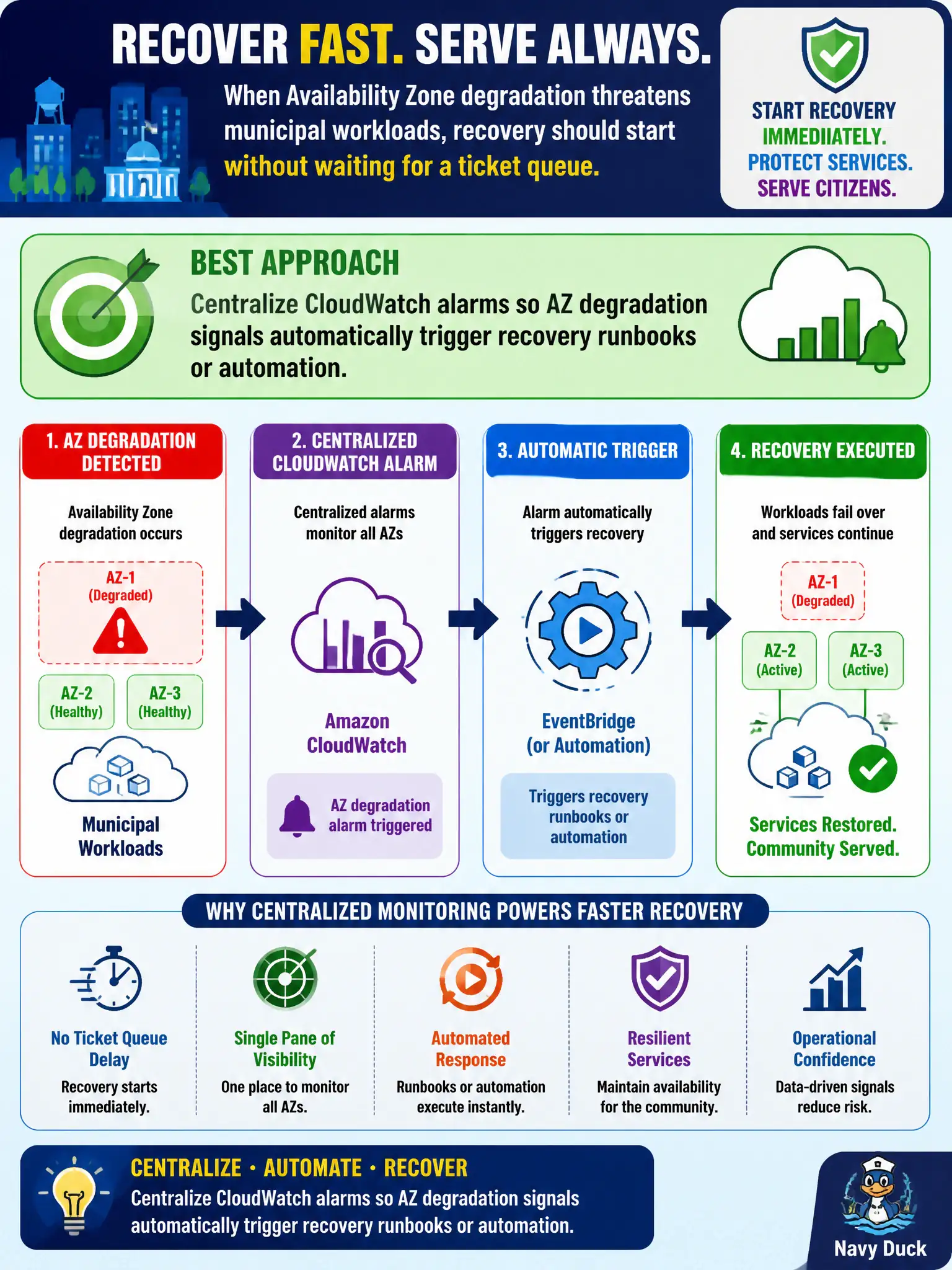
When an AZ sneezes, do not wait for a ticket to age. Central CloudWatch alarms should poke the recovery runbooks—or the automation—so systems heal while humans catch up.
Full Explanation
When Availability Zone degradation threatens municipal workloads, recovery should start from centralized signals rather than a ticket queue. Centralizing CloudWatch alarms so AZ degradation automatically triggers recovery runbooks or automation shortens mean time to recovery for citizen services. Silencing all alarms during incidents removes awareness when it is needed most. Requiring a weekly CAB before any automated recovery introduces delay incompatible with AZ events. Monitoring only one admin laptop CPU as the org-wide signal misses fleet and zonal health. Exam caveat: automation must be scoped—over-aggressive failover causes flapping, so pair alarms with defined actions and cooldowns. Operational check: simulate AZ impairment in non-production, confirm the centralized alarm fires, verify automation or runbook execution, and keep human gates only where policy requires them. In municipal cloud governance, record the owners, success metrics, and rollback or restore contacts beside this technical choice so the next incident, budget review, or audit does not rediscover the decision from scratch under time pressure. In municipal cloud governance, record the owners, success metrics, and rollback or restore contacts beside this technical choice so the next incident, budget review, or audit does not rediscover the decision from scratch under time pressure.