
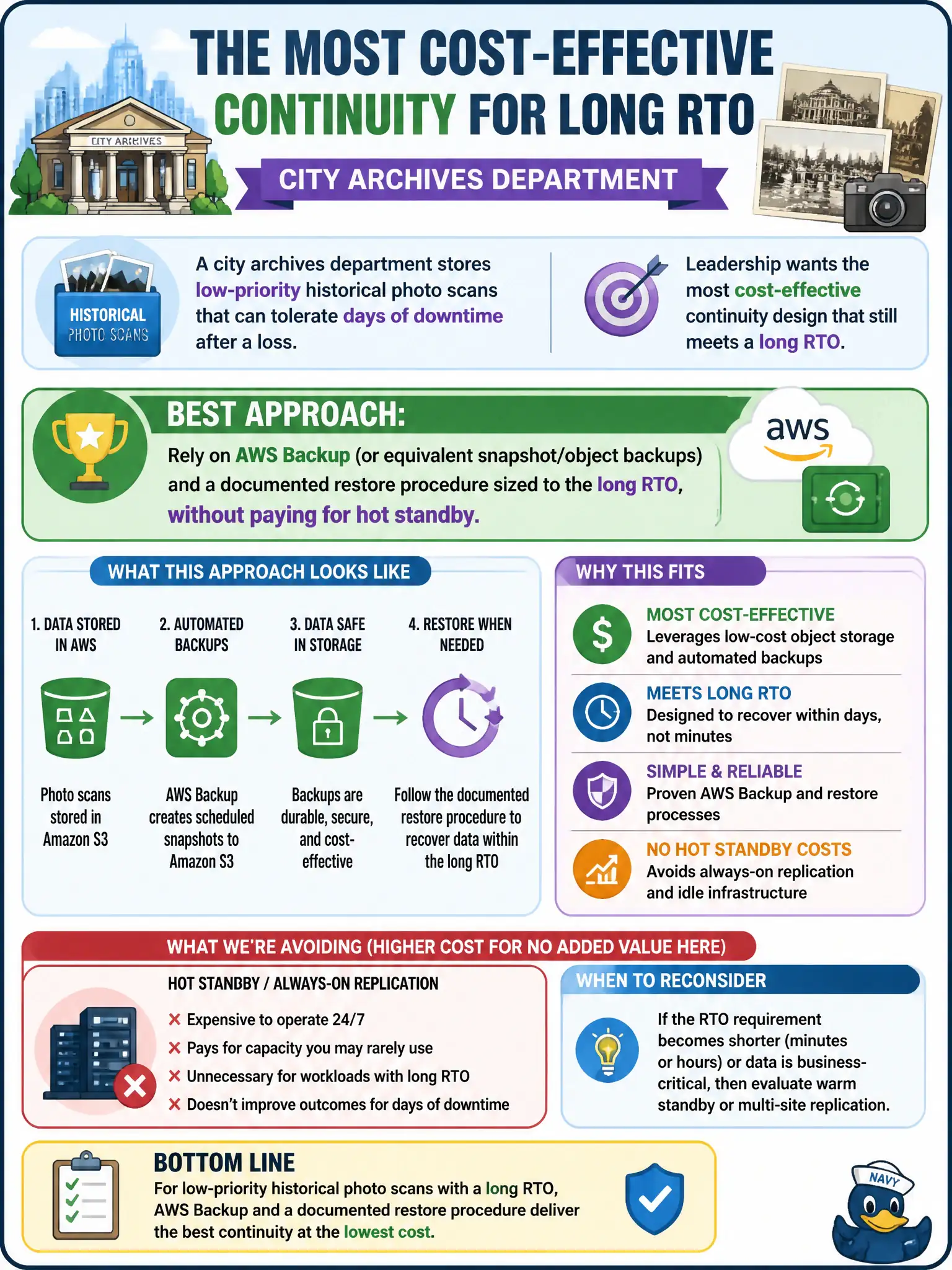
A city archives department stores low-priority historical photo scans that can tolerate days of downtime after a loss. Leadership wants the most cost-effective continuity design that still meets a long RTO. Which approach best fits?
Select an answer to reveal the explanation.
Short Explanation
A dusty photo archive that can wait days does not need a second city always running lights-on. Back it up, practice the restore, and skip the hot-standby tax until the RTO actually demands it.
Full Explanation
Low-priority historical photo archives that tolerate days of downtime should use cost-effective backup-and-restore continuity rather than always-on multi-Region capacity. AWS Backup or equivalent snapshot and object backups with a documented restore procedure sized to the long RTO meet leadership's cost goal without hot standby year-round. Continuously synced active-active stacks with hot standby always on overspend relative to that RTO. A full warm-standby global database and always-on second-Region fleet similarly funds unused readiness. Storing archive objects only on one workstation with no cloud backups fails durability even when RTO is long. Exam caveat: long RTO still needs tested restores and retention matching records policy. Operational check: restore a representative photo batch to a clean account, time it against the long RTO, verify checksums, and confirm backup cost fits the archive budget. In municipal cloud governance, record the owners, success metrics, and rollback or restore contacts beside this technical choice so the next incident, budget review, or audit does not rediscover the decision from scratch under time pressure. In municipal cloud governance, record the owners, success metrics, and rollback or restore contacts beside this technical choice so the next incident, budget review, or audit does not rediscover the decision from scratch under time pressure.