
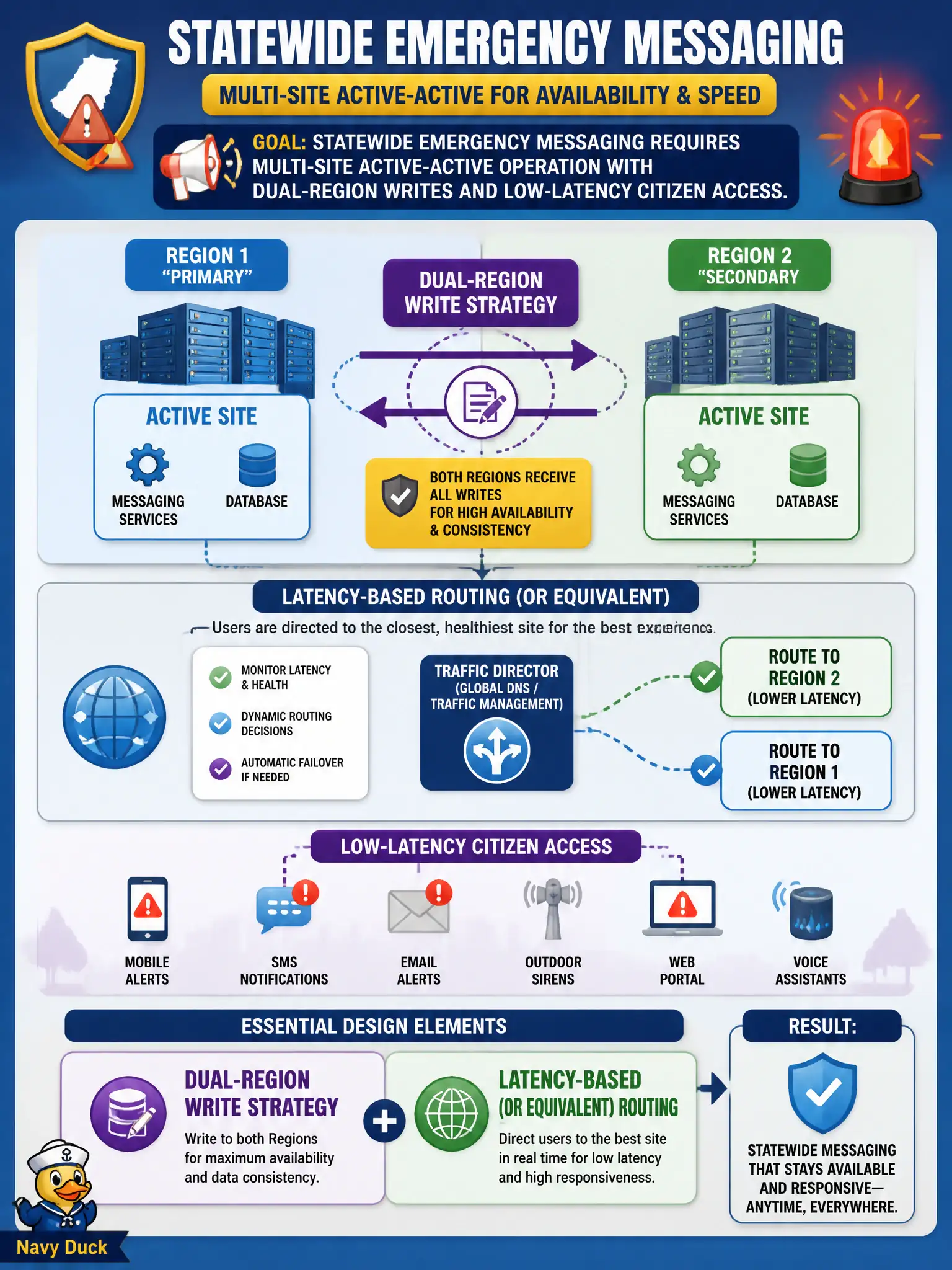
Statewide emergency messaging requires multi-site active-active operation with dual-Region writes and low-latency citizen access. Which design elements are essential?
Select an answer to reveal the explanation.
Short Explanation
Amber-class alerts cannot wait on one Region’s bad day. Active-active means both Regions can write, and latency routing steers citizens to the nearer healthy door.
Full Explanation
Statewide emergency messaging that must be multi-site active-active needs a dual-Region write strategy plus routing that steers citizens to a healthy low-latency endpoint. Pairing dual-Region writes with latency-based or equivalent routing keeps messaging available when either site can serve users. A single Region write master with only simple A-record DNS cannot survive Region loss or optimize multi-site latency. Active-passive DNS failover without dual-Region data leaves the secondary weak on fresh writes after cutover. Latency routing to one Region while disabling the second data plane is not active-active. Exam caveat: dual writes need conflict handling and idempotency—routing alone does not make writes correct. Operational check: write through each Region, read from the other, fail one endpoint health, confirm routing shifts, and validate new accepts on the survivor. In municipal cloud governance, record the owners, success metrics, and rollback or restore contacts beside this technical choice so the next incident, budget review, or audit does not rediscover the decision from scratch under time pressure. In municipal cloud governance, record the owners, success metrics, and rollback or restore contacts beside this technical choice so the next incident, budget review, or audit does not rediscover the decision from scratch under time pressure.