
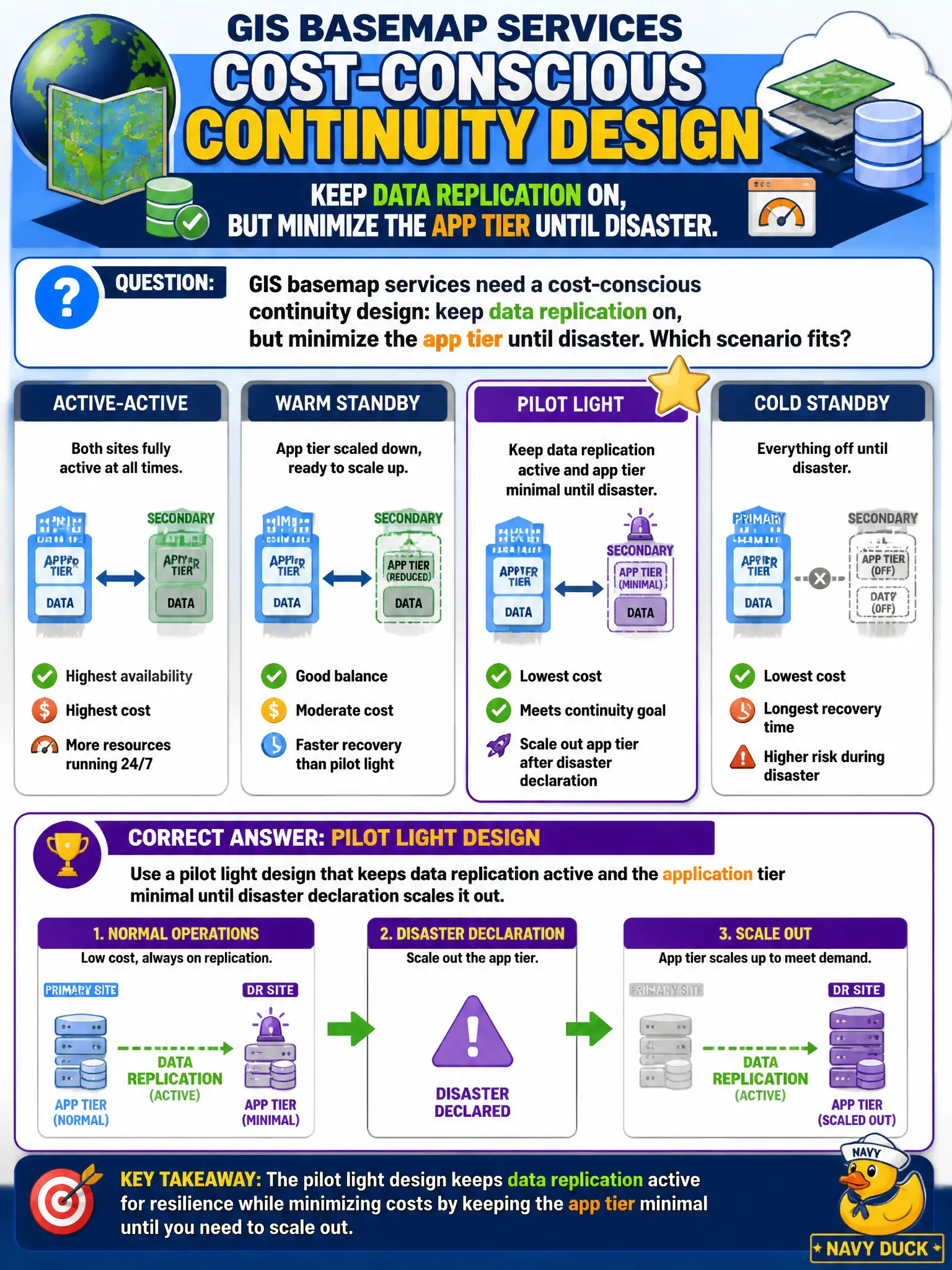
GIS basemap services need a cost-conscious continuity design: keep data replication on, but minimize the app tier until disaster. Which scenario fits?
Select an answer to reveal the explanation.
Short Explanation
Pilot light leaves the data furnace lit and the app tier as a spark. When disaster hits, fan the compute into a full stack—cheaper than running twin cities, faster than cold tape.
Full Explanation
GIS basemap continuity can use a pilot light: keep data replication healthy while minimizing the application tier until disaster declaration scales it out. That pattern is cost-conscious versus identical hot capacity in two Regions, yet faster than quarterly offline media restores. Full multi-site active-active with identical always-on capacity ignores the cost constraint. No replicas with quarterly tape restore yields long RPO/RTO unsuitable for many planning and emergency GIS users. Deleting GIS data nightly to simplify recovery destroys continuity. Exam caveat: pilot light needs automation to enlarge the app tier quickly and traffic management that knows when to cut over. Operational check: verify replication lag, scale out the minimal app tier in DR, publish a test endpoint, and time a usable map tile response for planners and emergency staff. In municipal cloud governance, record the owners, success metrics, and rollback or restore contacts beside this technical choice so the next incident, budget review, or audit does not rediscover the decision from scratch under time pressure. In municipal cloud governance, record the owners, success metrics, and rollback or restore contacts beside this technical choice so the next incident, budget review, or audit does not rediscover the decision from scratch under time pressure.