
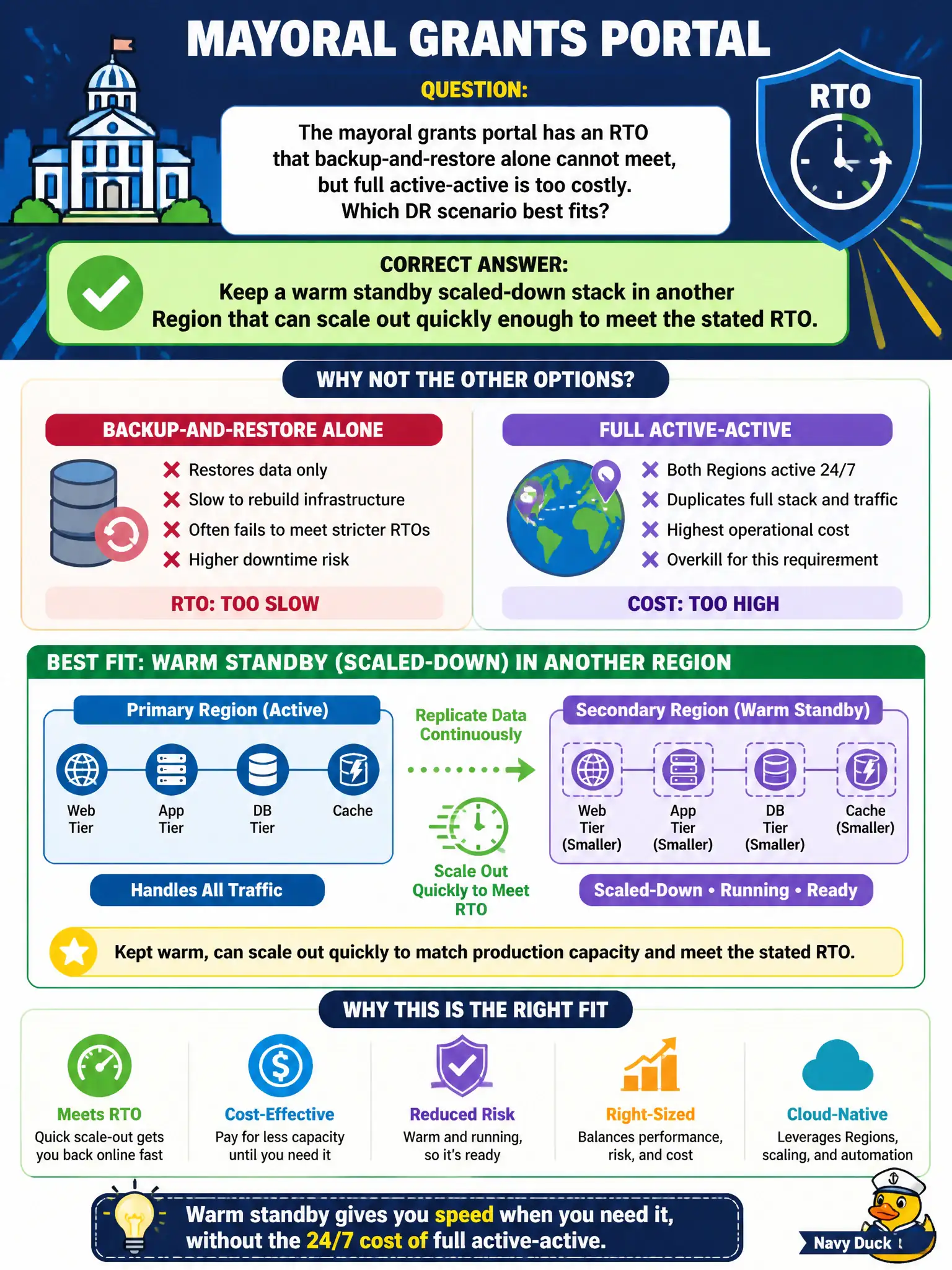
The mayoral grants portal has an RTO that backup-and-restore alone cannot meet, but full active-active is too costly. Which DR scenario best fits?
Select an answer to reveal the explanation.
Short Explanation
Warm standby is the middle seat: a smaller twin already humming, ready to grow when primary fails—faster than restore-from-zero, cheaper than running two full cities forever.
Full Explanation
When the mayoral grants portal RTO exceeds what backup-and-restore can deliver but full active-active is too costly, warm standby is the usual middle path. Keeping a scaled-down stack in another Region that can scale out quickly enough to meet the stated RTO balances continuity and spend. Backup and restore alone that accepts multi-day recovery fails the mayoral RTO. A pilot light with zero compute and no data replication cannot hit aggressive RTOs without long rebuilds. Declaring grants nonessential forever ignores expectations already encoded in the RTO. Exam caveat: warm standby cost tracks warmth—data and images must be current and scale-out automation tested or paper RTO will miss. Operational check: declare a drill failover, scale the standby, shift traffic, measure elapsed time against RTO, and compare monthly standby cost to active-active for finance. In municipal cloud governance, record the owners, success metrics, and rollback or restore contacts beside this technical choice so the next incident, budget review, or audit does not rediscover the decision from scratch under time pressure. In municipal cloud governance, record the owners, success metrics, and rollback or restore contacts beside this technical choice so the next incident, budget review, or audit does not rediscover the decision from scratch under time pressure.