
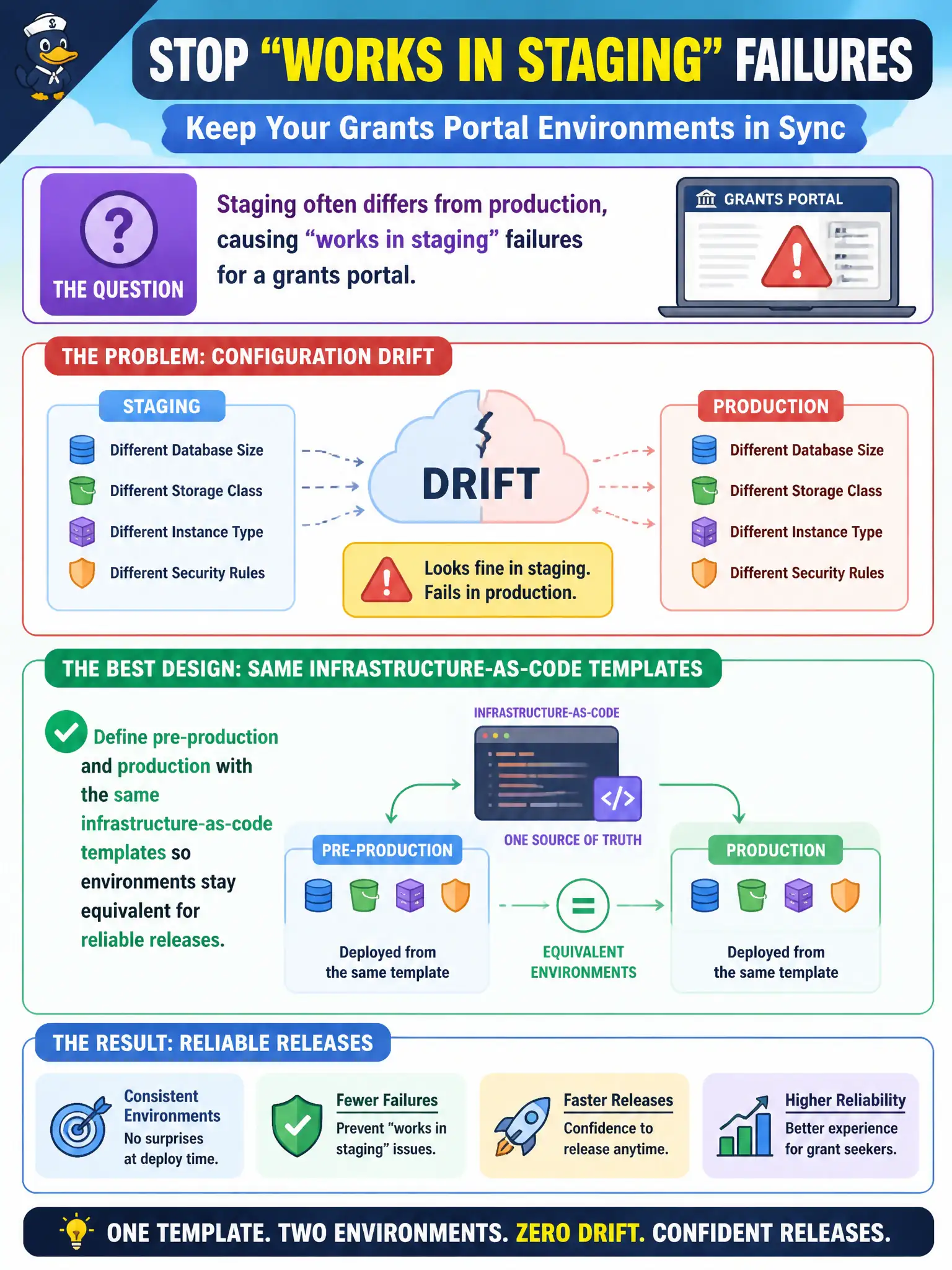
Staging often differs from production, causing “works in staging” failures for a grants portal. What design best prevents that configuration drift?
Select an answer to reveal the explanation.
Short Explanation
If staging is a cousin and production is a stranger, bugs hide until go-live. Same IaC templates for both means the dress rehearsal matches opening night.
Full Explanation
Staging that diverges from production is a common cause of false confidence for grants portals and similar civic applications. Defining pre-production and production from the same infrastructure-as-code templates keeps networking, IAM, runtime versions, and supporting services equivalent so release validation actually predicts production behavior. Maintaining staging as a unique hand-built environment guarantees drift. Allowing production-only console hotfixes that never return to staging widens the gap after every emergency change. Documenting differences only in chat threads leaves no enforceable source of truth for environment parity across municipal teams. Exam caveat: identical templates still need controlled differences for scale and secrets—express those as parameters or mappings, not as one-off console edits. Operational check: diff staging and production stacks from the shared templates, deploy a canary through both, and confirm configuration inventory matches except for documented parameter deltas before a grants release. In municipal cloud governance, record the owners, success metrics, and rollback or restore contacts beside this technical choice so the next incident, budget review, or audit does not rediscover the decision from scratch under time pressure.