
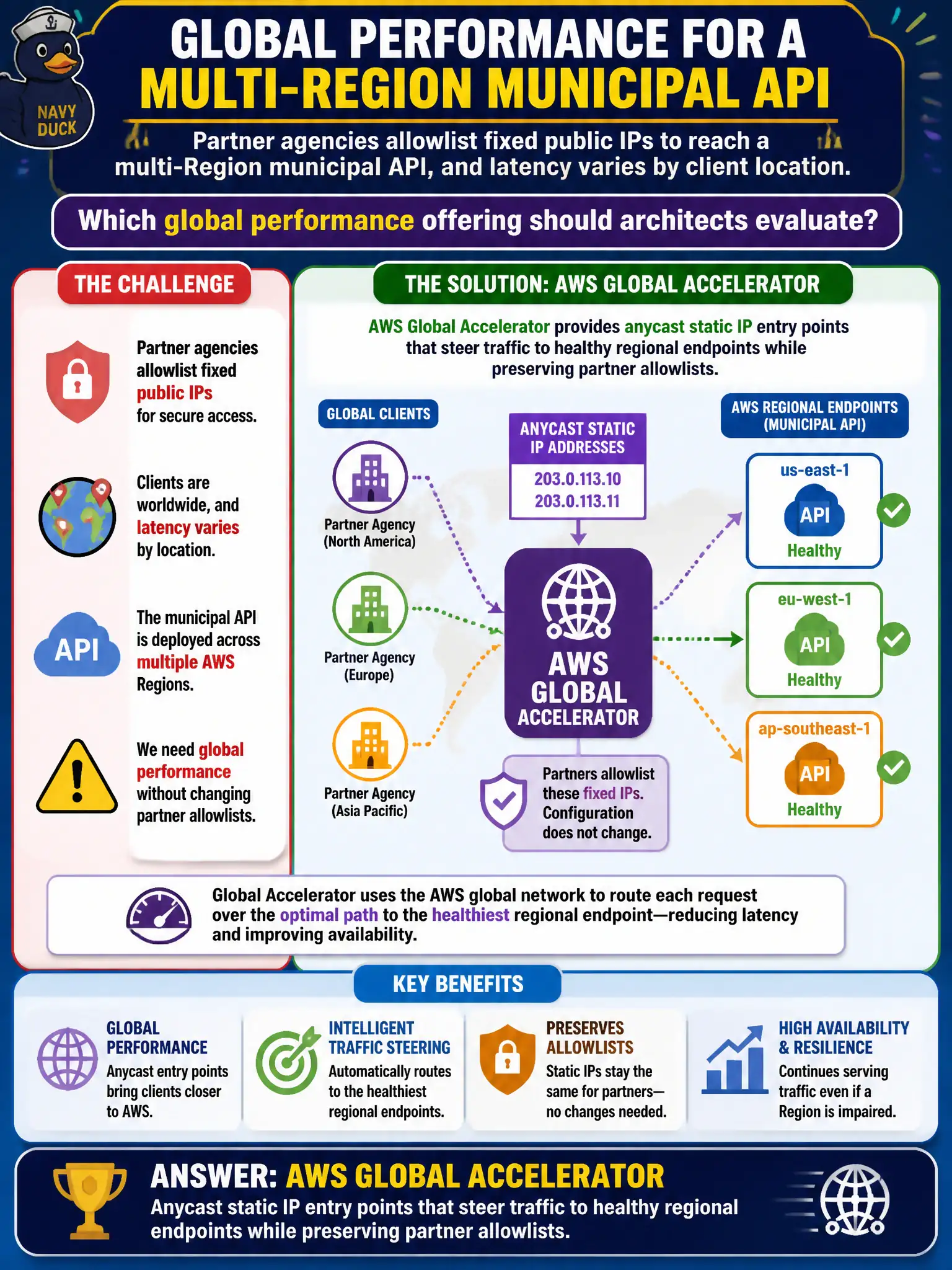
Partner agencies allowlist fixed public IPs to reach a multi-Region municipal API, and latency varies by client location. Which global performance offering should architects evaluate?
Select an answer to reveal the explanation.
Short Explanation
Partners with firewall allowlists hate IP addresses that wander. Global Accelerator hands them stable anycast IPs and still steers users to the healthy Region. It is the fixed front door with smart indoor routing.
Full Explanation
Partner agencies that allowlist fixed public IPs to reach a multi-Region municipal API need stable anycast entry points while still steering to healthy regional endpoints. AWS Global Accelerator provides static IP entry points that preserve partner allowlists and improve global performance by routing to healthy Regional endpoints. That offering should be evaluated because CloudFront alone is not always the right fit for dynamic APIs with sticky client IP allowlisting requirements. Choosing CloudFront only for dynamic private API calls that require sticky client IP allowlisting without evaluating Accelerator fails when partners’ firewall constraints dominate the design. Using a single Elastic IP in one Availability Zone as the only entry point for all Regions permanently fails as a global SPOF. Randomly changing public NLB addresses weekly so partners reconfigure firewalls fails operationally and destroys allowlist stability. Exam caveat: Accelerator improves entry-path performance and failover but does not replace application-tier caching or Region capacity planning—pair with healthy Regional targets and health checks. Operational check: pilot Global Accelerator with two Regional endpoint groups, give partners the static IPs for allowlisting, run failover by withdrawing one Region, and compare client RTT and error rates to the prior EIP design.