
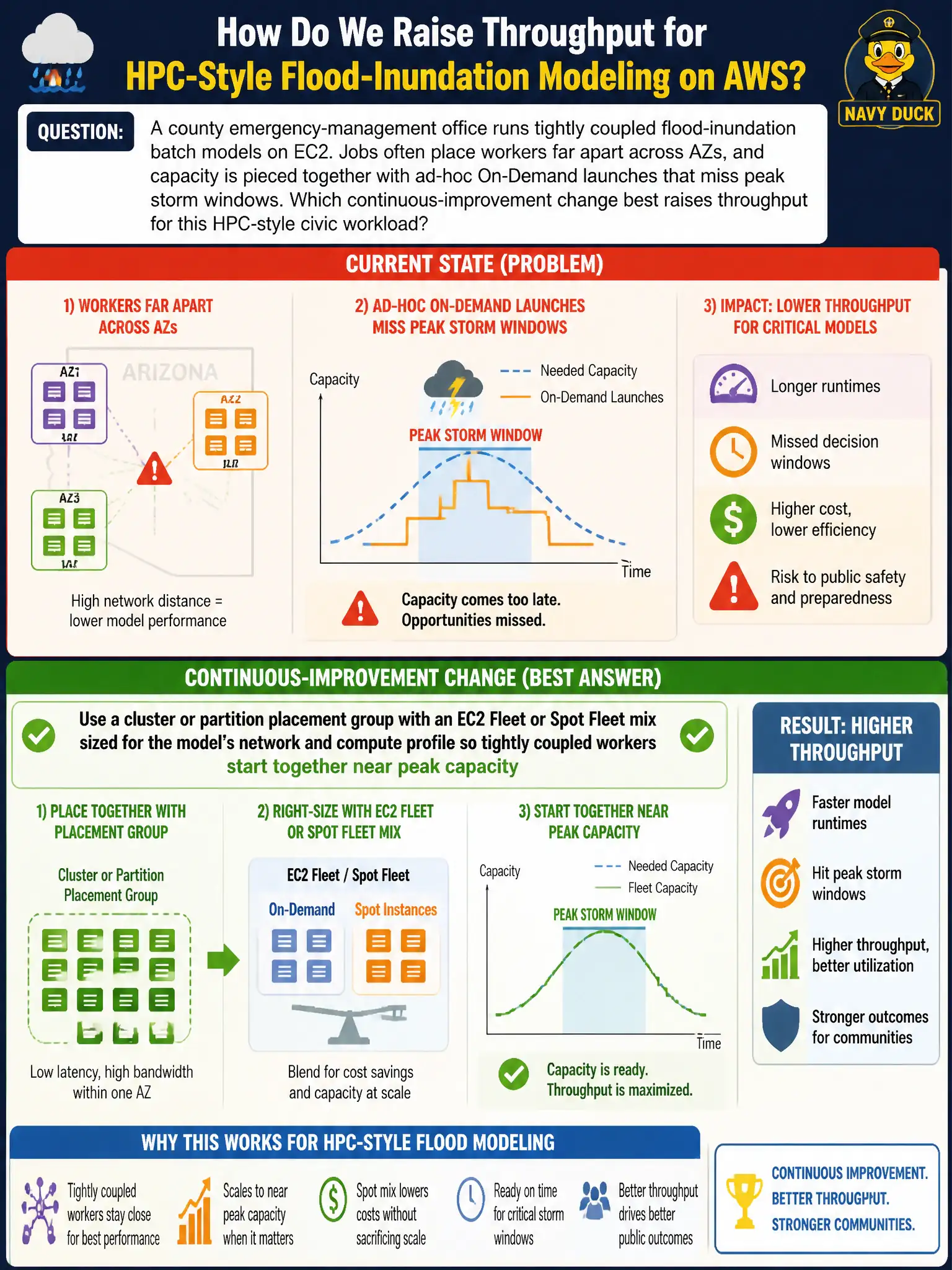
A county emergency-management office runs tightly coupled flood-inundation batch models on EC2. Jobs often place workers far apart across AZs, and capacity is pieced together with ad-hoc On-Demand launches that miss peak storm windows. Which continuous-improvement change best raises throughput for this HPC-style civic workload?
Select an answer to reveal the explanation.
Short Explanation
Flood models hate chatty neighbors across town—those workers need to sit in the same tightly packed neighborhood on the AWS campus. Pair a placement group with a fleet that can actually fill the seats when the storm clock is ticking.
Full Explanation
Tightly coupled flood-inundation batch models suffer when workers land far apart across AZs and capacity is pieced together too late for peak storm windows. Using a cluster or partition placement group with an EC2 Fleet or Spot Fleet mix sized for the model’s network and compute profile starts tightly coupled workers together near peak capacity, raising HPC-style throughput for emergency management. That continuous-improvement change works because MPI-style solvers need low-latency, high-bandwidth placement plus capacity strategies that assemble the fleet before the storm peak. Spreading workers across three Regions with independent VPCs fails by maximizing latency for tightly coupled exchange. Pinning every model worker to a single t3.micro in one AZ fails conceptually on both capacity and network profile for inundation solvers. Replacing batch solvers with Amazon SQS alone fails because queues decouple asynchronous work—they do not provide the collocated compute the numerical model requires. Exam caveat: cluster placement groups concentrate AZ risk; for storm season, balance coupling needs against Multi-AZ resilience for less tightly coupled stages of the pipeline. Operational check: create a cluster placement group, launch a representative Fleet mix in a dry-run storm window, measure all-to-all latency and job completion time versus the ad-hoc On-Demand pattern, and reserve capacity strategy notes for the next weather event.