
An author is refining instructions for a template that answers 'has my pet's referral to the cardiology specialty hospital been scheduled yet,' grounded on the Referral and Appointment objects. The draft instruction says: 'Answer using only the grounded data provided; if the grounded data does not contain a scheduled appointment, say the appointment is not yet scheduled rather than guessing.' Why is this an example of a good practice?
Select an answer to reveal the explanation.
Short Explanation
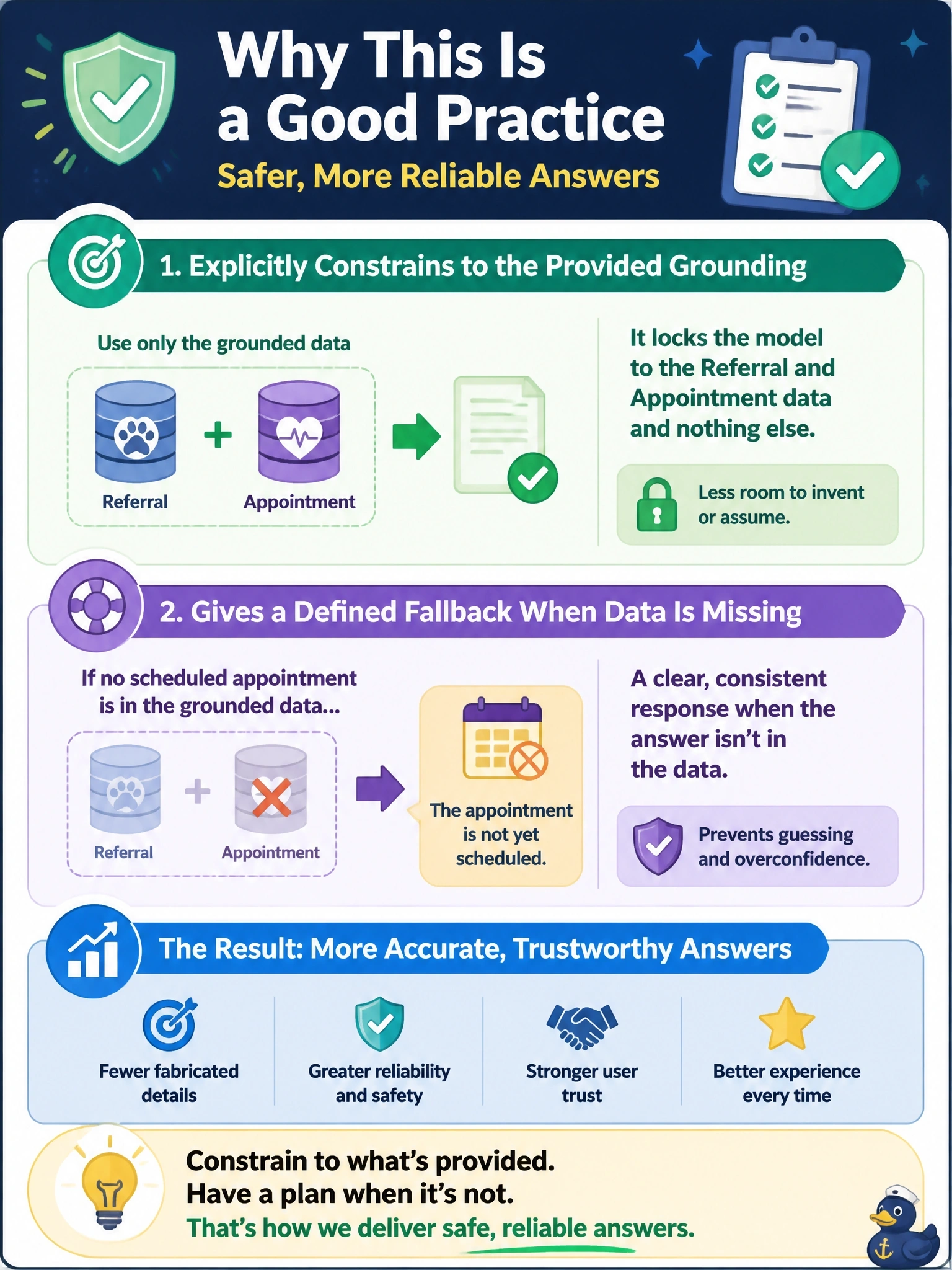
You’re telling the model to rely on the grounded data and what to say if it doesn’t contain the scheduling answer. That fallback helps prevent a confident guess, making this a good instruction pattern.
Full Explanation
This is good instruction-writing because it limits the model to the provided grounding and specifies an honest response when the Referral and Appointment data do not show a scheduled appointment. That reduces the risk of inventing a scheduling status or presenting an unsupported answer with confidence. The claim that a good instruction should never explain what to do when data is missing reverses the practice: defining a fallback is a useful way to handle missing evidence. The claim that models never respond when grounding is absent is also unreliable; without explicit direction, a model may still produce a plausible-sounding answer that is not supported by the data. The claim that instructions must avoid conditional logic imposes an arbitrary restriction: explaining how to respond in different situations, including when data is missing, is a normal and effective instruction pattern. An exam caveat is that grounding alone does not guarantee an appropriate response; the instruction should also tell the model how to handle an unavailable answer. As a practical check, confirm that the instruction names the permitted source of evidence and gives a clear fallback for the case where that source does not contain the answer.