
During an internal review, a manager asks whether Einstein Trust Layer masking alone is sufficient to guarantee a prompt template never surfaces inappropriate or harmful language in its generated response to a distressed pet owner. What is the accurate answer?
Select an answer to reveal the explanation.
Short Explanation
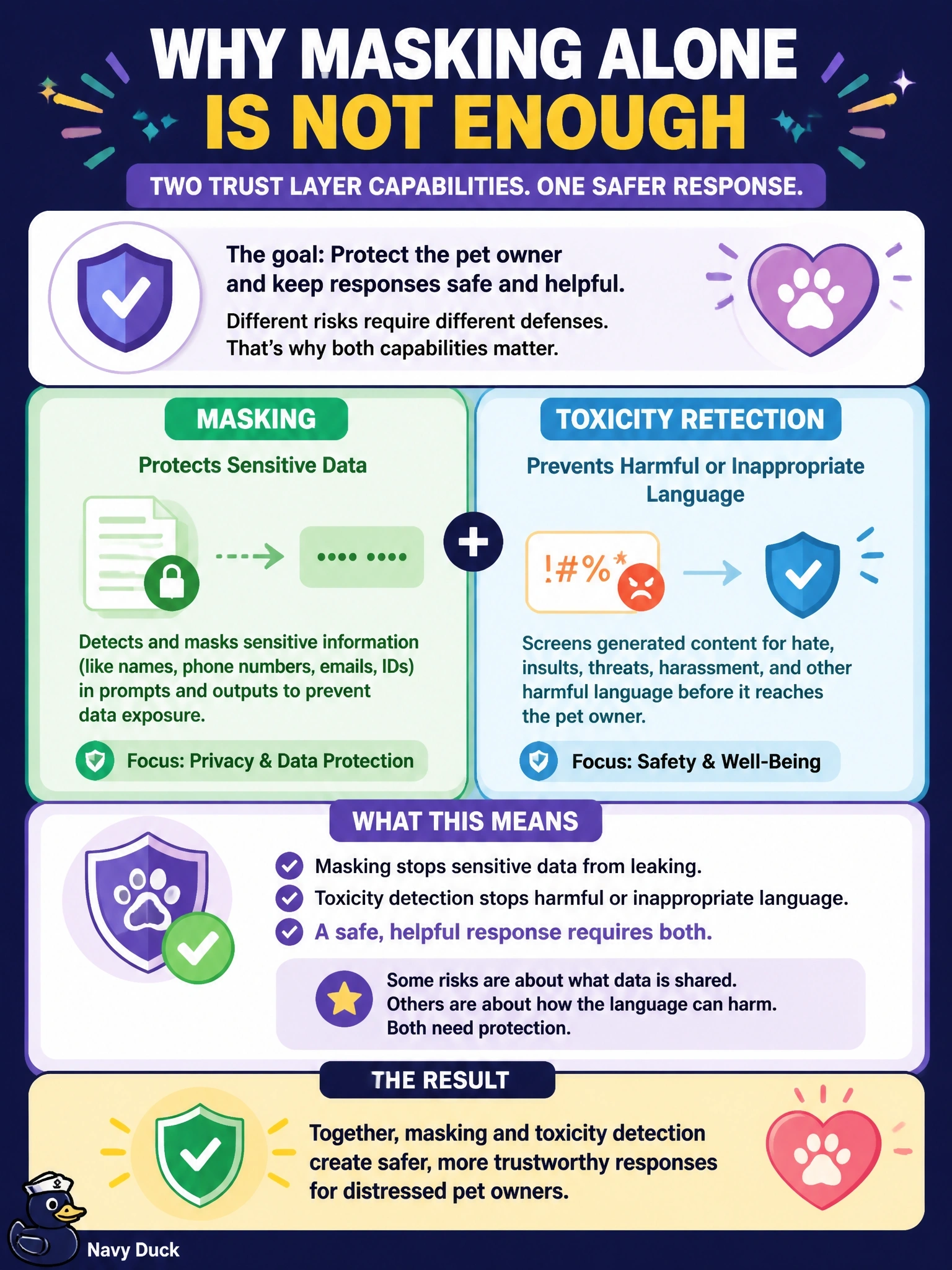
You can rely on masking to protect sensitive values, but it does not screen generated language for harmful content. Toxicity detection is the separate capability that addresses that risk, so both may matter here.
Full Explanation
The accurate answer distinguishes two Trust Layer capabilities: masking protects sensitive data values, while toxicity detection separately screens prompts and responses for harmful or inappropriate language. Masking alone therefore does not address the manager’s concern about harmful language, and both capabilities may be relevant to a protected response. Saying masking fully covers both risks conflates these capabilities and could leave harmful-language screening unaddressed. Saying the Trust Layer applies only to Agentforce agents is incorrect; its protections apply across Salesforce generative AI features, including Prompt Builder templates. Saying protections operate only after a response reaches the pet owner also misstates their timing: safeguards are designed to operate in the request-and-response flow, not merely as an after-the-fact remedy. The exam caveat is that masking and toxicity detection are complementary, not interchangeable, protections. As a practical check, identify whether the concern is sensitive-data exposure, harmful language, or both, then confirm that the relevant Trust Layer capabilities are enabled and configured for the template’s use.