
A specialty hospital's marketing coordinator wants a one-time bulk export of ready-to-send discharge-instruction letters for 200 recently completed surgeries, each personalized with the pet's name and procedure. Which factor makes Prompt Builder (invoked via a batch or Flow-triggered process) a reasonable fit here, rather than an ongoing Agentforce agent?
Select an answer to reveal the explanation.
Short Explanation
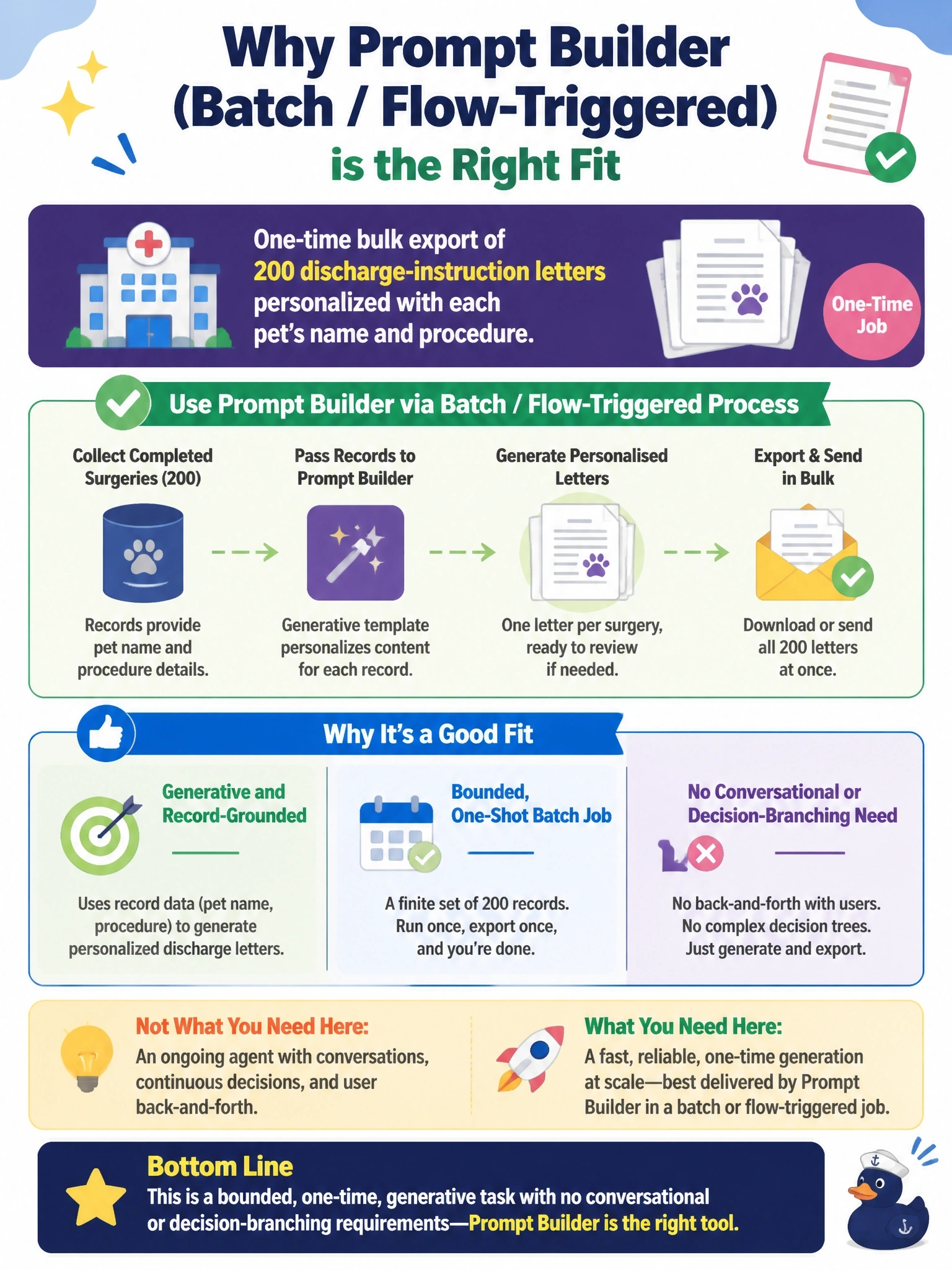
You have a generative task: personalized, record-grounded letters, so Prompt Builder fits. Because this is a bounded, one-time batch rather than an ongoing conversation or branching decision, you don’t need an agent’s conversational machinery.
Full Explanation
The task is generative and grounded in each surgery record, so a Prompt Builder template can create a letter personalized with the pet’s name and procedure. Because the request is a bounded, one-time bulk export with no conversation or decision branching, invoking the template through a batch or Flow-triggered process is a reasonable fit; an ongoing Agentforce agent is not needed. The claim that an agent is inherently limited to one patient record per run turns a typical interactive use into an absolute technical limit. Agents are generally used interactively, but the key reason to avoid one here is that the job has no conversational requirement. The claim that batch jobs can never call generative AI is also false: Salesforce batch and asynchronous processes can invoke generative capabilities, including prompt templates. The claim that a prompt template requires a live chat session is false as well; templates can be executed programmatically and asynchronously without synchronous user interaction. An exam caveat is to assess whether a task is generative separately from whether it needs an agent: a generative task can still be a poor fit for a conversational agent. As a practical check, confirm that the process can pass each surgery record’s data to the template and collect the resulting letters for export.