
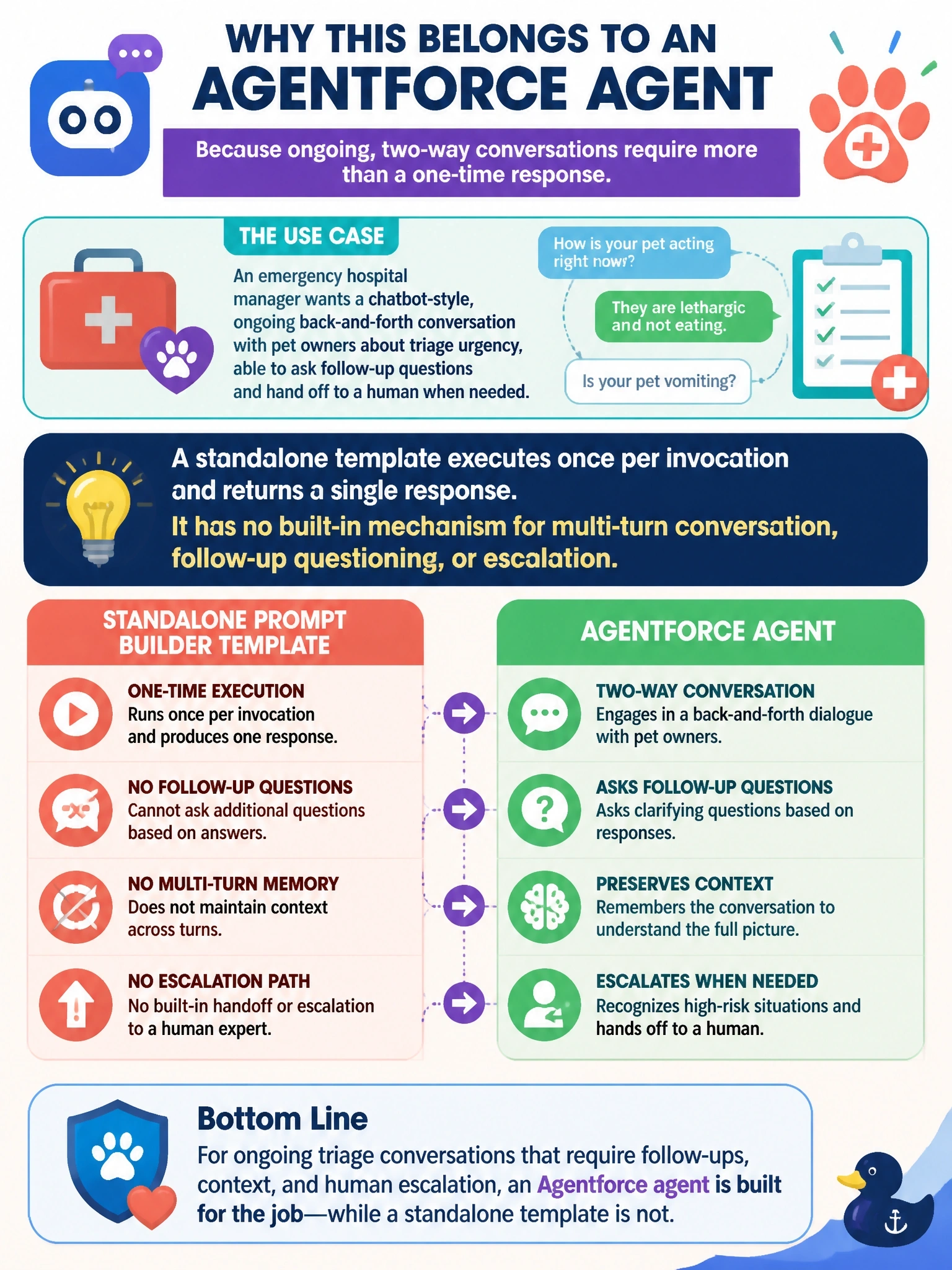
An emergency hospital manager wants a chatbot-style, ongoing back-and-forth conversation with pet owners about triage urgency, able to ask follow-up questions and hand off to a human when needed. Why would an architect say this belongs to an Agentforce agent rather than to a standalone Prompt Builder template?
Select an answer to reveal the explanation.
Short Explanation
A standalone Prompt Builder template is a one-shot “ask, get an answer” tool, so it cannot manage follow-up questions or handoffs across an ongoing conversation. You need an Agentforce agent for the reasoning loop and topic/action structure that support that back-and-forth.
Full Explanation
A standalone Prompt Builder template is invoked, grounds itself in available information, and returns one response; it has no built-in mechanism for multi-turn dialogue, follow-up questions, or escalation. An Agentforce agent provides the reasoning loop, topics, and actions needed to decide whether to ask a clarifying question or hand off to a human. The claim that Prompt Builder templates cannot merge patient data is not the architectural limitation: templates can use patient and record data as grounding sources. The claim that agents are cheaper per execution introduces a pricing comparison that is not the reason for this design choice; cost does not provide the conversational capability the requirement calls for. The claim that templates can be invoked only through Flow and cannot be exposed directly in a conversational channel is also not the relevant limitation: templates can be invoked through multiple surfaces, including Flow, Apex, and record pages. An exam caveat is that a template can generate useful text for a conversation, but that alone does not give it an ongoing dialogue loop or built-in escalation. As a practical check, ask whether the requirement is one response from known inputs or a conversation that must decide what to ask or do next.