
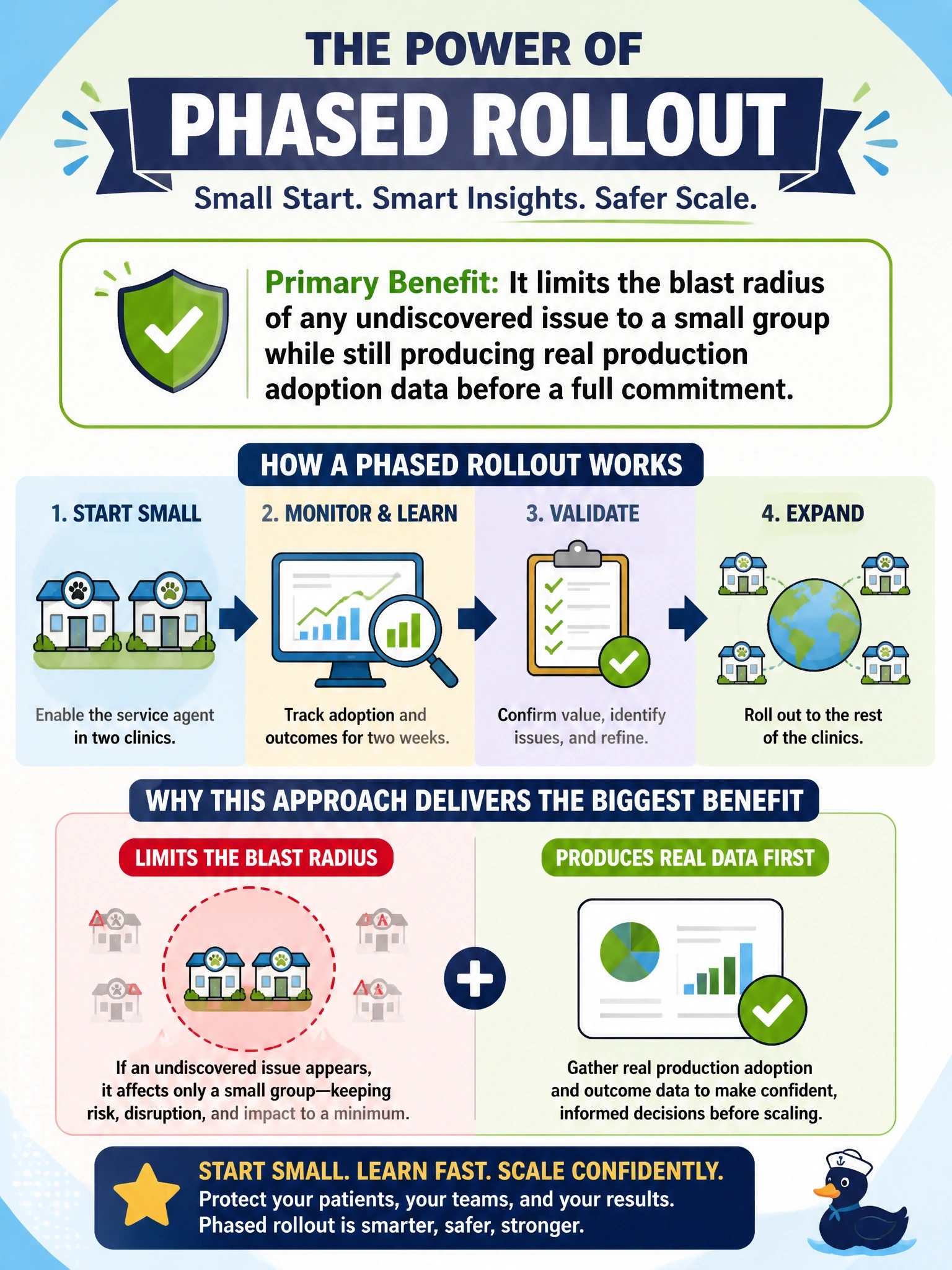
Instead of enabling the newly deployed emergency-triage Service agent for every clinic at once, Hartswell Veterinary Group's specialist rolls it out to two clinics first, monitors adoption and outcomes for two weeks, then expands to the rest. What is the primary benefit of this phased rollout compared to enabling it everywhere immediately?
Select an answer to reveal the explanation.
Short Explanation
Rolling out to two clinics first is a controlled experiment, if something's wrong, only two clinics feel it while you fix it. It also hands you real adoption data before you bet the whole rollout on it.
Full Explanation
A phased rollout to a small subset of clinics limits how much of the organization is affected if the deployment surfaces an issue that Testing Center did not catch, while still generating genuine production adoption data, such as real conversation volume, resolution rates, and owner feedback, that a sandbox never can. That combination of contained risk and real-world validation is the primary reason phased rollouts are preferred over an all-at-once release for a significant new capability like emergency triage. Testing Center's ability to evaluate test cases has no dependency on how many clinics are live in production, so that is not a real constraint driving the phased approach. A phased rollout is explicitly a step toward eventual full deployment, not a permanent restriction, so describing it as preventing later expansion misrepresents the whole point of the strategy. A phased rollout does not exempt the initial release from needing a passing Testing Center run first; disciplined pre-deployment testing and a cautious rollout strategy are complementary practices, not substitutes for one another.