
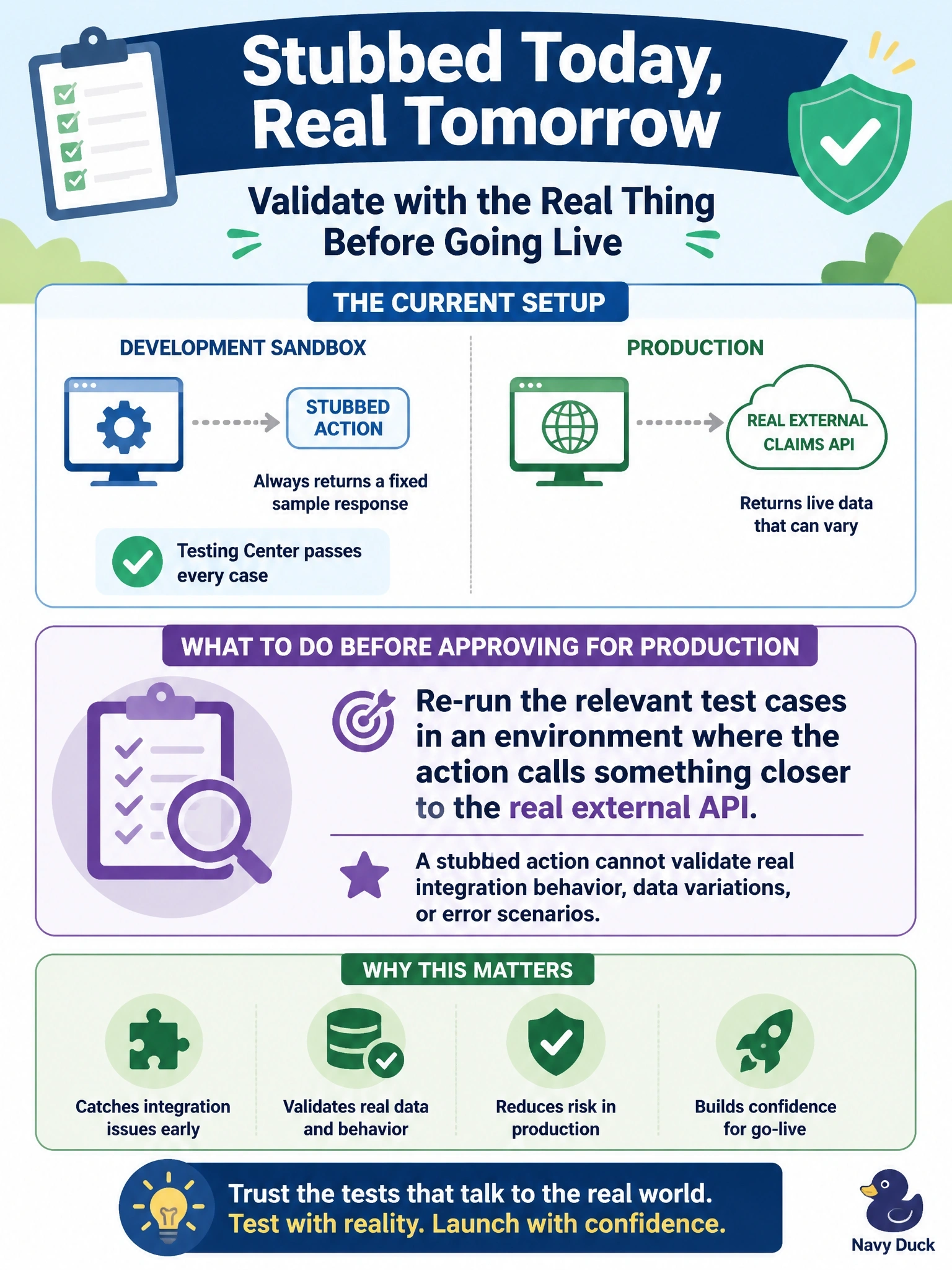
Gladewind Veterinary Group's development sandbox uses a stubbed version of the insurance-claims lookup action that always returns a fixed sample response, while production calls the real external claims API. Testing Center passes every case in the development sandbox. What should the specialist do before treating this as proof the agent is ready for production?
Select an answer to reveal the explanation.
Short Explanation
A stub that always hands back the same canned answer will pass every test, but it isn't proving the real integration works, it's just proving the agent can read a script. You still need to test against something closer to the real API before calling it done.
Full Explanation
A stubbed action that always returns a fixed sample response can make every test case pass while telling the specialist nothing about how the agent behaves against the real external claims API's actual response shapes, latency, errors, or edge cases. Before treating a clean development-sandbox run as proof of production readiness, the specialist needs to validate the relevant test cases in an environment where the action integrates with something closer to the genuine external service, since that is the only way to catch integration-specific failures a stub cannot expose. Testing Center results are not automatically identical across environments; they reflect whatever the environment's underlying actions and data actually do, which is exactly why a stub versus a real API produces very different confidence levels. A stub and a real external API are not functionally interchangeable, since the real API can fail, time out, or return unexpected data in ways a fixed canned response never will. Disabling the Einstein Trust Layer has nothing to do with validating an integration and would only remove a data-protection safeguard without addressing the actual gap in test coverage.