
Thornfield Veterinary Partners' specialist has limited time before go-live and must decide how to allocate new Testing Center test cases across the agent's topics: routine appointment lookups, prescription refills involving controlled substances, and general clinic-hours questions. Which allocation approach best reflects sound testing judgment?
Select an answer to reveal the explanation.
Short Explanation
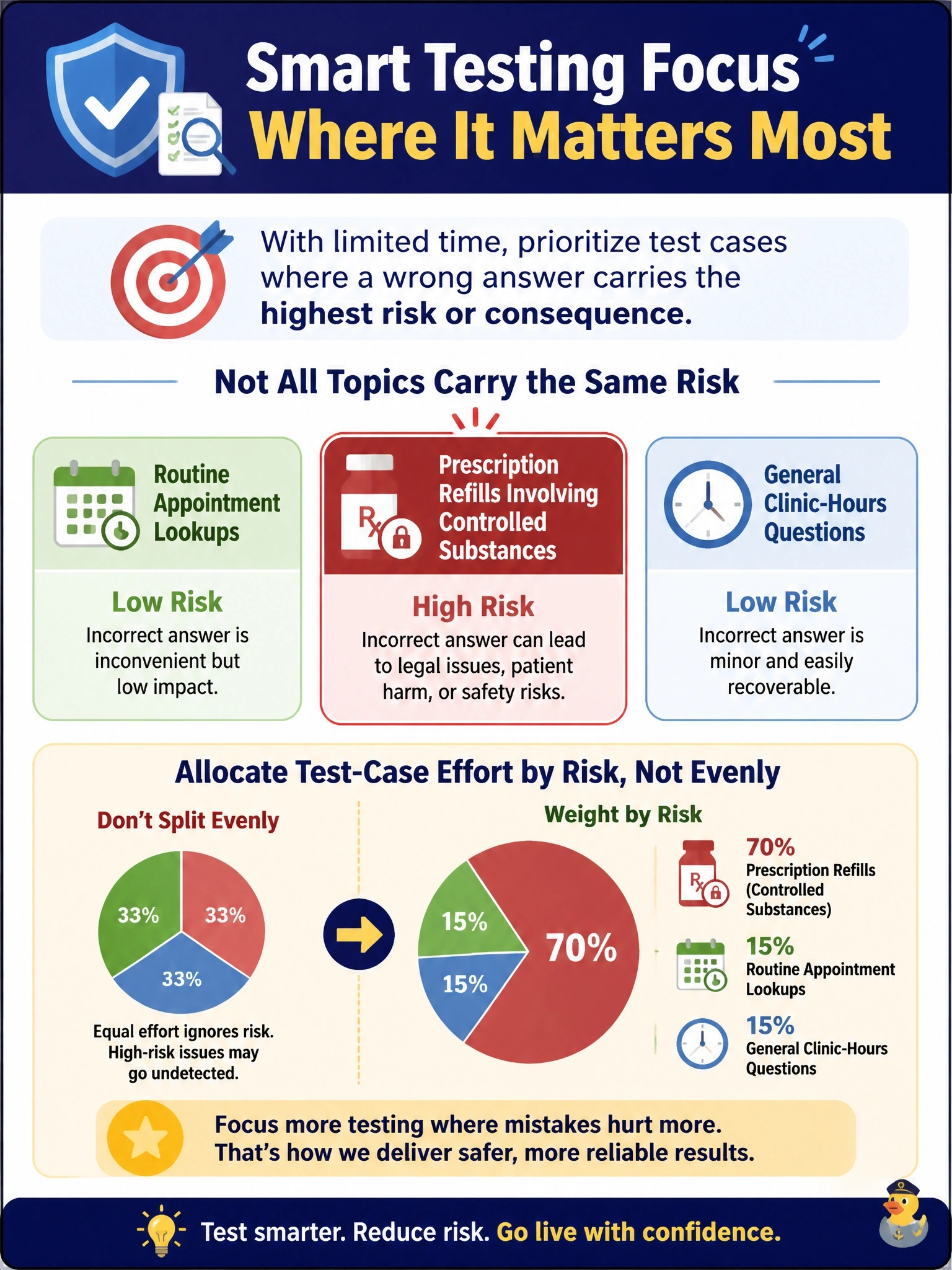
Not every wrong answer costs the same. A missed clinic-hours question is a shrug, a wrong call on a controlled substance is a real problem, so put your limited testing time where a mistake actually hurts.
Full Explanation
With limited time before go-live, the specialist should prioritize testing effort according to the consequence of a failure in each area, and a wrong answer involving controlled-substance refills carries far more risk, both for pet safety and for regulatory exposure, than a wrong answer about clinic hours. Weighting test-case effort toward the higher-risk topic is a defensible, risk-based use of limited time. Splitting effort exactly evenly across all three topics treats a low-stakes question the same as a high-stakes one and wastes scarce testing time that could have gone toward the area where a mistake matters most. Testing only the simplest topic and ignoring the others leaves the highest-risk area completely unvalidated, which is the opposite of sound prioritization. Skipping the controlled-substance topic entirely misunderstands the boundary this exam draws: the test case is not evaluating a clinical judgment call, it is evaluating whether the Salesforce configuration correctly enforces the authorization rule or hold, which is squarely a testable configuration behavior, not a diagnosis.