
Timberline Veterinary Group's specialist is choosing between deploying an agent update directly through the sandbox org's production connection versus staging it through a dedicated deployment pipeline with a review step. Why does the deliberate, reviewed path matter for agent changes specifically?
Select an answer to reveal the explanation.
Short Explanation
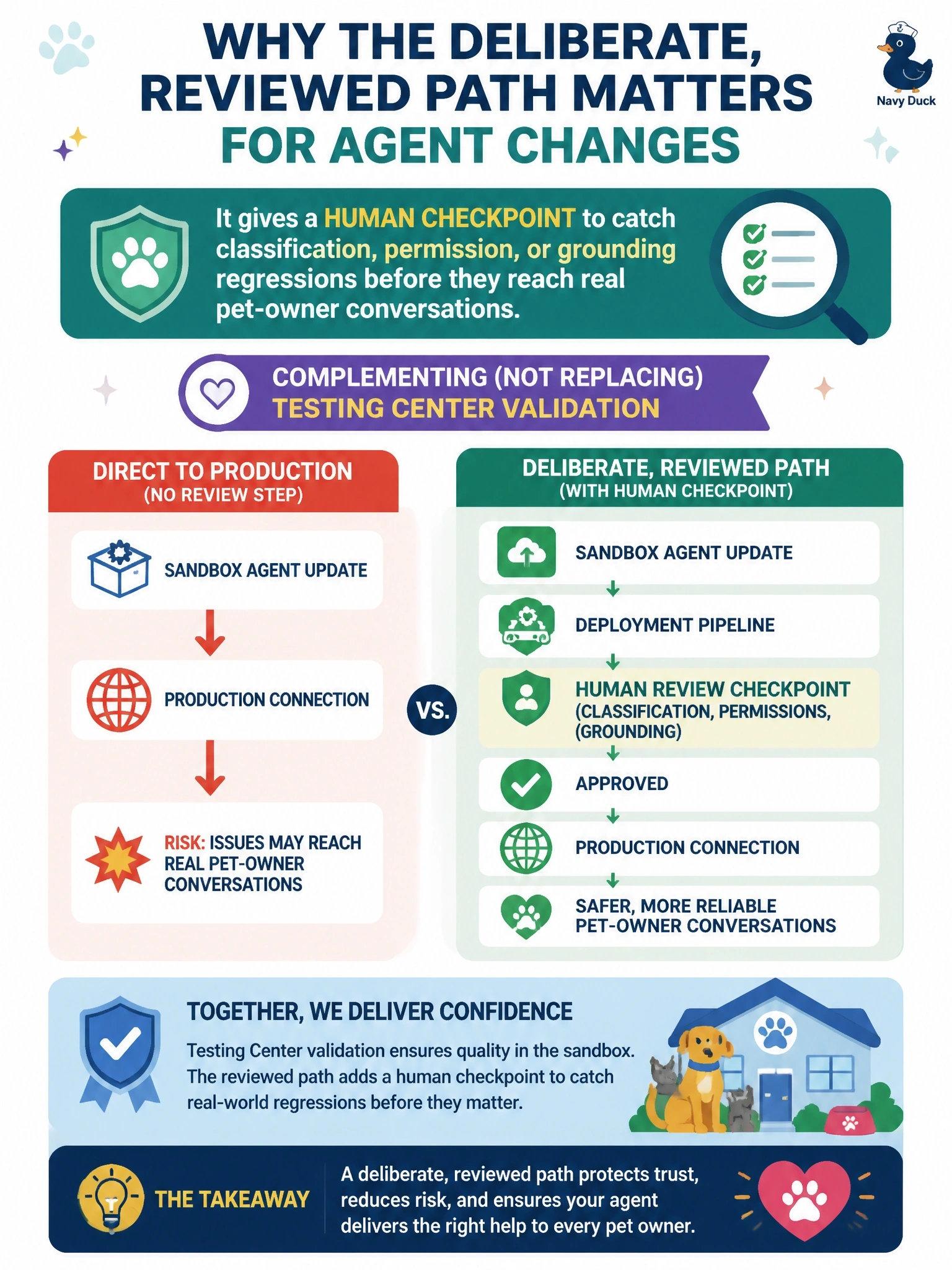
A review step is the second set of eyes before the recipe goes out to real customers. It's not there to replace the taste test in Testing Center, it's there to catch what the taste test missed.
Full Explanation
A deliberate, reviewed deployment path adds a human checkpoint specifically because agent changes can silently shift classification behavior, permission/security posture, or grounding accuracy in ways that are not always obvious from the change itself — a second reviewer looking at what's being deployed, alongside Testing Center's automated validation, catches problems neither step alone would reliably catch. It complements testing rather than substituting for it. Claiming agent changes carry no more risk than any other configuration change ignores that they directly shape what real pet owners are told and whether sensitive data is protected, which raises the stakes relative to, say, a cosmetic page-layout tweak. There is no platform-level technical block on direct sandbox-to-production agent deployment that forces a review pipeline — the review step is a deliberate practice choice, not a system limitation. Framing the review step as billing padding is a cynical, incorrect read of why deployment governance exists; its purpose is risk reduction for a system that talks directly to real people about their pets' care.