
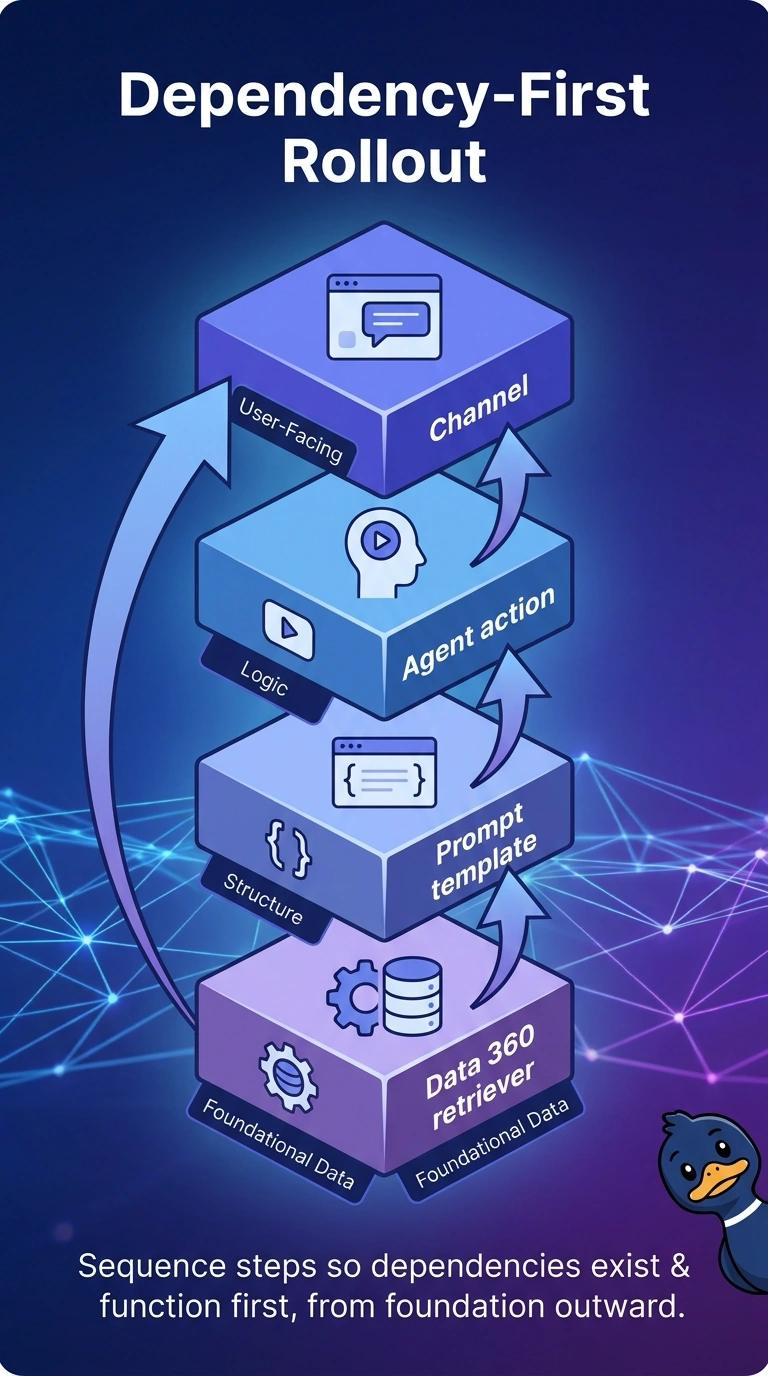
Redtail Veterinary Group's specialist must choose an order for a multi-step production rollout: create the Data 360 retriever, activate the prompt template that references it, deploy the agent action that calls the template, then enable the channel. What consideration should drive that ordering?
Select an answer to reveal the explanation.
Short Explanation
Build the foundation before the roof. Get the retriever live, then the template that leans on it, then the action that calls the template, and only then open the door to owners by enabling the channel.
Full Explanation
Dependency ordering should follow what each piece needs to already exist and work correctly: the retriever must exist and be indexed before the prompt template that grounds against it can activate meaningfully, the template must be active before the agent action calling it can function, and the action must be wired up before the channel is enabled and pet owners can actually reach the agent. This foundational-to-visible ordering minimizes the window where something is live but broken. Salesforce does not process deployments alphabetically by component name; that is not a real ordering mechanism. There is no runtime auto-resolution for missing dependencies — a template referencing a nonexistent retriever, or an action referencing an inactive template, will simply fail or misbehave rather than self-repairing. Sequencing by reverse build time is arbitrary and ignores actual functional dependencies; a component built more recently in the sandbox is not necessarily a prerequisite for anything else, so this ordering has no principled basis. The exam expects specialists to reason about deployment order from actual functional dependency, not shortcuts.