
Elkhorn Veterinary Partners' specialist writes a Testing Center case where the expected outcome is 'agent asks a clarifying question before booking' rather than a specific final action. Why is an expected outcome like this still a valid test case?
Select an answer to reveal the explanation.
Short Explanation
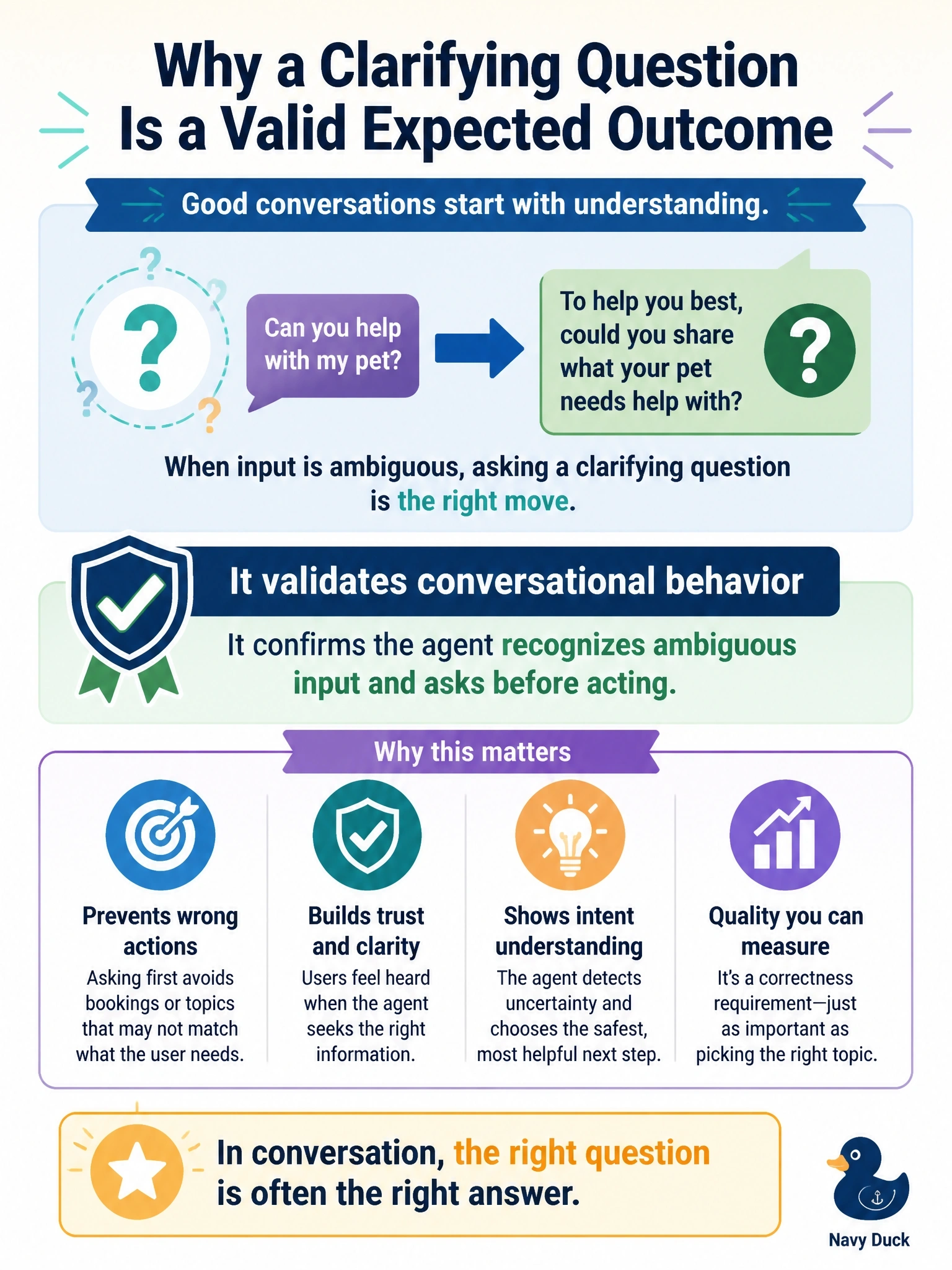
Sometimes the right move isn't to act, it's to ask. A test case that checks the agent knows to pause and clarify before booking is just as much a correctness check as one that checks it books the right slot.
Full Explanation
Correct agent behavior is not limited to picking the right topic and firing the right action — it also includes recognizing when input is ambiguous (say, an owner naming a pet without specifying which of two pets, or a date without a year) and asking a clarifying question rather than guessing. A test case that expects clarifying behavior validates exactly that judgment, which is a real, testable correctness requirement, not a lesser one. Testing Center is not restricted to single-final-action expectations; expected outcomes can validate conversational and classification behavior broadly, including that the agent appropriately withholds action pending clarification. This kind of test case is directly useful for evaluating the agent itself, not merely for training humans — it is precisely the agent's judgment being scrutinized. And this is not scoped to Employee agents only; a Service agent handling pet-owner appointment booking needs the same clarifying-question discipline whenever a request is genuinely ambiguous, regardless of agent type. The broader lesson: comprehensive test coverage includes conversational judgment, not only final-action correctness.