
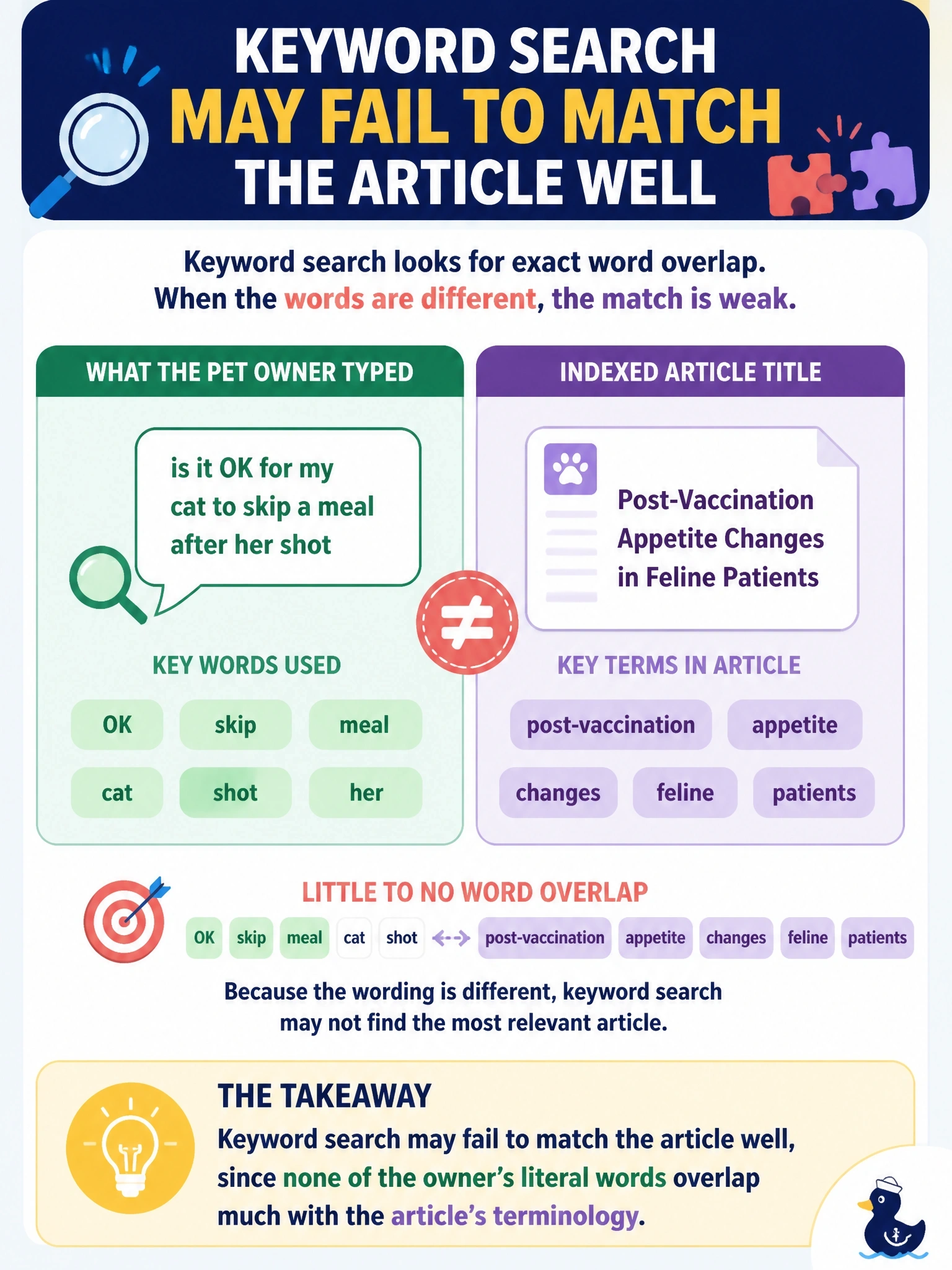
A pet owner searching Ridgeline's help content types 'is it OK for my cat to skip a meal after her shot,' but the indexed article is titled 'Post-Vaccination Appetite Changes in Feline Patients.' Using keyword search alone, what is the likely outcome?
Select an answer to reveal the explanation.
Short Explanation
Keyword search only knows what to look for, and the owner's words and the article's clinical title barely share any of the same vocabulary — that mismatch is exactly where keyword search struggles.
Full Explanation
Keyword search matches based on literal terms, so when a pet owner's casual phrasing ('skip a meal after her shot') shares very little vocabulary with an article's clinical title ('Post-Vaccination Appetite Changes in Feline Patients'), keyword search is likely to miss a good match even though the content is clearly relevant to a human reader. This is precisely the weakness that vector or hybrid search is meant to address, since semantic matching can bridge that vocabulary gap. It's incorrect to say keyword search 'always understands paraphrased intent' — that description actually characterizes vector search's strength, not keyword search's, and conflating the two is a common exam trap. Keyword search also doesn't perform any automatic translation of casual language into clinical terminology as part of its matching process; it operates on the literal terms present, not an inferred restatement. And the claim that keyword and vector search perform identically in every scenario contradicts the very asymmetry this question illustrates. For the exam, this vocabulary-mismatch scenario is the classic argument for choosing vector or hybrid search over keyword-only for conversational, plain-language queries.